Triangle patterns are chart structures in which price movement contracts between converging boundaries. The pattern becomes easier to classify when the swings begin narrowing in an orderly way, the same boundaries remain usable, and price reactions continue moving from one side of the structure to the other.
Definition: A triangle pattern is a consolidation structure formed by contracting price swings inside converging boundaries. The pattern is usually classified by the shape of those boundaries and by the way price compression develops before the structure resolves.
How Triangle Patterns Are Read
- A triangle is more than two lines that happen to converge on a chart.
- The structure becomes more defensible when successive swings contract rather than staying irregular.
- The same boundaries should remain usable as the pattern develops.
- Price should continue alternating across the structure instead of clustering aimlessly near the middle.
- Compression quality needs to be judged before the later breakout is interpreted.
Triangle Pattern Types
Triangle patterns are usually separated by the geometry of their upper and lower boundaries. The main distinction is whether one boundary is flat, whether the lower boundary rises, whether the upper boundary falls, or whether both boundaries converge toward each other.
| Triangle type | Boundary shape | Use when |
|---|---|---|
| Ascending triangle | A relatively flat upper boundary with a rising lower boundary. | The structure keeps pressing into a similar overhead area while higher reaction lows develop below it. |
| Descending triangle | A relatively flat lower boundary with a falling upper boundary. | The structure keeps reacting near a similar lower area while lower reaction highs develop above it. |
| Symmetrical triangle | Both boundaries converge toward each other. | Both sides of the structure compress as neither boundary remains flat. |
That classification tells you what kind of triangle is being observed. It does not yet answer whether the compression itself is clean enough to support the label with confidence.
Triangle Compression Integrity
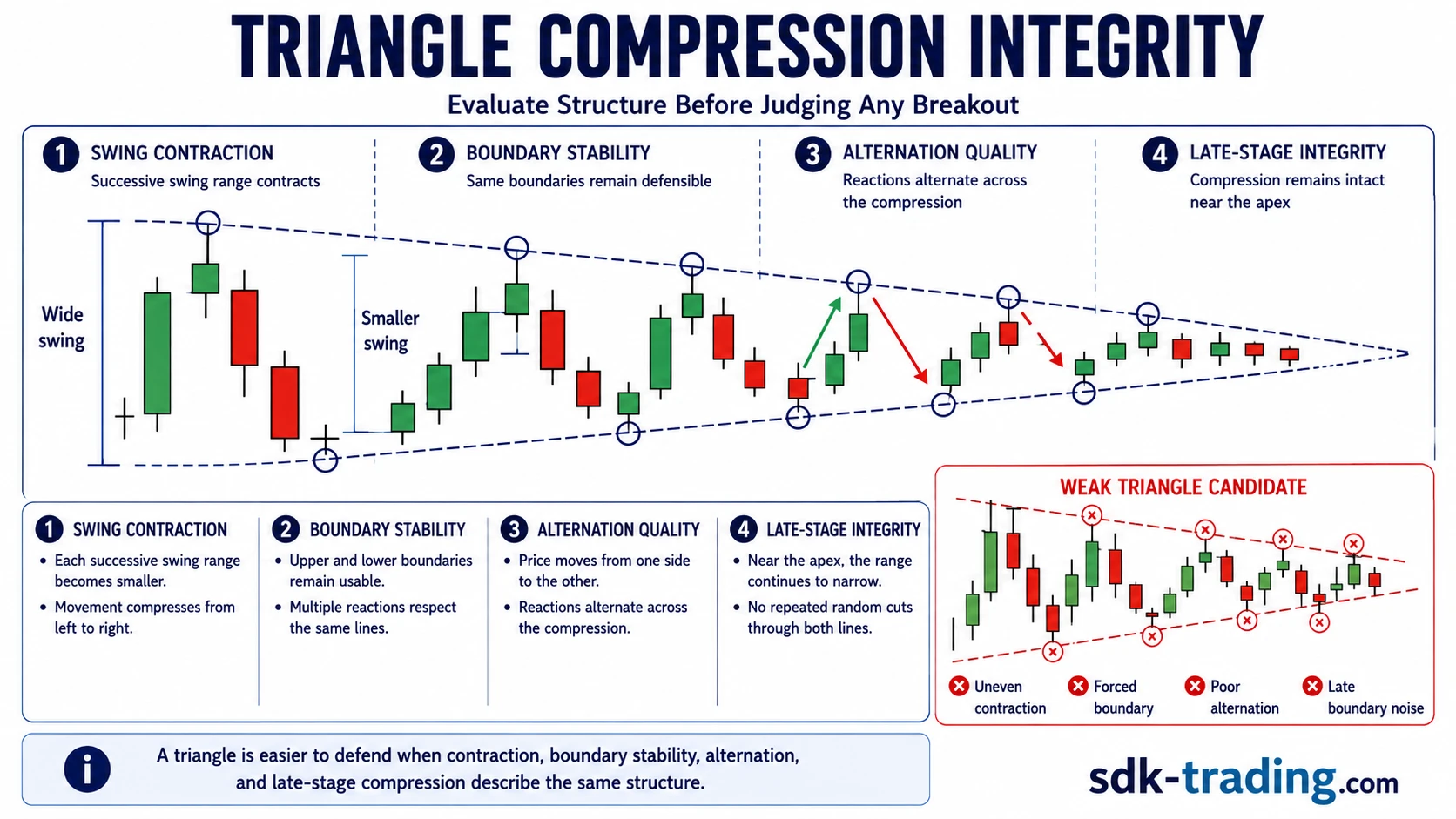
A useful triangle usually shows more than converging lines. The structure becomes clearer when four parts of the compression support each other: the swings begin contracting, the same boundaries remain usable, reactions continue alternating across the structure, and the pattern still behaves like a compression near the apex.
| Diagnostic | What to check | Why it matters |
|---|---|---|
| Swing contraction | Check whether the successive price swings are actually becoming smaller. | This shows whether price is compressing rather than simply moving inside a wide and uneven range. |
| Boundary stability | Check whether the same upper and lower boundaries remain usable as the structure develops. | If the lines need to be redrawn repeatedly, the triangle label becomes harder to defend. |
| Alternation quality | Check whether price reactions continue moving from one side of the structure toward the other. | This shows that both boundaries are participating in the compression. |
| Late-stage integrity | Check whether the range is still narrowing near the apex. | If price starts cutting loosely through the boundaries, the compression can lose definition before the structure resolves. |
These four checks do not create a new pattern type. They simply help determine whether the narrowing structure still behaves like a triangle as it develops.
Why Converging Lines Alone Are Not Enough
Many charts contain price movement that can be forced between two converging lines. That alone does not make the structure a useful triangle pattern.
A weak candidate often shows uneven swings, reactions that cluster in the middle instead of moving from one side of the pattern to the other, or boundaries that only work after repeated redrawing. In those cases the triangle label may describe the drawing more than the price behavior itself.
The pattern is easier to trust when the contraction is visible in the swing sequence rather than imposed afterward by the analyst.
How Boundary Stability Affects the Reading
A triangle usually becomes clearer when the upper and lower boundaries remain broadly consistent while the structure develops. That does not mean every reaction has to touch the line perfectly. It means the boundaries continue describing the compression without constant adjustment.
If the upper line has to be moved after each new reaction high, or the lower line stops fitting the sequence after only one or two swings, the structure may be a loose consolidation rather than a clean triangle. Stable boundaries do not guarantee a useful pattern, but unstable boundaries weaken it quickly.
Alternation Across the Structure
A triangle is easier to recognize when price reactions keep traveling across the narrowing range. One swing approaches the upper side of the structure, the next swing approaches the lower side, and later swings continue that alternating rhythm while the overall range contracts.
This alternation matters because it shows that both sides of the compression are still active. When price simply drifts near the middle of the pattern without clear opposing reactions, the narrowing shape can remain visually present while the pattern itself becomes less informative.
What Late-Stage Compression Should Look Like
Near the apex, the range does not need to become perfectly smooth. But it should still behave like a compression. The swings usually remain contained, the range continues narrowing, and the structure does not dissolve into repeated loose cuts through both boundaries.
Late-stage noise is one of the easiest ways for a triangle label to become overstated. If price begins crossing the boundaries repeatedly without preserving the narrowing character of the structure, the pattern may be losing integrity before any later resolution occurs.
Stronger and Weaker Triangle Candidates
| Pattern quality | Typical behavior | What it suggests |
|---|---|---|
| Stronger candidate | Swings contract progressively, the same boundaries remain usable, reactions alternate, and compression remains orderly near the apex. | The triangle label matches the visible price structure more closely. |
| Weaker candidate | Swings stay uneven, the boundaries need frequent adjustment, reactions lose alternation, or late-stage price action becomes noisy. | The narrowing shape may still be present, but the structural case for a triangle is weaker. |
| Forced candidate | Two lines can be drawn around the chart, but the swing sequence does not really compress in a consistent way. | The pattern is being imposed on the chart rather than explained by it. |
Common Triangle Pattern Mistakes
| Mistake | Why it weakens the reading |
|---|---|
| Calling any converging pair of lines a triangle | The swing sequence may not be contracting in a meaningful way. |
| Ignoring boundary instability | If the structure only works after repeated redrawing, the pattern becomes less reliable as a classification. |
| Ignoring alternation quality | Without reactions moving across the structure, the compression may be visually narrow but structurally weak. |
| Overlooking late-stage noise | Repeated loose cuts through the boundaries can show that the pattern is losing integrity near the apex. |
| Jumping straight to the resolution question | A triangle should first be judged as a compression structure before any later outcome is interpreted. |
How to Evaluate a Triangle Pattern
- Identify whether the price structure is actually narrowing.
- Classify the boundary shape as ascending, descending, or symmetrical.
- Check whether successive swings are contracting.
- Check whether the same boundaries remain usable without constant redrawing.
- Check whether reactions continue alternating across the structure.
- Check whether the compression remains intact as price approaches the apex.
This process keeps the triangle label tied to observable structure. The chart does not need to look perfect, but the compression should remain visible in the swing behavior itself.
FAQ
What makes a triangle pattern valid?
A triangle pattern becomes easier to defend when price swings contract in an orderly way, the boundaries remain stable, reactions alternate across the structure, and compression stays intact near the apex.
Are triangle patterns only about converging trendlines?
No. Converging trendlines are part of the visual structure, but the swing sequence also needs to show real compression rather than random movement that happens to fit inside two lines.
Why does boundary stability matter in a triangle?
Boundary stability matters because a triangle is weaker when the lines have to be redrawn repeatedly. The same boundaries should continue describing the structure as it develops.
What weakens a triangle pattern near the apex?
Repeated noisy cuts through the boundaries or a loss of narrowing behavior can weaken the pattern near the apex, even if the original structure looked cleaner earlier.