Disposition effect in trading is the tendency to realize gains too early while delaying the realization of losses too long. The bias appears when the emotional comfort of locking in a winning position and the discomfort of admitting a losing position start to dominate the decision process.
Definition: The disposition effect is a behavioral-finance bias in which traders and investors are more willing to close positions showing gains than positions showing losses, even when updated evidence no longer supports that asymmetry.
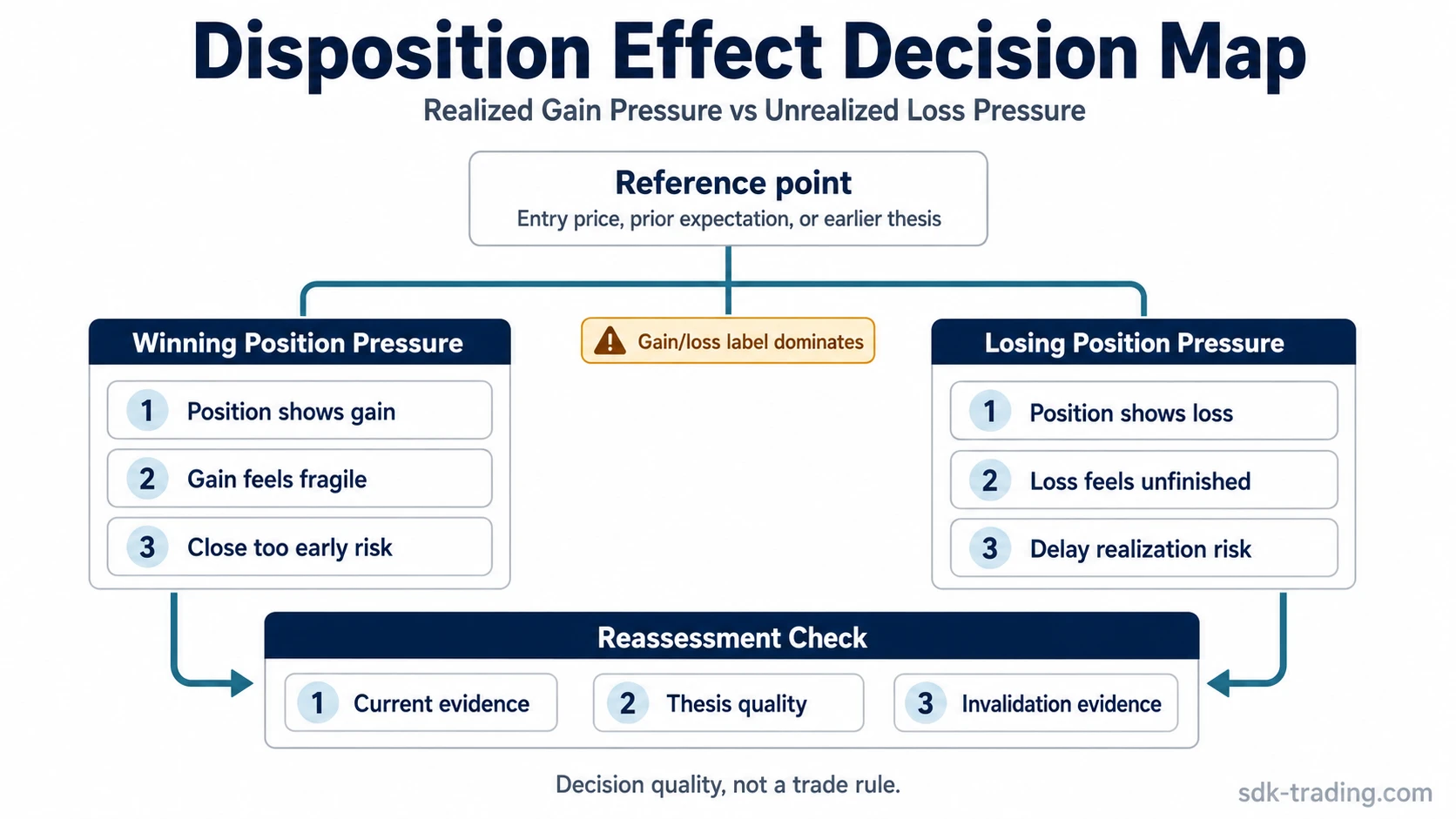
The core issue is not profit-taking by itself and not loss-holding by itself. A position can be reduced for valid reasons, and a loss can be held when the original thesis remains intact. The bias becomes more relevant when the realized gain or unrealized loss becomes the main reference point, rather than the current evidence around the position.
Key Points
- The disposition effect describes the tendency to sell winners too early and hold losers too long.
- The bias is linked to loss aversion, regret avoidance, mental accounting, and reference-point thinking.
- It can distort exit timing when decisions are driven by the comfort of realizing a gain or avoiding a realized loss.
- Not every closed winning position or held losing position is evidence of disposition effect.
- The useful distinction is whether the decision reflects updated evidence or emotional attachment to the gain or loss state.
What the Disposition Effect Means in Trading
In trading and investing, the disposition effect describes an asymmetric response to gains and losses. A gain may feel fragile, so closing the position creates relief. A loss may feel unfinished, so keeping the position open preserves the possibility of recovery and delays the discomfort of realizing the loss.
This can create a decision gap between realized gains and unrealized losses. The winning position is treated as something to protect from reversal, while the losing position is treated as something that might still return to the original reference point. The market evidence may have changed, but the trader’s internal reference point remains anchored to the entry price, prior expectation, or earlier thesis.
The effect belongs to trading psychology because it changes how evidence is processed. The question is not only whether a position is up or down. The question is whether the gain or loss state has started to outweigh current evidence, thesis quality, and invalidation evidence.
Why Traders Sell Winners and Hold Losers
The disposition effect often begins with loss aversion. A realized loss can feel more painful than an equivalent gain feels satisfying, so delaying the loss can feel emotionally easier than accepting it. The position remains open not because the evidence is stronger, but because the loss has not yet become final.
Regret avoidance can reinforce the same behavior. Closing a losing position creates a visible decision that can later feel wrong if the market recovers. Holding the position keeps the decision unresolved. The trader avoids the immediate regret of closing the loss, but may also avoid reassessing whether the original premise still holds.
Mental accounting adds another layer. A trader may treat each position as a separate account with its own gain or loss label. A winning position is mentally classified as success that can be protected. A losing position is mentally classified as unfinished business. That separation can make the portfolio less coherent, especially when weaker positions receive more emotional attention than stronger evidence deserves.
Decision-process note: The disposition effect is strongest when the position’s gain or loss label becomes more important than the current evidence. The same action can be reasonable or biased depending on why it is taken.
Disposition Effect Decision Pattern
A disposition-effect pattern becomes clearer when emotional pressure, visible behavior, and interpretation risk are separated. The concept works as a diagnostic lens for decision quality, not as a trade rule.
| Trigger | Behavioral pressure | Visible decision behavior | Interpretation risk |
|---|---|---|---|
| A position moves into profit | The gain feels vulnerable and worth protecting | The trader realizes the gain quickly | The position may be closed because the gain feels safe, not because evidence has weakened |
| A position moves into loss | The loss feels uncomfortable to make final | The trader delays realizing the loss | The position may remain open because recovery feels possible, not because evidence still supports it |
| The entry price becomes the reference point | Break-even starts to feel like the required outcome | The trader waits for price to return to the original level | The old reference point may dominate newer market information |
| One position is mentally separated from the portfolio | The trader wants that position to become “right” on its own | Capital remains tied to a weaker idea | Risk can become concentrated in positions with deteriorating evidence |
Disposition Effect Example in Trading
Example: A trader holds two positions. One shows a moderate gain after moving in the expected direction. The other shows a loss after the original setup weakens. The trader closes the winning position quickly because the gain feels worth protecting, but keeps the losing position open because a recovery to break-even still feels possible.
The scenario becomes a disposition-effect example only if the gain and loss labels are driving the decisions more than updated evidence. If the winning position is closed because the premise has weakened, that can be a valid reassessment. If the losing position is held because the thesis remains intact and risk is still defined, that is not automatically irrational.
The diagnostic issue is the asymmetry. The gain is treated as something to secure, while the loss is treated as something to postpone. That asymmetry can make the trader act quickly where patience may be justified and wait passively where reassessment may be needed.
Disposition Effect vs Related Trading Biases
Disposition effect overlaps with several trading psychology concepts, but it has a narrower meaning. It is specifically about realizing gains and losses asymmetrically. Other biases can support that behavior, but they are not identical to it.
| Related concept | Core distinction | Connection to disposition effect |
|---|---|---|
| Loss aversion | Losses feel more painful than comparable gains feel rewarding | It can make realizing a loss feel harder than realizing a gain |
| Sunk cost fallacy | Past commitment starts to justify continued commitment | It can reinforce holding a losing position because time, attention, or capital has already been spent |
| Confirmation bias | Evidence that supports the existing view receives more attention than conflicting evidence | It can help a trader defend a losing position instead of reassessing it |
| Hindsight bias | Past outcomes feel more predictable after they happen | It can distort review by making earlier exits or delayed losses seem obvious after the fact |
| Endowment effect | Ownership can make an asset feel more valuable than it would otherwise appear | It can make a trader more attached to an existing position, especially when closing it would confirm a loss |
When It Is Not the Disposition Effect
Boundary: Not every held loss is disposition effect, and not every taken profit is disposition effect. The bias is about the reason behind the decision, not the surface action alone.
A winning position can be closed because evidence has weakened, volatility has changed, the original thesis has played out, or the position no longer fits the trader’s risk framework. Those reasons are different from closing only because a visible gain feels emotionally satisfying.
A losing position can also be held for non-biased reasons. The original premise may remain intact, the position may still fit a defined risk plan, or the market may not have reached the condition that would invalidate the idea. Holding a loss becomes more suspect when the main reason is the desire to avoid making the loss real.
The practical test is evidence quality. If the decision can be explained by current structure, thesis validity, risk context, and updated information, the disposition-effect label may be too simplistic. If the explanation depends mainly on break-even hope, regret avoidance, or discomfort with realization, the bias becomes more plausible.
Why It Matters for Trading Decisions
The disposition effect can matter because it may change how risk is distributed. A trader who repeatedly closes winners quickly and lets losers remain unresolved can end up with a portfolio or watchlist dominated by weaker positions. That does not mean every case produces poor results, but it can make the decision process less balanced.
The bias can also affect review quality. A closed winner may be remembered as discipline, while a held loser may be described as patience. Both interpretations can be valid in some situations, but both can also hide emotional decision-making if the evidence is not reviewed consistently.
A cleaner review separates outcome from process. The gain or loss state is only one input. The stronger question is whether the position still has a valid reason to exist under current evidence. That distinction keeps the disposition effect in its proper role: a bias lens for reviewing decisions, not a fixed rule for what to do next.
FAQ
What is the disposition effect in trading?
The disposition effect in trading is the tendency to realize gains too early while delaying the realization of losses too long. It reflects an asymmetric response to winning and losing positions.
Why do traders hold losing positions too long?
Traders may hold losing positions too long because realizing the loss feels final, while keeping the position open preserves the possibility of recovery. Regret avoidance, loss aversion, and reference-point thinking can all contribute.
How is disposition effect different from loss aversion?
Loss aversion describes the general tendency to feel losses more strongly than gains. Disposition effect is a more specific trading and investing pattern: selling winners too early and holding losers too long.
Is taking profit always disposition effect?
No. Taking profit can be reasonable when evidence has changed or the original premise has played out. It becomes more consistent with disposition effect when the gain is realized mainly because the profit feels emotionally secure.