Recency bias is the tendency to give the newest information more weight than the broader evidence supports. In trading, it can distort judgment when a recent price move, news event, trade result, volatility spike, or short streak starts to feel more important than the full market context.
Definition: Recency bias in trading happens when the latest market input dominates the decision process because it is fresh, memorable, or emotionally salient, rather than because it has genuinely changed the evidence.
The issue is not that recent information is useless. New evidence can matter when it alters the decision context, invalidates a prior scenario, confirms a new condition, or reveals a shift that older information no longer explains. Recency bias appears when freshness itself becomes the reason for giving the input extra authority.
Key Points
- Recency bias gives the latest information too much influence when it is not representative of the full decision context.
- Trading judgment can be pulled by recent price action, news, volatility, trade outcomes, or short win and loss streaks.
- Valid new evidence changes the decision case; biased weighting reacts mainly to what feels newest or most vivid.
- The practical distinction is evidence quality, not the age of the information alone.
What Is Recency Bias?
Recency bias is a judgment error where recent information feels more important than older or wider information, even when the older evidence remains relevant. In a trading context, the bias can make the last candle, last session, last news release, or last trade outcome feel like the main explanation for what should happen next.
A trader may look at a market that has been range-bound for weeks, then give one strong session disproportionate weight because it is the most vivid data point. Another trader may experience one sharp loss and start treating the next similar setup as more dangerous than the actual evidence suggests. In both cases, the decision is being pulled toward the newest input rather than balanced against the wider context.
Core boundary: Recency bias is not the same as updating a view. Updating a view is evidence-based when the new information alters the decision context. Recency bias is present when the new information receives extra weight mainly because it is fresh.
How Recency Bias Affects Trading Decisions
Recency bias affects trading decisions by changing how evidence is weighted. The newest input becomes easier to remember, easier to explain, and harder to ignore. That can make the decision process less balanced, especially when the input is emotionally charged.
Common recent inputs include:
- Recent price movement: A fast rally or selloff can make the latest direction feel more reliable than the broader structure supports.
- Recent volatility: A sudden expansion in range can make conditions feel more unstable, even if the larger structure has not changed.
- Recent news: A fresh headline can dominate attention before its actual market impact is clear.
- Recent trade outcome: One win can increase confidence, while one loss can make a similar setup feel lower quality without enough evidence.
- Recent streak: A short sequence of wins or losses can feel like a new pattern, even when the sample is too small.
The bias becomes stronger when the newest input is vivid. A sharp candle, a large gap, a surprising headline, or a painful loss can stay mentally available longer than slower evidence such as trend context, range behavior, participation, volume, or prior failed attempts.
Recency Bias vs Valid New Evidence
Recent information can be valid. A new breakout, failed breakout, volatility expansion, earnings reaction, or macro headline may change the evidence set. The problem is not recency itself. The problem is treating the latest event as decisive before checking whether it has actually changed the decision case.
| Question | Evidence-based update | Recency bias risk |
|---|---|---|
| Did the recent input change market structure? | The new move broke, reclaimed, rejected, or redefined an important area. | The move feels important only because it happened last. |
| Is the recent input representative? | The new behavior fits a wider pattern of confirmation or deterioration. | One data point is treated as if it summarizes the whole situation. |
| Does older evidence still matter? | Older evidence is weighed against the new condition. | Older evidence is dismissed because it feels less vivid. |
| Would the decision look the same without the emotional weight? | The decision still makes sense after separating the fresh event from the full evidence set. | The decision depends mainly on the emotional force of the latest event. |
Important limitation: Older evidence is not automatically better. A fresh input can be more important than older information when it changes the current condition. The useful test is whether the new input changes the evidence, not whether it is simply newer.
Recency Bias Classification Test
Use the classification test to separate a valid update from a weighting error. The question is not whether the latest event matters. The question is whether it deserves the amount of influence it is receiving.
| Recent input | Broader evidence displaced | Bias risk | Cleaner interpretation question |
|---|---|---|---|
| A strong one-day rally | Prior range behavior, failed breaks, volume context, and higher-timeframe structure | Calling the market strong because the latest session was strong | Did the rally change acceptance, structure, or participation? |
| A sharp loss on one trade | The full sample of similar setups and the original quality criteria | Treating one painful result as proof that the setup type is unreliable | Did the loss expose a process issue or only one outcome? |
| A fresh headline | Existing trend, positioning, market reaction, and follow-through | Assuming the headline controls the decision before price behavior confirms impact | Has the market actually repriced the information? |
| A short win streak | Risk quality, sample size, and whether the same conditions still exist | Increasing confidence because the newest outcomes were favorable | Is the process still valid without relying on the streak? |
| A recent failed setup | Context differences between the failed setup and the current situation | Avoiding all similar structures because the latest one failed | Are the current conditions actually the same? |
Recency Bias Examples in Trading
Recency bias is easiest to see when the newest event becomes the main explanation, even though the decision still needs wider context.
Winning streak example: A trader has several profitable trades in a short period and starts treating the next similar setup as higher quality. The streak may feel meaningful, but the cleaner question is whether the next setup still meets the same evidence standards. A small streak does not automatically prove stronger decision quality.
Sharp loss example: A trader takes a loss after a valid-looking setup fails. The next time a similar setup appears, the recent loss may feel more important than the actual market structure. The loss may contain useful feedback, but it should not automatically dominate the new decision unless the same weakness is present again.
Fast rally example: A market rises quickly after several quiet sessions. The latest movement can make the market feel stronger, but the better question is whether price acceptance, participation, and follow-through have changed. A fast move is recent evidence, not automatically representative evidence.
Recent failed setup example: A breakout fails, and the failure remains mentally vivid. Later, another breakout attempt appears in a different context. Recency bias can make the earlier failure feel like the controlling evidence, even though the current structure may not be the same.
Recency Bias vs Similar Trading Biases
Recency bias often overlaps with nearby cognitive biases, but the source of distortion is different. The central issue is the overweighting of fresh information.
| Bias or concept | Main distortion | Difference from recency bias |
|---|---|---|
| Anchoring bias | An older reference point keeps controlling judgment. | Recency bias overweights what just happened; anchoring bias overweights a prior reference point. |
| Confirmation bias | Evidence that supports an existing view receives more attention. | Recency bias favors fresh information; confirmation bias favors information that supports the existing belief. |
| Hindsight bias | An outcome feels obvious after it has already happened. | Recency bias affects weighting before or during a decision; hindsight bias reshapes interpretation after the result. |
| Overconfidence bias | Confidence becomes stronger than the evidence supports. | Recent wins can feed overconfidence, but recency bias is specifically about the newest outcomes receiving extra weight. |
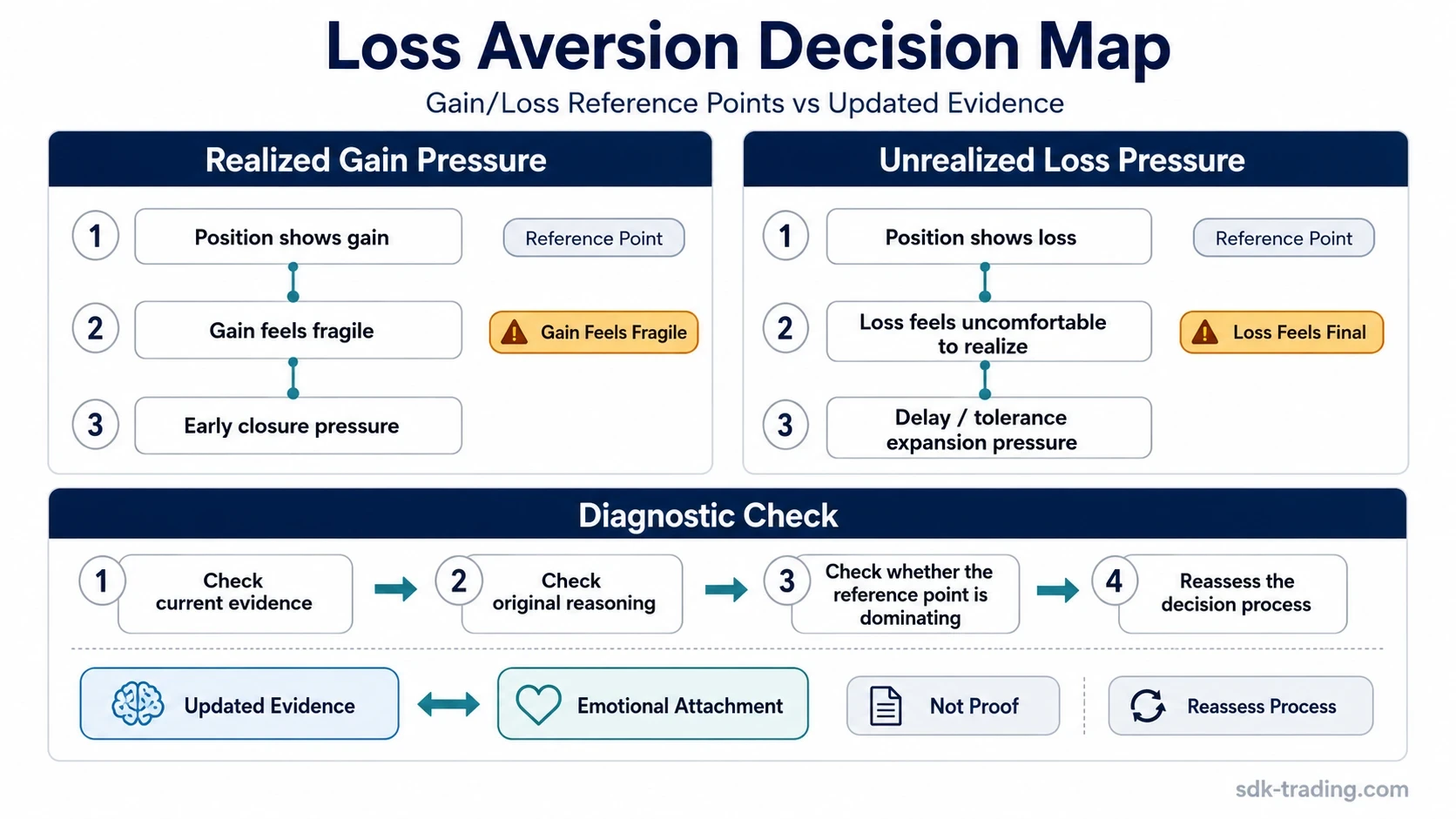
| Loss aversion | A loss feels more painful than an equivalent gain feels positive. | A recent loss can trigger recency bias, but loss aversion is about the unequal emotional weight of losses. |
| Sunk cost fallacy | Past commitment keeps influencing the current decision. | Recency bias is pulled by the latest input, while sunk cost thinking is pulled by what has already been invested. |
| Availability heuristic | Information that is easy to recall feels more likely or important. | Recent information is often easy to recall, so recency bias can work through availability. |
| Primacy bias and recency effect | Early or late information receives extra memory weight. | Recency bias in trading is the decision distortion that can follow when late information receives too much authority. |
Common Mistakes and Limitations
Recency bias is not solved by ignoring the latest information. The latest information may be the most important information if it changes the current condition. The mistake is skipping the comparison between the new input and the full evidence set.
| Common mistake | Why it weakens judgment | More balanced interpretation |
|---|---|---|
| Treating the latest price move as automatically decisive | The newest move may be only one part of a larger range, trend, or failed attempt. | Check whether the move changed acceptance, structure, or participation. |
| Ignoring older but still relevant evidence | Support, resistance, trend context, volatility regime, and prior reactions may still matter. | Older evidence should remain in the model unless the new input genuinely invalidates it. |
| Reacting to a recent win or loss as process proof | One outcome can feel more informative than it is. | Separate outcome review from evidence review before changing the quality standard. |
| Assuming a fresh headline has already changed the market | The headline may be visible before its market impact is confirmed. | Distinguish information arrival from market repricing and follow-through. |
Boundary: Recency bias is a weighting problem. A decision becomes more vulnerable when fresh information is treated as more representative without enough evidence. A decision becomes cleaner when recent information is tested against structure, context, and whether the broader evidence has actually changed.
FAQ
What does recency bias mean in trading?
Recency bias in trading means giving the latest market event, trade result, price move, or news item more decision weight than the broader evidence supports.
Is recent information always a bias?
No. Recent information can be valid when it changes the structure of the evidence. Bias appears when the information receives extra weight mainly because it is new, vivid, or emotionally salient.
How can recency bias affect trading judgment?
It can make a trader overreact to the latest price move, recent volatility, a fresh headline, a winning streak, or a recent loss while underweighting wider context.
How is recency bias different from confirmation bias?
Recency bias favors the newest information. Confirmation bias favors information that supports an existing view. The two can overlap when a fresh event also appears to confirm what a trader already believes.