Patience in trading breaks down when a trader treats incomplete evidence as enough reason to act. Real patience is not passive waiting. It is the ability to wait for defined criteria while action pressure, boredom, or missed-move anxiety tries to change how the evidence is weighted.
Patience in trading means delaying action until the planned conditions are either present, invalidated, or no longer relevant. The useful test is simple: the trader is not waiting because waiting feels safe; the trader is waiting because the current evidence has not yet met the decision criteria.
Key Points
- Patience is criteria-based waiting, not a personality trait or a vague instruction to stay calm.
- Impatience often appears as chasing, overtrading, boredom trades, or acting before the evidence is complete.
- Discipline defines the process that tells a trader when patience is valid and when it has expired.
- Patience becomes stubbornness when the original reason for waiting has been invalidated.
- A useful patience process includes criteria, alerts, evidence rechecks, and review after pressure-heavy decisions.
What Patience Means in Trading
Patience in trading is the practice of waiting for defined evidence before acting, while also recognizing when the reason for waiting has changed. It is not the same as doing nothing, hoping, or refusing to update a view.
The key word is “defined.” A trader cannot measure patience if the required conditions are vague. Waiting for “a better setup” is weak if the setup has no observable criteria. Waiting for acceptance, confirmation, rejection, volume behavior, volatility contraction, or another pre-defined condition is more useful because the trader can compare pressure against evidence.
This is why patience belongs inside the decision process rather than outside it. It does not replace analysis. It protects the analysis from being rewritten by urgency.
Why Impatience Leads to Chasing and Overtrading
Impatience usually starts when price moves, time passes, or another trader appears to be acting faster. The pressure is not always obvious. It can show up as a small change in wording: “close enough,” “I do not want to miss it,” or “I can manage it later.” Those phrases often appear when the trader is no longer reading the evidence neutrally.
When action pressure rises, incomplete evidence can begin to look complete. A partial move can look like confirmation. A normal pause can feel like an opportunity that must be taken immediately. This is one reason FOMO trading is closely tied to weak patience: the trader starts responding to the fear of exclusion rather than the quality of the setup.
Overtrading can follow the same pattern. If every minor movement feels like something that must be used, the trader is no longer waiting for the planned conditions. The market is supplying motion, but motion is not the same as valid evidence.
The Patience Mechanism: Pressure, Evidence, Recheck
The practical value of patience is that it creates a pause between pressure and classification. That pause does not need to be emotional or motivational. It can be a mechanical recheck of what is actually present.
| Pressure state | Distorted reading | Evidence recheck | Better classification |
|---|---|---|---|
| Price starts moving before all criteria are present | The move feels like proof that action is required | Which criteria are complete, missing, or invalidated? | Incomplete evidence, not a complete decision condition |
| No setup appears for a long period | Boredom makes a weak setup feel acceptable | Would this still qualify without the boredom pressure? | Possible boredom trade, not valid patience ending |
| A position or idea moves against the original view | Waiting feels disciplined because changing view is uncomfortable | Has the original reason for waiting been invalidated? | Possible stubbornness, not patience |
| The crowd becomes highly confident | Agreement feels like confirmation | Is current evidence stronger, or only the social pressure? | Possible crowd-pressure distortion |
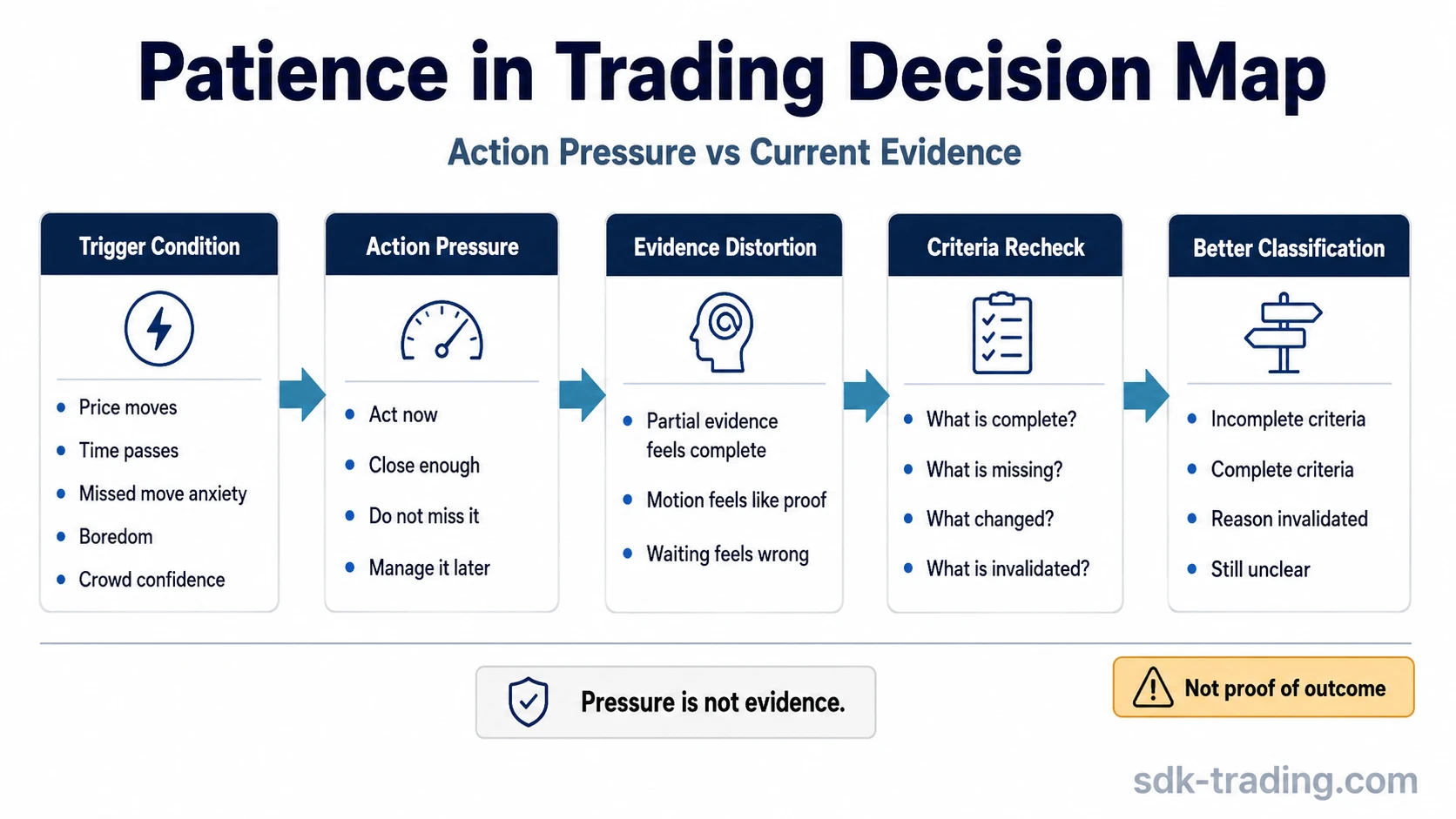
The goal is not to remove pressure. The goal is to stop pressure from becoming evidence. A trader can feel urgency and still require the same criteria that existed before the urgency appeared.
Patience vs Discipline, Freezing, and Stubbornness
Patience is often mixed with nearby ideas, but the differences matter. A trader can wait for the right reason, avoid a decision for the wrong reason, or keep waiting after the reason has expired.
| State | What it means | Decision-process test |
|---|---|---|
| Patience | Waiting while defined evidence is still incomplete | The criteria are known, and the current evidence has not met them yet |
| Discipline | Following the process that defines when waiting is valid | The trader applies the same criteria before, during, and after pressure appears |
| Freezing | Avoiding a decision even after evidence changes | The trader has enough information to reassess, but avoids classification |
| Stubbornness | Continuing to wait or hold after the original reason is invalidated | The trader protects the old view instead of updating to current evidence |
This distinction prevents patience from becoming a label for every delay. A delay is only useful when it protects the process. It becomes harmful when it protects an old assumption.
When Patience Turns Into Stubbornness
Patience expires when the reason for waiting is no longer valid. That can happen because the setup completes, the setup fails, the market context changes, or the trader realizes that the original criteria were too vague to be useful.
Boundary: patience is not a reason to ignore invalidation. If the original condition is broken, continuing to wait may be stubbornness, avoidance, or attachment to the prior view.
This matters because traders often use patient language after the evidence has already changed. “I am waiting it out” can sound disciplined, but the real question is whether the wait still belongs to the original plan. If the answer is no, the trader is no longer practicing patience. The trader is delaying reassessment.
A related pressure can appear during fast downside movement. The trader may delay a needed review because acting feels emotionally difficult. Panic selling shows the opposite side of the same pressure problem: urgency narrows the decision process until evidence is no longer being reviewed clearly.
Practical Scenario: Alert, Partial Move, Pressure to Chase
A trader sets an alert near a planned area. Price reaches the area and starts moving, but only part of the required evidence appears. The movement creates pressure: acting now feels safer than missing the move. A patience-based process does not ask whether the trader feels urgency. It asks whether the original criteria are actually complete.
If the criteria are incomplete, the trader can classify the situation as pressure without treating it as confirmation. If the criteria are complete, patience may no longer be the right response. If the original reason has failed, continuing to wait is not patience. The classification depends on current evidence, not on the emotional intensity of the moment.
This scenario also shows why patience is not the same as passivity. The trader is still doing something: comparing the current state to the plan, separating pressure from evidence, and deciding whether the situation is incomplete, complete, invalidated, or unclear.
How to Build Patience Around Criteria, Alerts, and Review
Patience becomes easier to apply when it is attached to observable criteria. The trader should be able to name what must appear, what would weaken the idea, and what would make the idea no longer worth tracking. Without those boundaries, patience can become a vague emotional demand.
In faster day-trading contexts, the same rule becomes stricter because price movement can make partial evidence feel complete before the planned criteria are actually met.
- Define the evidence before pressure appears: decide what would count as a valid condition before the market starts moving quickly.
- Use alerts to reduce screen pressure: an alert can create distance between monitoring and reacting, but it should trigger a recheck, not automatic action.
- Separate waiting from avoidance: if enough evidence exists to reassess, delaying the reassessment is not patience.
- Review pressure-heavy decisions: after a trade or missed trade, note whether the decision followed criteria or was rewritten by urgency.
- Track the reason for waiting: if the reason changes, the classification should change with it.
Patience also weakens when the surrounding environment becomes euphoric. During market euphoria, rising confidence can make waiting feel irrational even when the trader’s criteria are still incomplete. That does not prove that action is wrong. It means crowd pressure should not replace the evidence recheck.
What Patience Does Not Mean
Patience does not mean waiting forever. It does not mean ignoring risk, avoiding decisions, or refusing to update a view. It also does not mean that a patient trader will be right. Patience only improves the decision process by reducing the chance that urgency, boredom, or social pressure will redefine the evidence.
Useful test: if the trader can clearly state what is being waited for and what would invalidate the wait, the delay can be evaluated. If the trader cannot state either one, the delay is probably not a reliable patience process.
The strongest version of patience is narrow and conditional. It waits for evidence, not comfort. It ends when the evidence completes, fails, or changes enough to require a new classification.
FAQ
What does patience in trading mean?
Patience in trading means waiting for defined evidence before acting. It is valid only while the planned criteria are incomplete and the original reason for waiting has not been invalidated.
Is patience the same as discipline in trading?
No. Patience is the waiting behavior. Discipline is the process that defines when waiting is justified, when action is allowed, and when the original idea should be reassessed.
When does patience become stubbornness?
Patience becomes stubbornness when the trader keeps waiting after the original reason has failed or after current evidence no longer supports the old view.
How can a trader build patience without freezing?
A trader can use defined criteria, alerts, invalidation rules, and review notes. The goal is to wait for evidence, not to avoid a decision after enough evidence is already present.