A moving average crossover strategy does not begin and end when one average crosses another. The crossover creates an event. The strategy begins when that event is tested against the market condition, price response, average behavior, and the conditions that would weaken or invalidate the original reading.
Core distinction: a crossover tells you that the faster average moved from one side of the slower average to the other. A crossover strategy defines what must happen around that event for the interpretation to remain coherent.
| Scenario | What happens after the crossover | Framework reading |
|---|---|---|
| Primary continuation scenario | Price holds in the direction of the cross, the averages maintain slope, and separation develops rather than collapsing immediately. | The crossover remains consistent with a directional market condition. |
| Alternative whipsaw scenario | Price continues rotating around both averages while the lines flatten or cross back and forth. | The event has low value because directional structure has not developed. |
| Invalidation scenario | Price rejects the attempted direction and the crossover reverses or the structure that supported the reading is lost. | The original interpretation no longer fits the observed market behavior. |
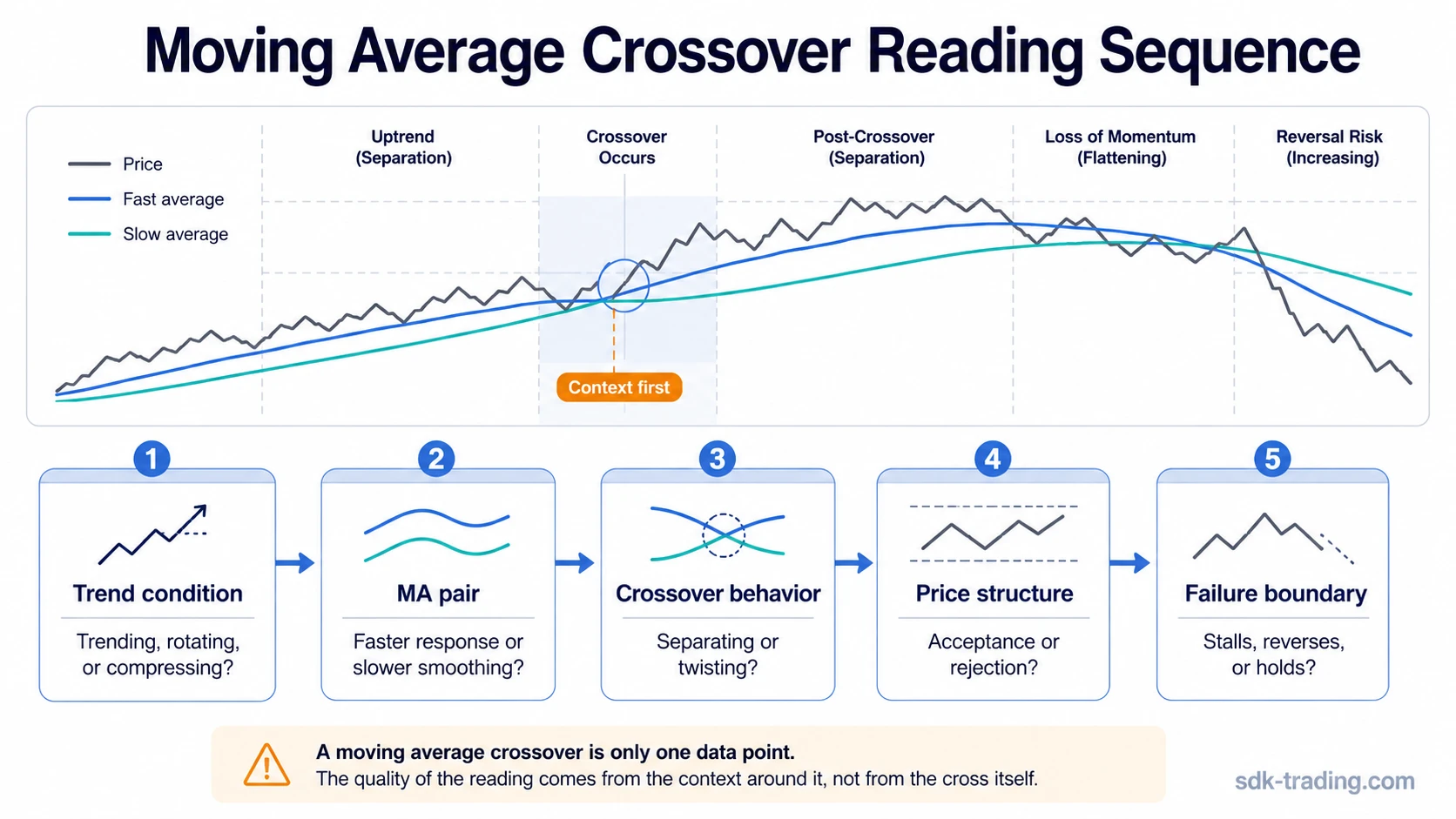
The Crossover Is the Event, Not the Conclusion
A faster moving average crossing above a slower average means the faster calculation has moved to the upper side of the slower calculation. A bearish crossover describes the opposite relationship.
That event alone does not establish that a durable trend change has occurred. Moving averages summarize previous price data, so a cross can appear during a clean directional transition, inside a sideways range, or after much of a move has already happened.
A separate trend-strength measure such as an ADX trend filter can help describe whether the surrounding environment is directional or weakly rotating. It remains a separate measurement rather than automatic confirmation of the crossover.
Primary Scenario: Directional Continuation
The cleaner crossover scenario begins before the lines intersect. Price is already showing directional behavior rather than repeated rotation around both averages.
After the cross, the framework looks for consistency between three observations:
- price continues to behave on the expected side of the average structure;
- the faster and slower averages retain directional slope rather than flattening immediately;
- the distance between the averages develops instead of repeatedly collapsing.
The crossover is therefore part of an existing sequence. It becomes more coherent when the later price behavior continues to support the same directional interpretation.
Alternative Scenario: The Cross Forms Inside Rotation
The same crossover can occur inside a range. Price moves above the averages, then below them, while the faster line repeatedly crosses the slower line.
Nothing is mathematically wrong with the crossover. The averages are correctly responding to alternating price movement. The problem is that the market has not developed the directional separation required for a trend-following interpretation.
Whipsaw condition: repeated crosses combined with flat or converging averages usually describe rotation more clearly than they describe a new trend.
Invalidation: When the Original Reading Stops Fitting
An interpretation weakens when the market rejects the behavior that originally supported the cross.
For example, a bullish crossover may form while price is advancing above both averages. If price then falls back through the same structure, the averages flatten, and the faster average crosses back below the slower one, the original continuation scenario has lost its supporting evidence.
This is an interpretation boundary rather than a trade instruction. It defines when the original scenario no longer matches the chart.
How Moving Average Choice Changes the Scenario
The crossover framework stays the same, but different moving averages change how quickly the event appears.
An EMA places more influence on recent observations and can therefore respond faster than an equally long simple average.
A SMA gives every observation inside its lookback period equal weight. That usually creates a smoother and slower response to new price movement.
A WMA increases weights linearly toward the newest observations, creating another form of recent-price sensitivity.
Hull moving average responsiveness uses a different construction designed to reduce some lag while maintaining smoothing.
These choices alter sensitivity and timing. They do not remove the need to judge whether the market is trending, rotating, or already extended when the cross occurs.
Pair Length Changes Timing, Not the Core Logic
Shorter moving-average pairs usually respond sooner because both calculations contain more recent data. They can also cross more frequently when price is unstable.
Longer pairs usually smooth more movement and react later. A 50/200 crossover, for example, represents a much slower observation horizon than a 9/20 relationship.
| Pair type | Typical behavior | Main limitation |
|---|---|---|
| Short / short | Fast response to recent price changes | Higher exposure to repeated crosses and noise |
| Medium / medium | More smoothing with moderate response | Can still whipsaw during ranges |
| Long / long | Slow representation of broader directional change | The crossover can appear well after the initial price transition |
No pair removes the basic trade-off between responsiveness and lag.
A Signal Interaction Example
Suppose price advances from a base while a faster average moves toward a slower rising average. The fast line then crosses above the slow line.
If price continues holding above the average structure and the two lines begin separating with positive slope, the primary continuation scenario remains coherent.
If price instead returns into the prior range and both averages flatten, the same crossover becomes a whipsaw candidate. If price then rejects the attempted advance and the fast average crosses back below the slow one, the initial interpretation is no longer supported.
Primary: cross + directional price behavior + sustained slope and separation.
Alternative: cross + range rotation + flat or repeatedly converging averages.
Invalidation: attempted direction is rejected and the structure supporting the original crossover disappears.
Late Crossovers Need a Different Reading
A crossover can also occur after a large portion of the directional move has already developed. This is a direct consequence of using averages calculated from previous observations.
A bullish cross after an extended advance or a bearish cross after a long decline may describe the existing move more than the beginning of a new one.
The framework should therefore distinguish between a crossover that develops alongside an emerging structural change and one that appears only after price has already travelled far from the earlier transition.
What Makes the Strategy Different From the Crossover Definition
The crossover definition answers a narrow question: when did the faster moving average move from one side of the slower moving average to the other?
The strategy framework asks a different set of questions: what market condition produced the event, what happened afterward, which alternative scenario remains possible, and what observable behavior would make the original interpretation stop fitting?
Interpretation limit: a moving average crossover strategy organizes conditional scenarios around a lagging price-derived event. It does not turn the crossover into a standalone forecast or deterministic trading instruction.