An order block is read as a prior origin area for displacement, while a breaker is read after that prior area fails and subsequent structure changes how the same zone is interpreted.
The difference is not the rectangle itself. A marked zone may first be treated as an order block candidate, but the label can change if price accepts beyond it, breaks structure, and returns to the area with a different response.
A wick, a brief breach, or a single candle through the zone is not enough by itself. Breaker logic needs a sequence: prior area, failure, structural change, and a subsequent response that supports a new reading.
Key Points
- An order block focuses on the origin area before displacement.
- A breaker focuses on what happens after a prior area fails.
- The same zone can receive a different label only after structure and response change the reading.
- A brief violation weakens the original read, but it does not automatically create a breaker.
- The comparison is diagnostic, not a trading instruction.
Order Block vs Breaker: The Core Difference
Order block logic starts with origin. The question is whether a prior candle area or consolidation area acted as the source of a meaningful price expansion. Breaker logic starts after that earlier area has failed. The question becomes whether the failed area is now being treated differently after a structure break or clear acceptance beyond it.
A bearish breaker block, for example, is not just an old bearish zone with price moving through it. It needs later structure and response evidence showing that the prior area is no longer behaving like the same origin zone and can now be reviewed through failed-hold or role-change logic.
Definition: In trading price action, an order block is mainly an origin reading, while a breaker is mainly a failed-area reading. The order block asks where the move began; the breaker asks what the market did after that area stopped holding its earlier meaning.
Quick Comparison Table
| Comparison point | Order block | Breaker |
|---|---|---|
| Main idea | Prior origin area behind displacement or strong directional movement. | Prior area that failed, then became relevant again after later structural behavior. |
| Sequence focus | Area forms before the move away. | Area matters after failure, breach, acceptance, or different treatment. |
| Required later behavior | Later reaction should not immediately erase the origin logic. | Subsequent response should show that the prior zone no longer holds the same role. |
| Structure evidence | Displacement, imbalance, or directional expansion may support the origin read. | Structure break, failed hold, and retest behavior may support the breaker read. |
| What weakens the reading | Immediate reclaim, weak displacement, or no meaningful reaction from the area. | No acceptance beyond the area, no structural change, or quick recovery back into the prior range. |
| Common mistake | Calling any last candle before movement an order block. | Calling every broken order block a breaker before the sequence supports the change. |
When Each Reading Fits Better
The cleaner comparison is not “which one is stronger?” but “which lens fits the sequence now?” An order block reading fits better when the prior area still behaves like an origin zone. A breaker reading fits better only after the market has shown that the old area failed and then responded around it in a different way.
| Use this lens when… | Order block lens | Breaker lens |
|---|---|---|
| The zone first appears | The zone precedes a directional expansion and can be studied as the origin of the move. | The zone is not yet a breaker because failure has not happened. |
| Price revisits the area | The area still contains the revisit or produces a reaction that keeps the origin logic intact. | The revisit follows a prior failure and tests whether the failed-area reading is being respected. |
| Price breaches the area briefly | The reading weakens, but a wick or shallow violation may still be unresolved. | The reading is premature unless the breach is followed by acceptance or structural change. |
| Structure changes after the breach | The original order-block interpretation may no longer be the best label. | The breaker lens becomes more relevant if the old zone no longer acts as origin. |
| The market quickly reclaims the zone | The original read may remain unresolved rather than fully invalidated. | The breaker read weakens because the market did not accept the failed-area interpretation. |
Same Area, Different Later Behavior
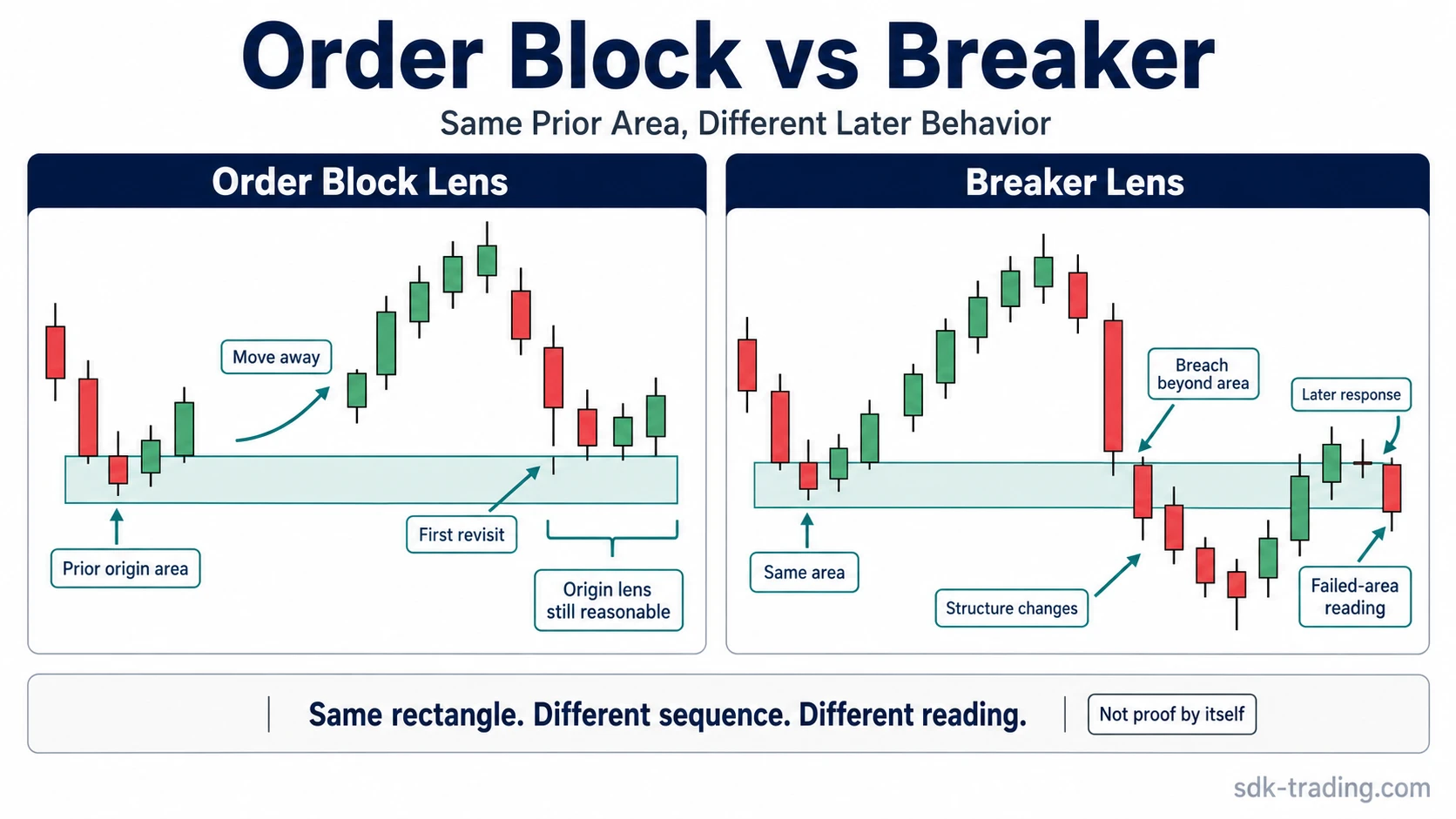
Price can leave a clear prior area, move away with directional force, and later return to the same marked rectangle. At that first stage, the rectangle may be studied as an order-block candidate because the focus is on the origin of the move.
The reading changes only if the evidence changes. If price pushes through the area, breaks structure, accepts beyond it, and later reacts around the same zone from the other side, the old order-block candidate may become a breaker candidate. The label changes because the sequence changed, not because the rectangle changed shape.
Example of an order block vs breaker reading: Price leaves a compact bearish-origin area and expands upward with visible displacement in price action. On the first revisit, the area still contains the pullback, so the order-block lens remains reasonable. Later, price trades back through that same area, holds below it for more than a brief wick, and the next recovery attempt stalls near the old zone. At that point, the earlier order-block label is no longer enough; the same area may now be evaluated through breaker logic.
Identification Criteria
The main criteria are sequence-based. Start with the prior area, then check the move away, the later test, the failure or acceptance, and the reaction after the area is revisited. The label should come after those observations, not before them.
| Criterion | Diagnostic question | Cleaner reading |
|---|---|---|
| Origin area | Did the area appear before a meaningful directional move? | Supports an order-block review if the move away is clear enough. |
| Displacement | Did price leave the area with expansion rather than slow drift? | Strengthens origin logic, but still needs later context. |
| Failure or breach | Did price merely wick through the area, or did it accept beyond it? | A wick is weaker evidence than acceptance or structural shift. |
| Structure change | Did the breach alter the surrounding market structure? | Supports breaker logic if the old area loses its earlier role. |
| Later response | Does price later treat the old area as a changed zone? | Breaker logic becomes more defensible when the subsequent response respects the failed-area reading. |
Clean, Weak, and Invalid Readings
A clean comparison separates three states: the reading may be supported, unresolved, or invalid. This matters because many chart labels are applied too early, before the market has shown whether the old area was truly accepted or rejected.
| Reading state | What it looks like | Interpretation |
|---|---|---|
| Clean order-block reading | Prior origin area, clear move away, later revisit that does not fully erase the zone. | The origin logic remains intact enough to keep the order-block label under review. |
| Weak or unresolved reading | Brief wick through the area, shallow breach, or mixed reaction without acceptance. | The original reading is weakened, but breaker logic is not yet clean. |
| Cleaner breaker reading | Prior area fails, structure changes, and later behavior treats the old zone differently. | The same area can be reviewed through failed-area or role-change logic. |
| Invalid breaker reading | Price breaches the zone but quickly reclaims it without structural acceptance. | The breaker label is premature because the market did not maintain the changed role. |
Common Mistakes When Comparing Order Blocks and Breakers
The most common mistake is assigning the breaker label as soon as a prior order-block area is touched or briefly broken. A breaker reading needs more than damage to the old zone. It needs evidence that the old zone has stopped behaving like the same origin area.
Another mistake is using the same label through the whole sequence. The same rectangle can move from candidate order block, to weakened zone, to failed area, to breaker candidate. Each label belongs to a different stage of the evidence.
A third mistake is confusing breaker logic with liquidity-trap logic. inducement before a move can explain why price may move into a vulnerable area, but it does not replace the need to evaluate the later failure, acceptance, and structure around the zone.
Common mistake: A wick or brief breach does not automatically create a breaker reading. It may only show that the original order-block read is under pressure. The breaker label becomes more defensible only when later structure and response support the changed-role reading.
How Displacement and Inducement Affect the Reading
Displacement helps explain why an order-block area was worth marking in the first place. A stronger move away from the origin area gives the zone more structural relevance than a slow drift or random candle cluster.
Inducement is different. It can describe a move into a vulnerable area that tempts early labeling before the later structure is clear. That context can make a breach look convincing, but it does not by itself prove that the old zone has become a breaker.
The cleanest distinction is sequence-based: origin supports the order-block lens, failure and different treatment support the breaker lens, and unresolved behavior should stay unresolved until the market gives clearer evidence.
Limitations of the Comparison
Order block and breaker labels are interpretive tools, not proof of what the market will do next. The same price area can look clear in hindsight but remain ambiguous while it is forming.
The reading weakens when price does not accept beyond the prior area, when structure does not change, or when the next reaction quickly reclaims the move. In those cases, forcing a breaker label can make the chart look more certain than the evidence allows.
Mitigation logic may sit near the same discussion, but it should not be folded into every order block vs breaker comparison. The cleaner task is to decide whether the old area is still being read as an origin zone or has become a failed-area reading after later behavior.
FAQ
Are order blocks and breaker blocks the same?
No. An order block is mainly read as a prior origin area, while a breaker block is read after that prior area fails and later behavior changes how the same zone is interpreted.
Does every broken order block become a breaker?
No. A broken order block becomes a breaker candidate only when the breach is followed by enough structural evidence, acceptance, or changed treatment around the old area.
Is a wick through an order block enough to call it a breaker?
No. A wick can weaken the original reading, but it is not enough by itself. Breaker logic needs later evidence that the area has changed role.
What is the simplest way to separate an order block from a breaker?
Ask whether the zone is being studied as the origin of a move or as a failed area after later structural behavior. Origin points toward order-block logic; failed-area behavior points toward breaker logic.