A liquidity sweep strategy is a conditional framework for reading how price interacts with visible liquidity, not a fixed trading signal. The sequence starts with a visible high, low, or boundary, then a probe through that level, an acceptance test, later behavior, and a failure condition. The framework helps separate a failed move through liquidity from accepted development beyond the old boundary, but it does not create automatic reversal, entry, stop, or target signals.
Key Points
- A liquidity sweep strategy is conditional, not predictive.
- The first cross of a level matters less than whether price accepts beyond it.
- Clean readings need visible liquidity, a meaningful probe, failed acceptance, and coherent later behavior.
- Accepted development beyond the old boundary can invalidate the sweep reading.
- The framework should not be turned into fixed entry, stop, or target rules.
How a Liquidity Sweep Strategy Works
A liquidity sweep is read when price moves through a visible liquidity area and then later behavior shows that the move did not hold beyond the prior boundary. In strategy form, the focus is not the wick itself. The focus is the relationship between the old boundary, the probe, acceptance behavior, and what price does afterward.
The useful reading begins before the sweep. A prior high, low, range edge, or repeated boundary has to be visible enough to matter structurally. If the level is not clear, the later cross may be ordinary noise rather than meaningful liquidity interaction.
After price crosses the old level, the framework asks one main question: does price fail to accept outside the boundary, or does it begin developing beyond it? A failed acceptance keeps the sweep reading alive. Accepted development weakens or invalidates it because price is no longer only probing the level. It is building structure beyond it.
The Components That Decide the Reading
The components matter as a sequence. Reading one candle, one wick, or one level in isolation creates weak interpretation. The cleaner approach is to check how each component changes the next one.
| Component | What It Shows | How It Changes the Reading |
|---|---|---|
| Visible boundary | A prior high, low, range edge, or repeated area that market participants can see. | If the boundary is weak or unclear, the sweep reading starts with low quality. |
| Liquidity area | The zone beyond the boundary where stops or pending activity may concentrate. | The area gives the probe structural relevance, but it does not prove intention or outcome. |
| Probe through the level | Price moves beyond the old boundary. | A probe starts the test, but the probe alone does not complete the reading. |
| Acceptance behavior | Whether price holds and develops beyond the boundary or returns inside prior structure. | This is the main separator between a failed sweep reading and an accepted break. |
| Later behavior | The structure that forms after the probe. | Coherent return behavior strengthens the reading; messy or extended outside development weakens it. |
| Failure condition | The point where the sweep interpretation no longer fits the evidence. | Prevents one wick through a level from being treated as a complete strategy. |
Liquidity Sweep Strategy Component Interaction Map
The logic works as a process, not a signal checklist. Each step can strengthen, weaken, or invalidate the interpretation.
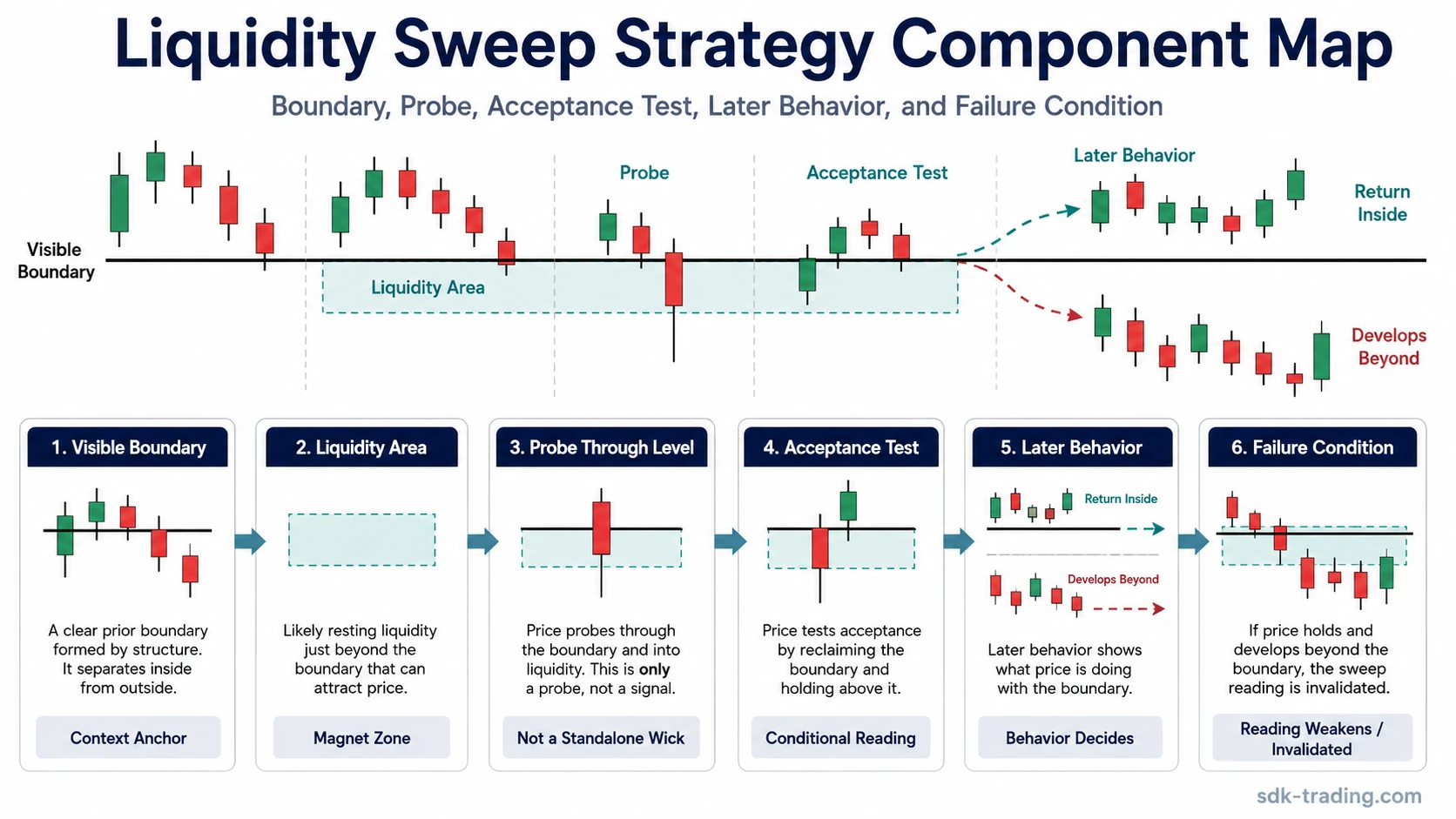
| Sequence Step | Diagnostic Question | Stronger Reading | Weaker or Invalid Reading |
|---|---|---|---|
| 1. Boundary | Was there a visible high, low, or range edge? | The level is clear and repeated enough to matter. | The level is random, noisy, or visible only after the fact. |
| 2. Liquidity area | Is the probe occurring around a meaningful upper or lower boundary? | The probe interacts with an obvious liquidity area. | The move occurs in the middle of structure with no clear boundary. |
| 3. Probe | Did price only cross the level, or did it begin building beyond it? | The probe is meaningful but not yet accepted. | Price keeps developing beyond the level without clear rejection. |
| 4. Acceptance test | Does price return inside the old structure or hold outside it? | Failed acceptance appears and the old boundary remains relevant. | Accepted development forms beyond the old boundary. |
| 5. Later behavior | Does later structure confirm or weaken the sweep reading? | The response remains coherent with failed acceptance. | Later structure becomes inconsistent, choppy, or accepted outside the level. |
| 6. Failure condition | What would make the sweep reading no longer valid? | The interpretation stays conditional and evidence-based. | The reading is forced even after price accepts beyond the boundary. |
A liquidity void can sometimes appear near the probe or response phase if price moves through an area with thin participation or imbalance. That context may help explain the speed of movement, but it should not replace the acceptance test.
Failed Acceptance vs Accepted Development
Failed acceptance means price probes beyond the old boundary but does not continue building structure outside it. The market returns inside the prior area, which keeps the sweep reading coherent. The important point is not that price crossed the level. The important point is that the cross failed to become accepted development.
Accepted development means price crosses the old boundary and then begins holding, rotating, or continuing beyond it. When that happens, the old level may no longer be acting as a failed sweep area. It may be turning into a new area of accepted structure.
| Reading | Behavior After the Probe | Framework Implication |
|---|---|---|
| Failed acceptance | Price probes beyond the old boundary, then returns inside prior structure. | The sweep reading remains possible if later behavior stays coherent. |
| Accepted development | Price holds or develops beyond the old boundary. | The sweep reading weakens or becomes invalid because the move is no longer only a failed probe. |
| Unclear response | Price becomes noisy around the boundary without clean acceptance or rejection. | The framework should remain unresolved rather than forcing a conclusion. |
Clean, Weak, and Invalid Liquidity Sweep Readings
A cleaner sweep reading needs more than a level break. It needs a visible boundary, a meaningful probe, failed acceptance outside the boundary, and later behavior that fits the failed-acceptance idea. If one part of that sequence is missing, the interpretation weakens.
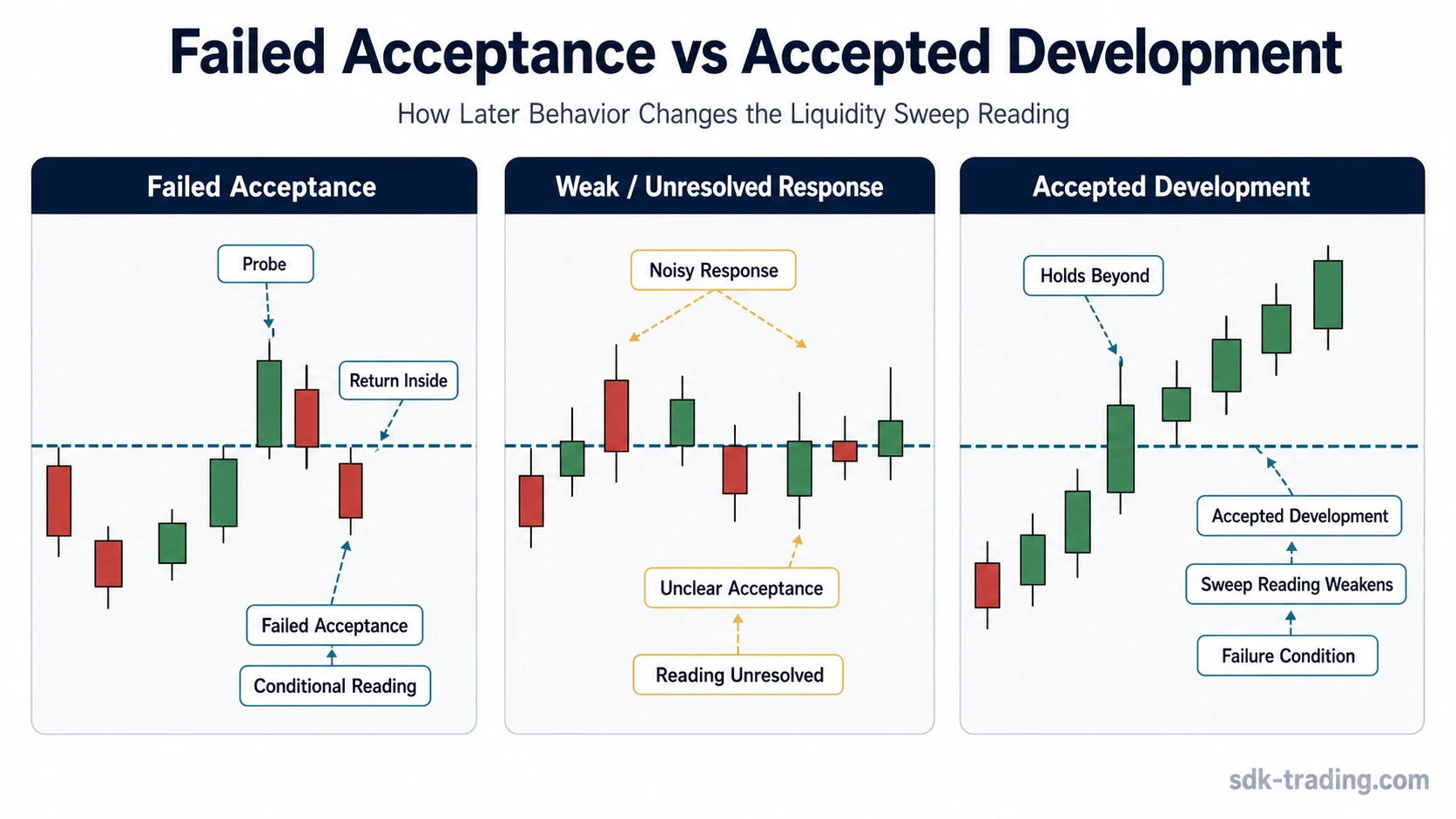
| Reading Quality | Typical Structure | What It Means |
|---|---|---|
| Clean | Visible boundary, meaningful probe, failed acceptance, and coherent return inside prior structure. | The sweep reading is structurally defensible, while still conditional. |
| Weak | Poor boundary quality, unclear probe behavior, noisy response, or mixed later structure. | The reading may exist, but the evidence is not strong enough to treat it as a clean framework signal. |
| Invalid | Price accepts beyond the old boundary and continues developing there. | The sweep interpretation no longer fits the behavior because the move has become accepted structure. |
The invalid reading is the most important filter. A strategy framework that cannot identify when its own premise has failed becomes a labeling exercise rather than a disciplined interpretation process.
Where Buy-Side and Sell-Side Liquidity Fit
Liquidity sweeps can form around upper or lower visible boundaries. When price probes above prior highs or an upper range edge, the relevant area is usually described as buy-side liquidity. When price probes below prior lows or a lower range edge, the relevant area is usually described as sell-side liquidity.
The directional label only tells where the liquidity area sits. It does not decide whether the sweep reading is clean, weak, or invalid. That still depends on boundary quality, probe behavior, acceptance, and later structure.
Liquidity Sweep vs Liquidity Grab and Break of Structure
A liquidity grab is often used for a brief move through a visible level that quickly fails to hold outside it. Liquidity sweep is closely related, but in a strategy framework the term is usually treated through the full process: visible liquidity, probe, acceptance test, later behavior, and invalidation.
A break of structure is different. It focuses on whether price has changed the prior structural sequence. A sweep can happen before, during, or around structural change, but the two labels should not be treated as identical. A move through liquidity that becomes accepted development may no longer fit a failed-sweep reading, even if it still has structural importance.
| Concept | Main Focus | Common Misread |
|---|---|---|
| Liquidity sweep | Probe through visible liquidity followed by an acceptance test and later behavior. | Assuming the first cross of a level is enough. |
| Liquidity grab | Brief grab through a visible area that fails to sustain outside it. | Treating every grab as a complete strategy framework. |
| Break of structure | Change in the prior swing or structural sequence. | Calling every structural break a failed liquidity sweep. |
Common Mistakes in Liquidity Sweep Strategy
The most common mistakes come from treating the sweep as a standalone event instead of a conditional process. The framework becomes weaker when the reader skips boundary quality, acceptance behavior, or invalidation.
| Mistake | Why It Creates Risk | Cleaner Interpretation |
|---|---|---|
| Mistaking any wick for a sweep | A wick can appear in ordinary volatility without meaningful liquidity interaction. | Start with visible boundary quality before labeling the move. |
| Assuming reversal | A failed probe can precede a reaction, but it does not guarantee reversal. | Keep the reading conditional until later behavior supports or weakens it. |
| Ignoring acceptance | Price may cross a level and then continue developing beyond it. | Separate failed acceptance from accepted development. |
| Treating sweep, grab, and structure break as identical | Related ideas can describe different parts of the same move. | Use each label for the specific behavior it describes. |
| Adding fixed entry, stop, or target rules | Mechanical execution rules can turn a diagnostic framework into a signal system. | Use the framework to interpret structure, failure, and context without forcing trade instructions. |
Failure Conditions and Risk Boundaries
A liquidity sweep strategy needs a failure condition because the label can become stale. If price accepts beyond the old boundary, keeps developing outside it, or repeatedly fails to return inside prior structure, the original sweep reading loses force.
| Condition | Effect on the Sweep Reading |
|---|---|
| The boundary was not clearly visible before the move. | The reading starts weak because the liquidity area is not structurally obvious. |
| Price crosses the level but does not reject or return. | The reading remains unresolved and may shift toward accepted development. |
| Price builds structure beyond the old boundary. | The failed-sweep idea is weakened or invalidated. |
| Later behavior becomes noisy and inconsistent. | The reading should remain conditional rather than forced. |
| The interpretation requires a fixed trade rule to make sense. | The framework has drifted away from structure reading and into unsupported execution logic. |
Framework Application Example
Consider a market that has tested the same upper boundary several times. Price later moves slightly above that boundary, then quickly returns inside the prior range. At that point, the sweep reading is only a scenario. It strengthens if later behavior continues to reject the outside area and respects the old boundary as failed acceptance. It weakens if price keeps returning above the boundary and building structure there.
If price begins holding above the old boundary, the better interpretation may be accepted development rather than a failed sweep. The probe does not decide the reading by itself; later structure decides whether the sweep idea remains coherent or should be discarded.
Liquidity Sweep Strategy FAQ
Is every move beyond liquidity a sweep?
No. A move beyond a visible level becomes more relevant only when the boundary was clear and later behavior shows failed acceptance or meaningful interaction with the old structure. A simple cross of a level is not enough.
Is a liquidity sweep a reversal signal?
No. A liquidity sweep can appear before a reversal, continuation failure, or wider structural shift, but it does not predict the next move by itself. The reading depends on acceptance and later behavior.
What invalidates a liquidity sweep reading?
The reading weakens or becomes invalid when price accepts beyond the old boundary and continues developing there. In that case, the move is no longer only a failed probe through liquidity.
Is liquidity sweep the same as liquidity grab?
They are closely related, but not always identical. Liquidity grab usually emphasizes a brief move through a level, while liquidity sweep strategy emphasizes the full sequence of boundary, probe, acceptance test, later behavior, and failure condition.