Volume Spread Analysis events are recurring price-and-volume situations that organize market behavior into readable categories: climactic activity, weak participation, interrupted pressure, and effort that produces little result.
The main value of these events is classification. A trader can separate urgent activity from weak participation, strong effort from poor result, and apparent pressure from a market response that no longer confirms continuation.
Key Points
- VSA events classify price-and-volume behavior rather than acting as isolated trade signals.
- The main event groups involve climactic activity, weak demand, and pressure that stops or fails to continue.
- Event labels become more useful when location, result, background, and follow-through support the same reading.
- The cleanest reading path is event type first, then context and market response.
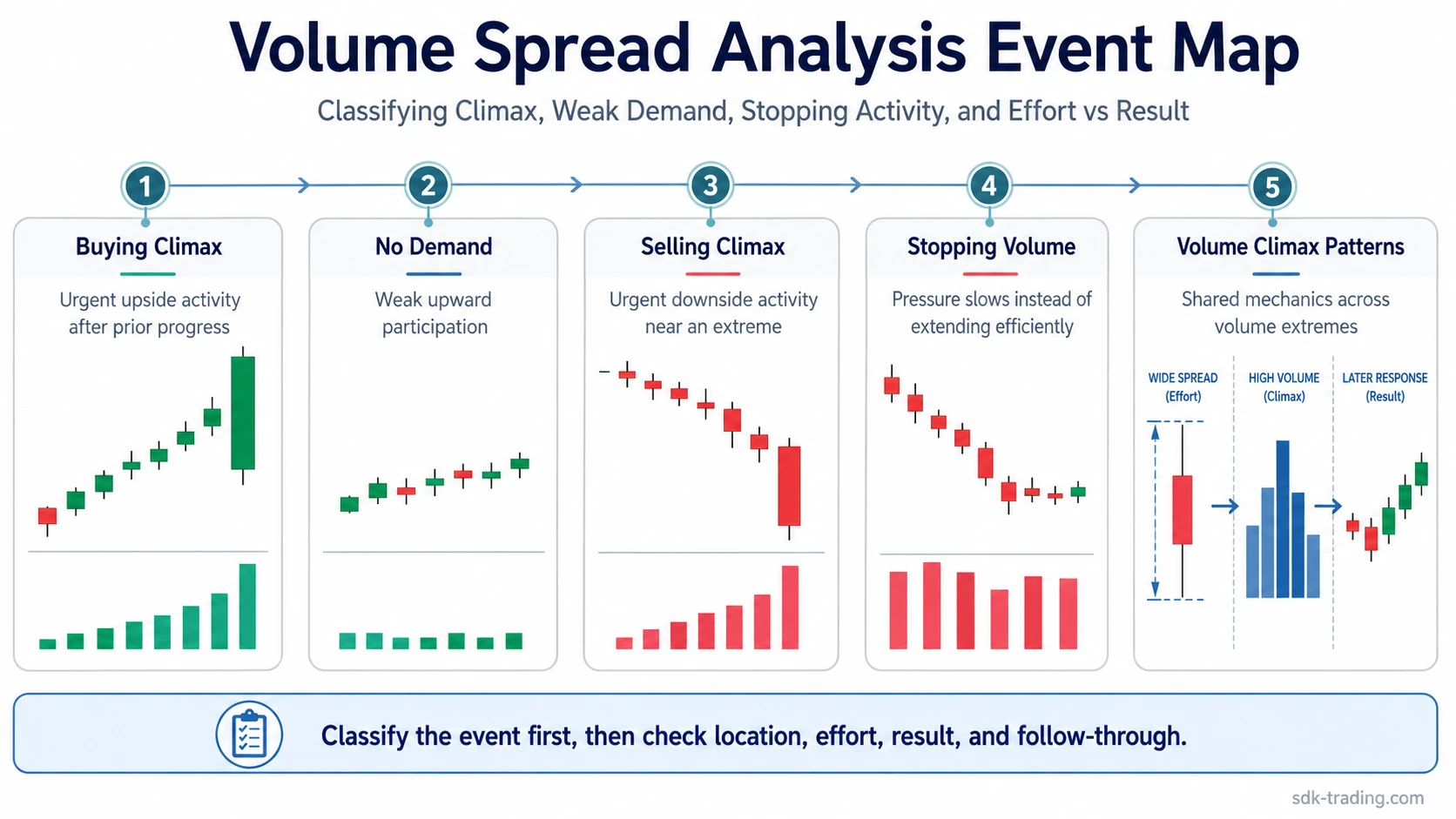
How Volume Spread Analysis Events Are Organized
Volume Spread Analysis events are easiest to separate by the behavior they describe. Some events focus on urgent activity near an extreme. Others focus on weak participation during an attempted move. Others focus on whether pressure is still producing progress.
The label is only the first layer. A cleaner reading asks what the event reveals: excessive effort, lack of demand, possible absorption, failed continuation, or pressure that no longer produces the same result.
| Event group | Core reading question | Main event type |
|---|---|---|
| Upside climactic activity | Is strong-looking upside activity becoming unstable after prior progress? | Buying climax behavior |
| Weak upward participation | Is an upward attempt failing to attract meaningful demand? | No Demand readings |
| Downside climactic activity | Is urgent selling becoming extreme rather than continuing efficiently? | Selling climax conditions |
| Pressure interruption | Is heavy activity slowing the decline instead of extending it? | Stopping volume action |
| Shared climax mechanics | What features make volume extremes useful or misleading across different event types? | Volume climax patterns |
Boundaries Between the Main VSA Event Types
VSA terms can sound similar when reduced to short definitions, but each event describes a different pressure condition. A climax reading focuses on urgent activity near an extreme. A No Demand reading focuses on weak participation during an upward attempt. Stopping Volume focuses on pressure losing downside efficiency.
The distinction matters because a high-volume event, a weak rally, and an interrupted decline should not be interpreted through the same lens. They may all involve price and volume imbalance, but the market behavior behind each one is different.
How to Move From Event Name to Market Reading
Start with the event label as classification. Then check where it appears. A wide bar with heavy volume near the edge of a range carries a different message than a similar bar in the middle of a noisy structure.
Next, compare effort with result. Heavy activity with limited progress can show that the market is meeting opposition. Low activity during a rally can show that demand is not returning with much force. The event becomes more useful when the result fits the behavior suggested by the label.
Finally, watch the next response. A VSA event that receives no follow-through should be treated differently from one that immediately changes the quality of movement. The later response helps separate a meaningful event from ordinary volume noise.
Common Ways VSA Events Get Misread
The first mistake is treating volume as automatically bullish or bearish. Volume shows participation, not direction by itself. The direction comes from the relationship between spread, close location, background, and the market response after the event.
The second mistake is using one event label without sequence. A single high-volume bar, weak rally, or failed push can matter, but the reading is stronger when several observations point to the same change in behavior.
The third mistake is forcing every bar into a named event. Some price-and-volume action is simply unclear. When the evidence does not fit cleanly, the safer reading is to leave the event unclassified until the next response gives more information.