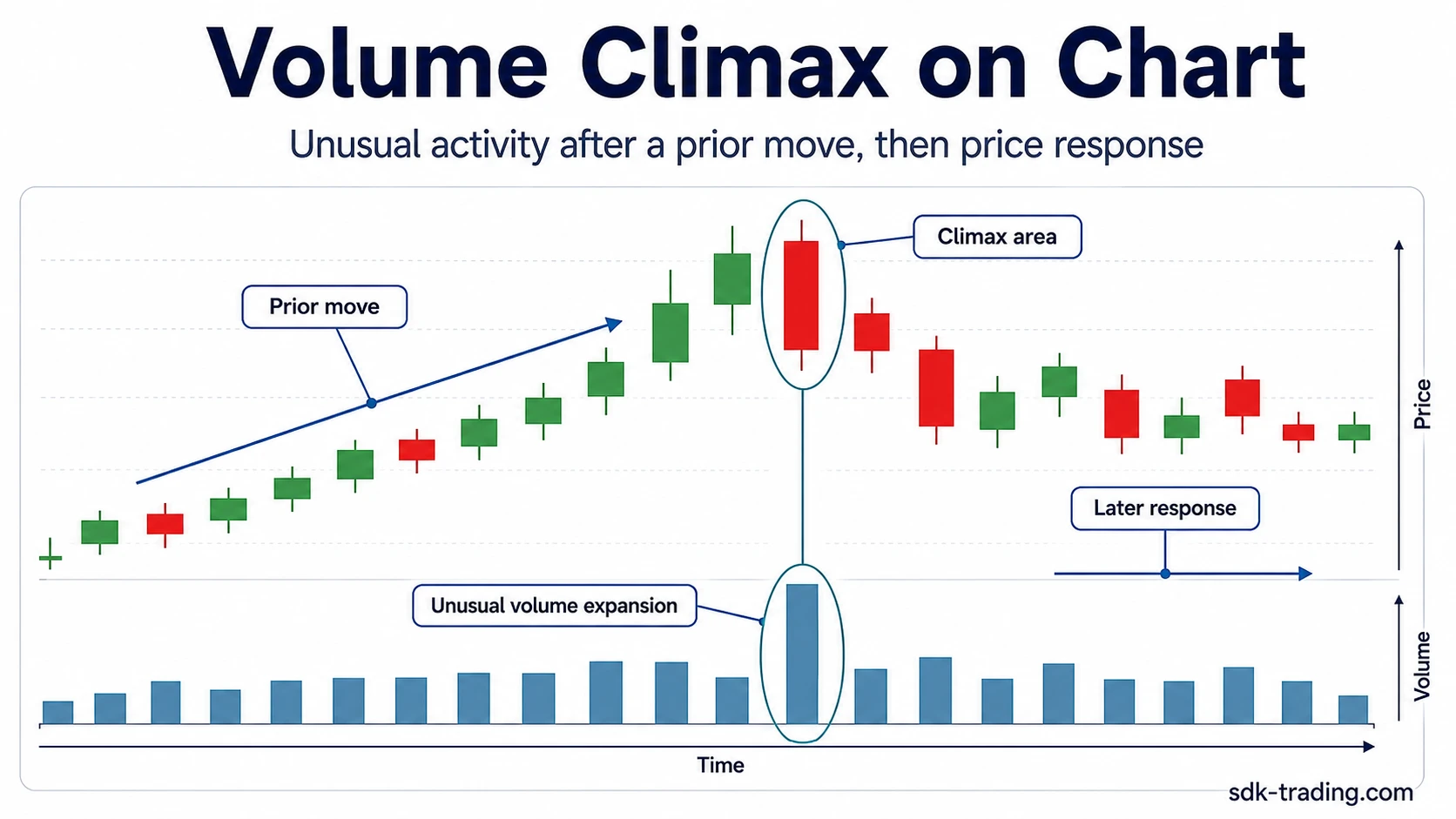
A volume climax reading starts with unusual activity, but high volume alone is only the first observation. In Volume Spread Analysis and Wyckoff-style reading, the useful question is whether the spike appears after a prior move, changes the effort-versus-result relationship, and is later accepted, absorbed, or rejected by price behavior.
Key Points
- High volume does not automatically mean reversal.
- Spread, close location, background trend, and structure change the reading.
- A volume climax reading needs a prior move, unusual activity, and a price result that separates efficient continuation from absorption or failure.
- Buying climax and selling climax are separate event readings; the narrower distinction is between a simple volume spike and a context-dependent climax reading.
When a Volume Spike Becomes a Volume Climax Reading
In the Wyckoff method and VSA, a volume climax describes a sharp expansion in activity after a prior move. The event may appear near the end of an advance, near the end of a decline, or during a forceful continuation attempt.
Working distinction: a volume spike becomes a volume climax reading only when unusual activity appears after a prior move and the price result shows whether that effort produced efficient continuation, absorption, or failure.
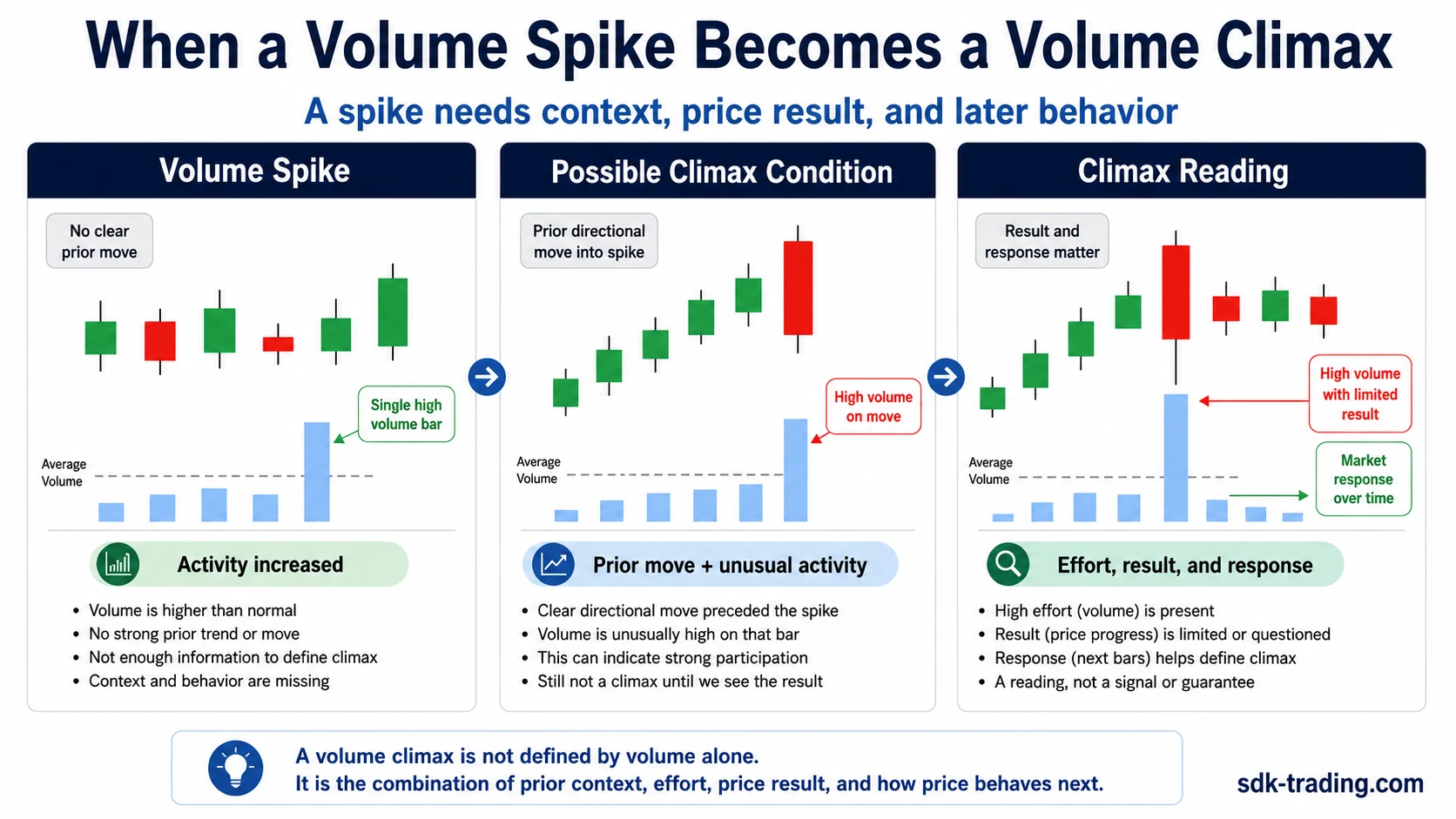
The classification should stay conservative until the spike is compared with the move into it, the spread and close it produced, and the follow-through that came after it. Without those pieces, the safer label is still high activity, not a confirmed climax reading.
Why High Volume Alone Is Not Enough
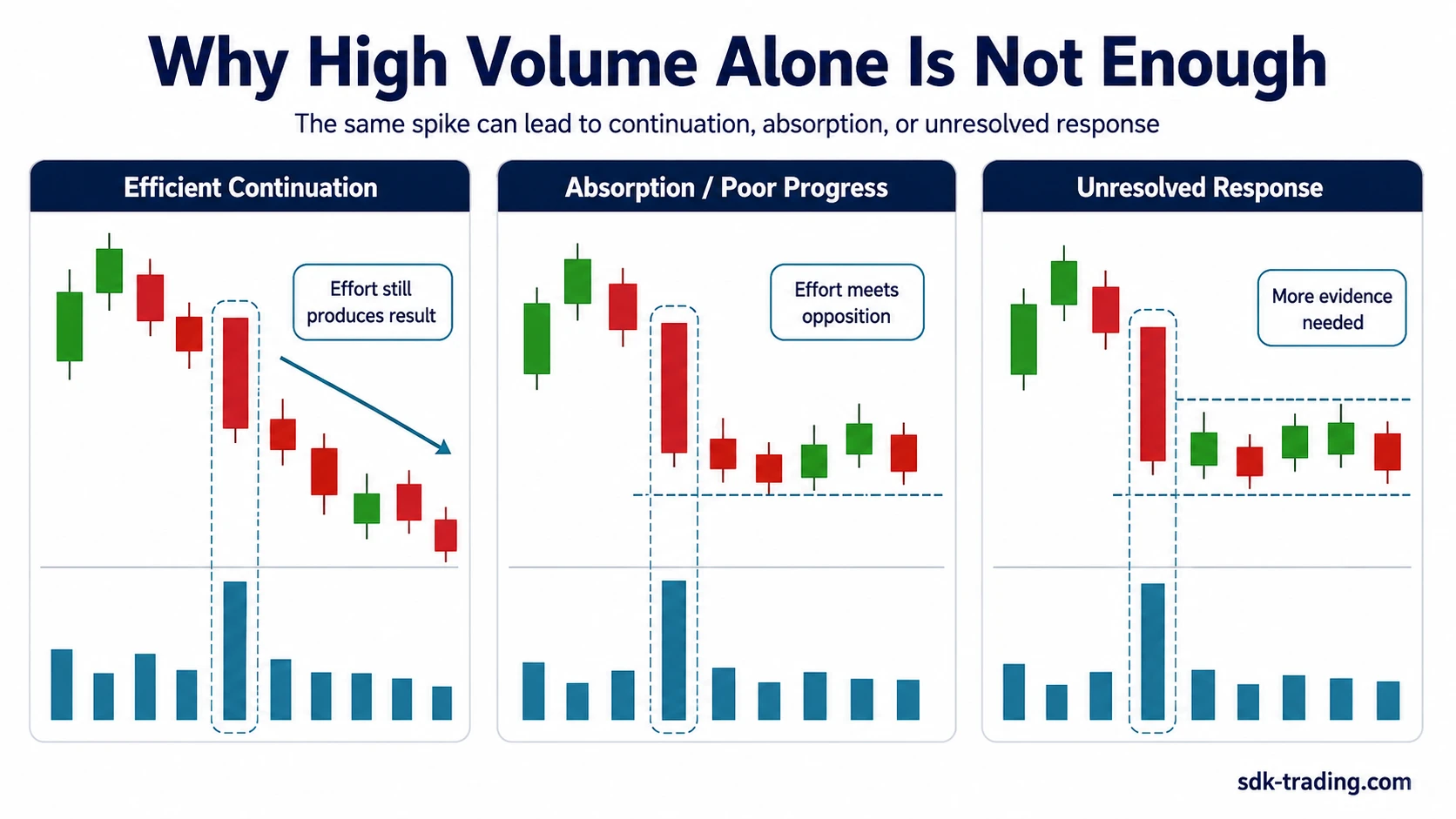
Main limitation: a volume climax can mark exhaustion, absorption, emotional participation, or continuation pressure. The label does not decide which one is happening. The later market response has to do that work.
A common mistake is to see a large volume bar and immediately assume that the move is finished. That reading is too fast because very high volume can appear during late participation, active absorption, forced activity, or still-efficient continuation.
The safer question is whether effort and result match. If volume expands and price continues efficiently, the activity may still support continuation. If volume expands but price makes limited progress, closes away from the extreme, or fails on the next test, the reading becomes more conditional.
The same discipline applies in the opposite participation problem: No Demand in VSA is not defined by low volume alone. It also needs spread, close location, background, and later response before the reading becomes useful.
How to Read Volume Climax Through Effort and Result
A VSA-style reading compares activity with the result produced by that activity. The bar itself is only the first observation. The next step is to compare the volume with spread, close location, background structure, and the bars that follow.
| Condition | Possible Interpretation | What Later Behavior Shows |
|---|---|---|
| High volume with a wide spread and close near the extreme | Strong directional effort may still be present. | Continuation supports that reading; immediate failure weakens it. |
| High volume with limited price progress | Effort may be meeting opposition or absorption. | A later test with weak follow-through can strengthen the absorption read. |
| High volume after an extended move | Late participation or exhaustion may be entering the move. | The idea remains incomplete until price fails to extend or begins to rotate. |
| High volume followed by failed continuation | The climax reading becomes more credible. | Renewed acceptance in the original direction shows that the high activity may have supported continuation rather than exhaustion. |
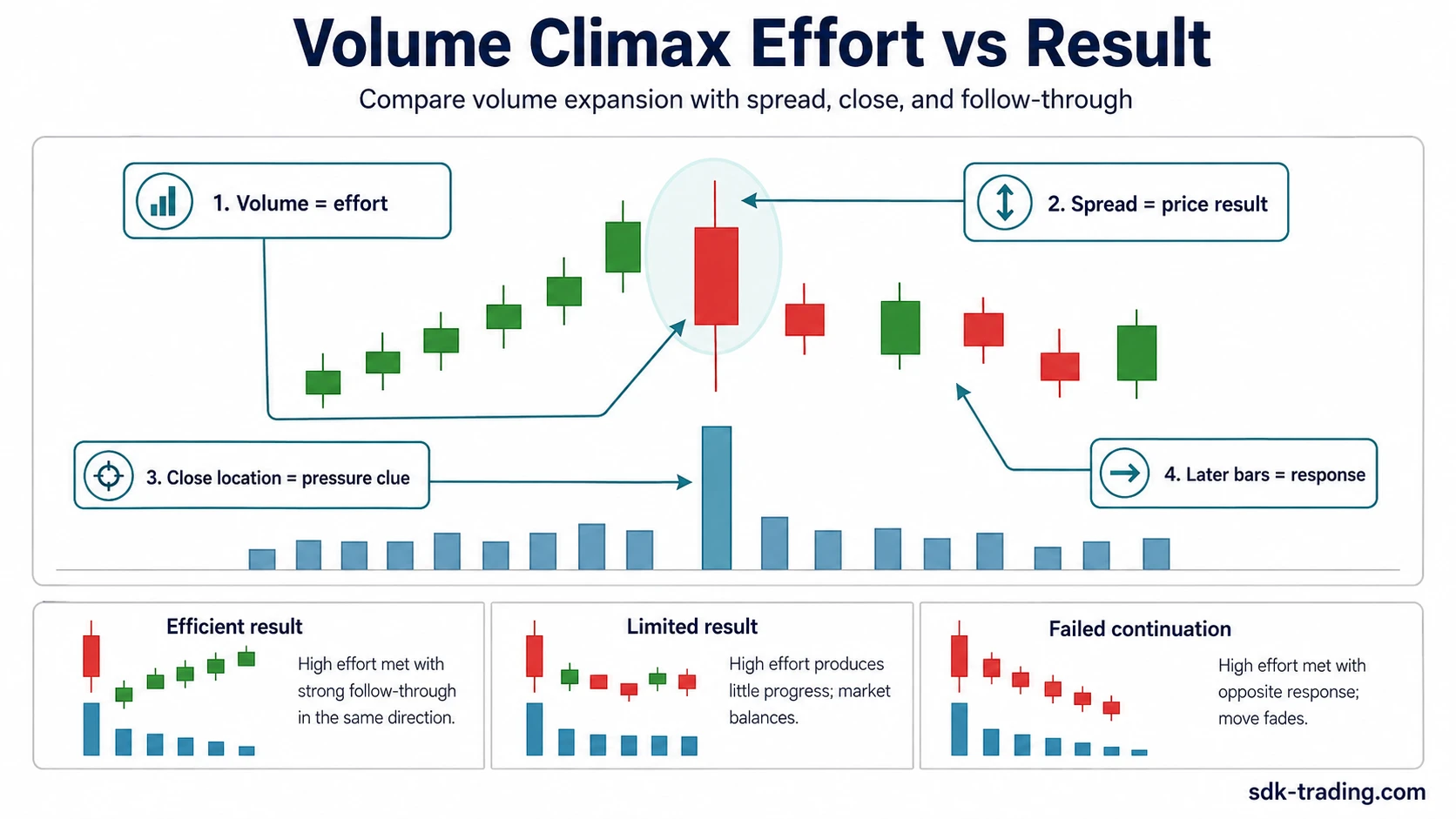
The strongest reading comes from the sequence. Context sets the expectation, the climax bar shows unusual effort, and the following bars show whether that effort was accepted, absorbed, or rejected.
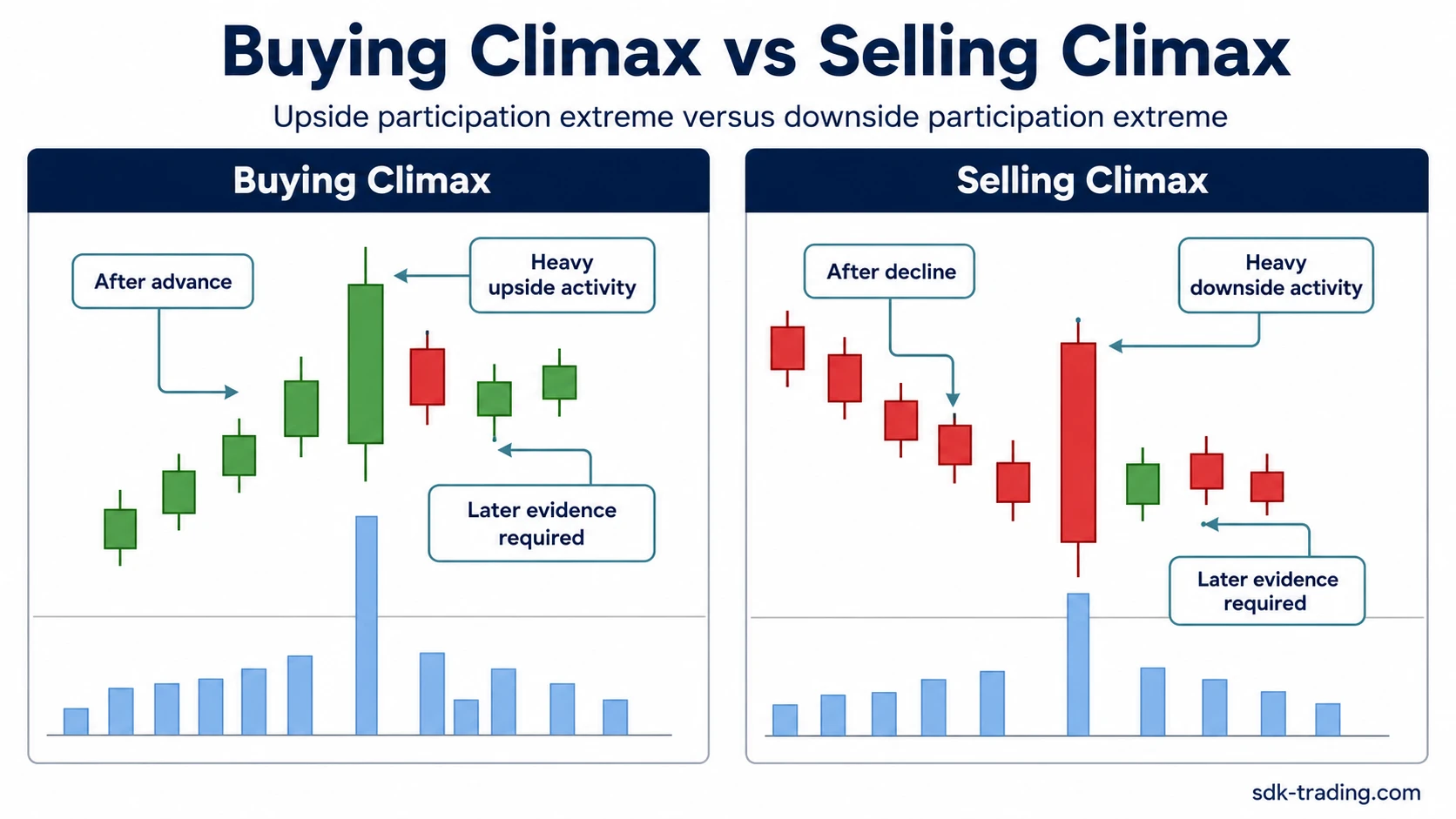
Buying Climax vs Selling Climax
A buying climax usually refers to unusually heavy upside activity after an advance, where demand may be late or where supply may begin to appear. Distribution still requires later evidence that upside progress is failing.
A selling climax usually refers to unusually heavy downside activity after a decline, where selling may be intense but downside progress may begin to slow. Accumulation still requires later evidence that downside pressure is losing efficiency.
The distinction matters because both readings are conditional. One develops after an advance, the other after a decline, but both still require spread, close location, structure, and follow-through before the interpretation becomes useful.
Volume Climax vs Ordinary Volume Spike
An ordinary volume spike only shows that activity increased compared with nearby bars. It may come from news, rebalancing, stop activity, session timing, or a sudden liquidity event. Without context, it remains a raw activity reading.
A volume climax reading is narrower. It asks whether unusually high activity appears at a point where the prior move may be reaching an important test. That makes the reading more contextual, but not more certain.
Useful distinction: a volume spike is a volume observation. A volume climax is a contextual interpretation that depends on price result, structure, and later behavior.
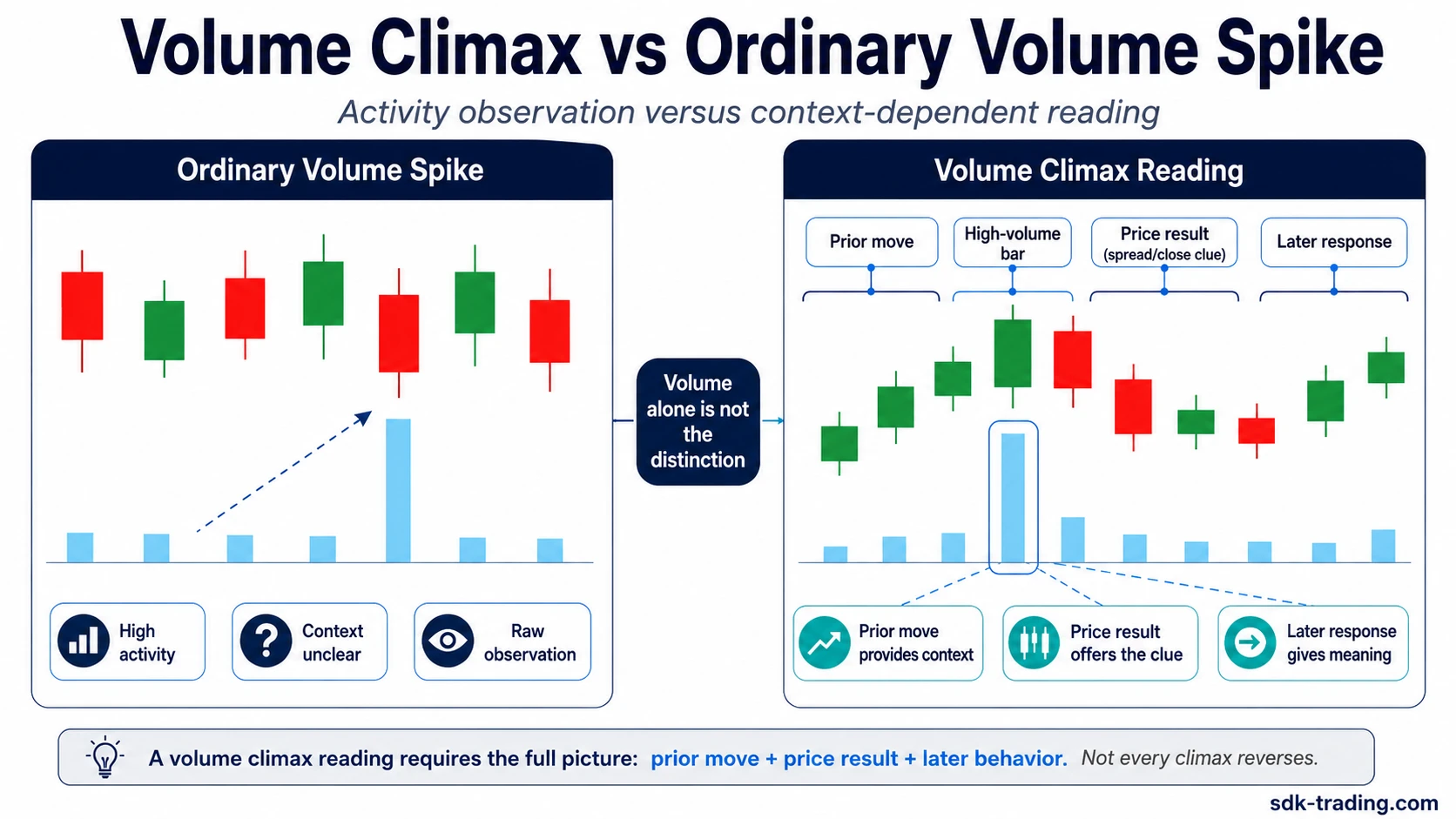
| Observation | Safer Classification | Why It Matters |
|---|---|---|
| One isolated high-volume bar | Volume spike | Activity increased, but context is not enough to classify a climax. |
| High activity after an extended move | Possible climax condition | The market may be reaching a participation extreme. |
| Heavy activity with poor progress afterward | Stronger climax reading | Effort may no longer be producing efficient result. |
Volume Climax Example in Context
Assume price has been declining for several sessions. A new downside bar appears with unusually high volume, but the spread is not as large as expected and the close finishes off the low. That observation can suggest that selling pressure met demand, but it is still not enough to call a reversal.
The next part of the sequence matters more. If a later downside test appears on weaker volume and price cannot make meaningful new progress, the absorption interpretation becomes stronger. If price instead accepts lower levels and continues with ease, the first high-volume bar was not a reliable stopping clue.
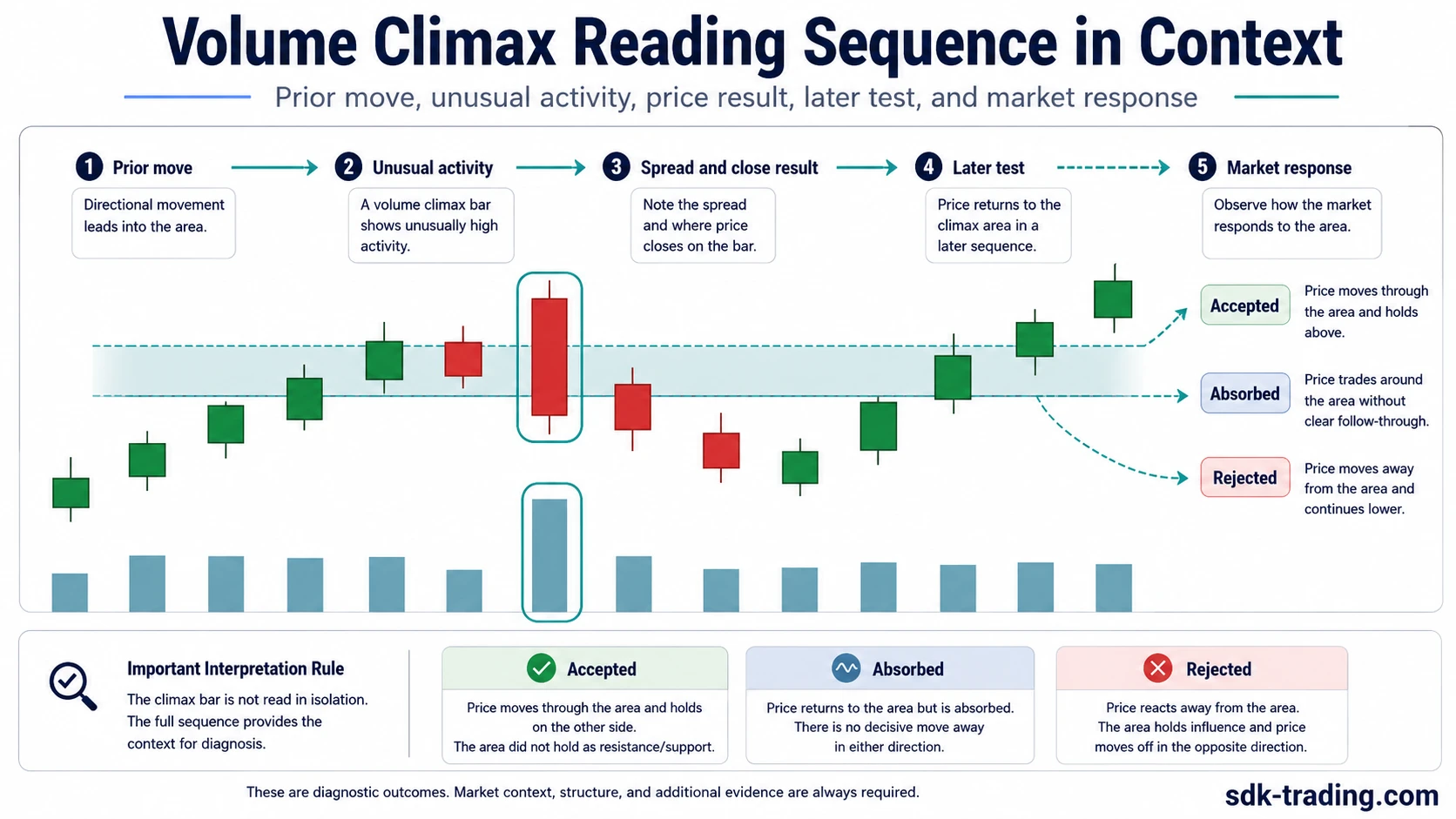
This is why the first high-volume event should stay classified as an observation until the next test gives it meaning. A climax reading becomes more useful only when the market shows whether the activity changed the balance between effort and result.
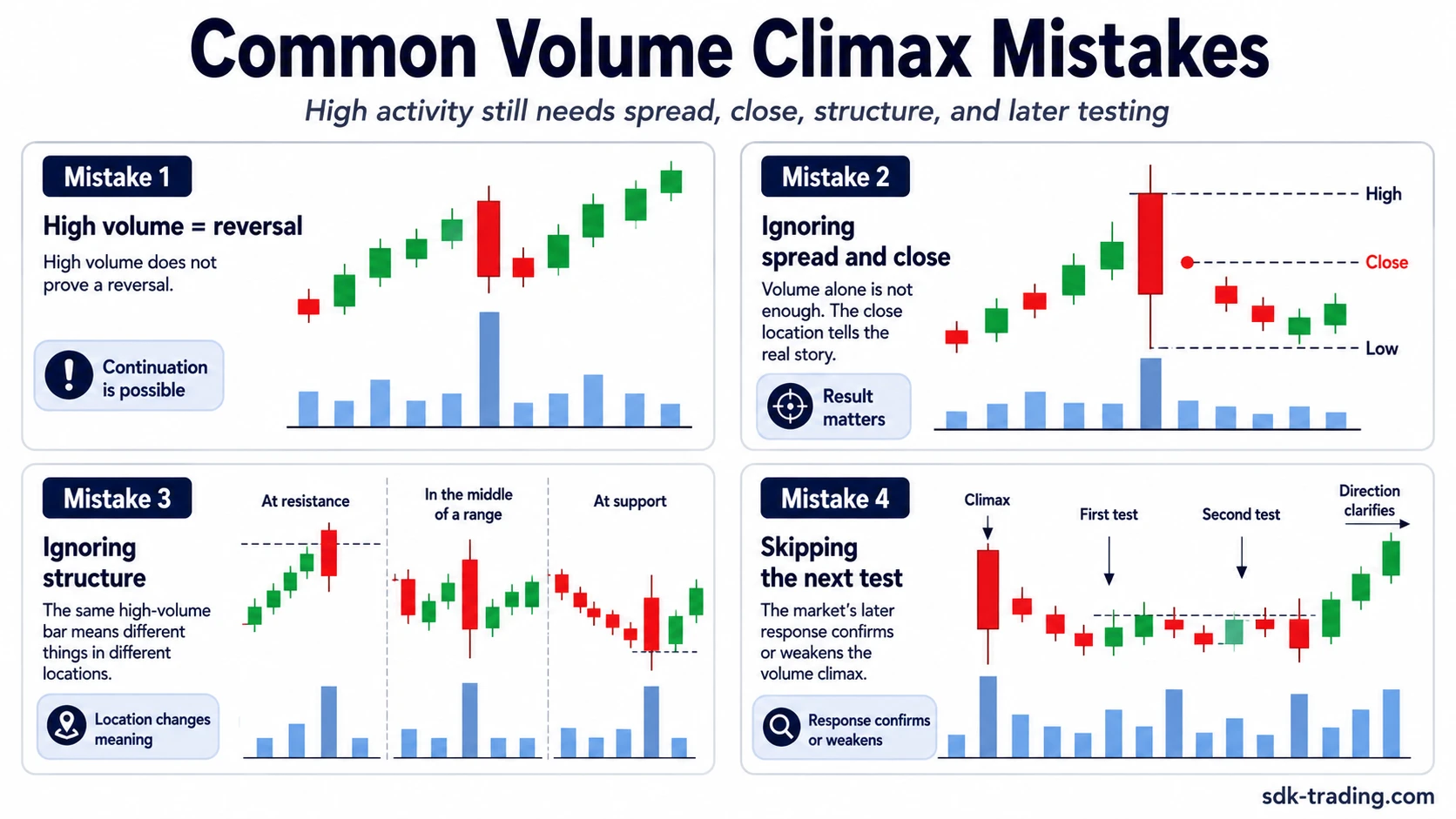
Common Mistakes
- Treating high volume as reversal proof. High activity can appear during continuation as well as exhaustion.
- Ignoring spread and close location. Volume needs to be compared with the price result it produced.
- Reading the climax outside structure. The same bar can mean different things near a range boundary, in the middle of a trend, or after a mature move.
- Skipping the next test. The first high-volume event is only an observation until the following bars show whether price can continue efficiently or begins to lose progress.
FAQ
When does a volume spike become a volume climax reading?
A volume spike becomes a volume climax reading when unusual activity appears after a prior move and the price result shows whether that effort produced efficient progress, absorption, or failure. Without that context, it is safer to call it high activity rather than a climax.
Can a volume climax reading fail?
Yes. The reading weakens if price continues efficiently in the original direction after the high-activity event. In that case, the volume may have supported continuation rather than exhaustion or absorption.
What is the difference between a volume climax and a volume spike?
A volume spike only says that activity increased. A volume climax reading adds context: where the spike appeared, what price did with that effort, and whether later behavior showed acceptance, absorption, rejection, or efficient continuation.
What makes a volume climax reading stronger in VSA?
The reading becomes stronger when unusually high volume appears after a prior move and price then struggles to make efficient progress. A later weak test, failed continuation, or rotation around the high-activity area can make the climax interpretation more defensible.