A buying climax is a late-stage upside event where unusually heavy buying appears after an advance and later price action tests whether that demand is still effective or being absorbed by supply.
In Volume Spread Analysis and Wyckoff analysis, the label is not assigned from high volume alone. The prior advance, spread, close location, and later acceptance or failure decide how much weight the reading deserves.
Definition: A buying climax is a VSA and Wyckoff event where expanded upside activity appears late in a move, creating an exhaustion or absorption question that must be tested by later behavior.
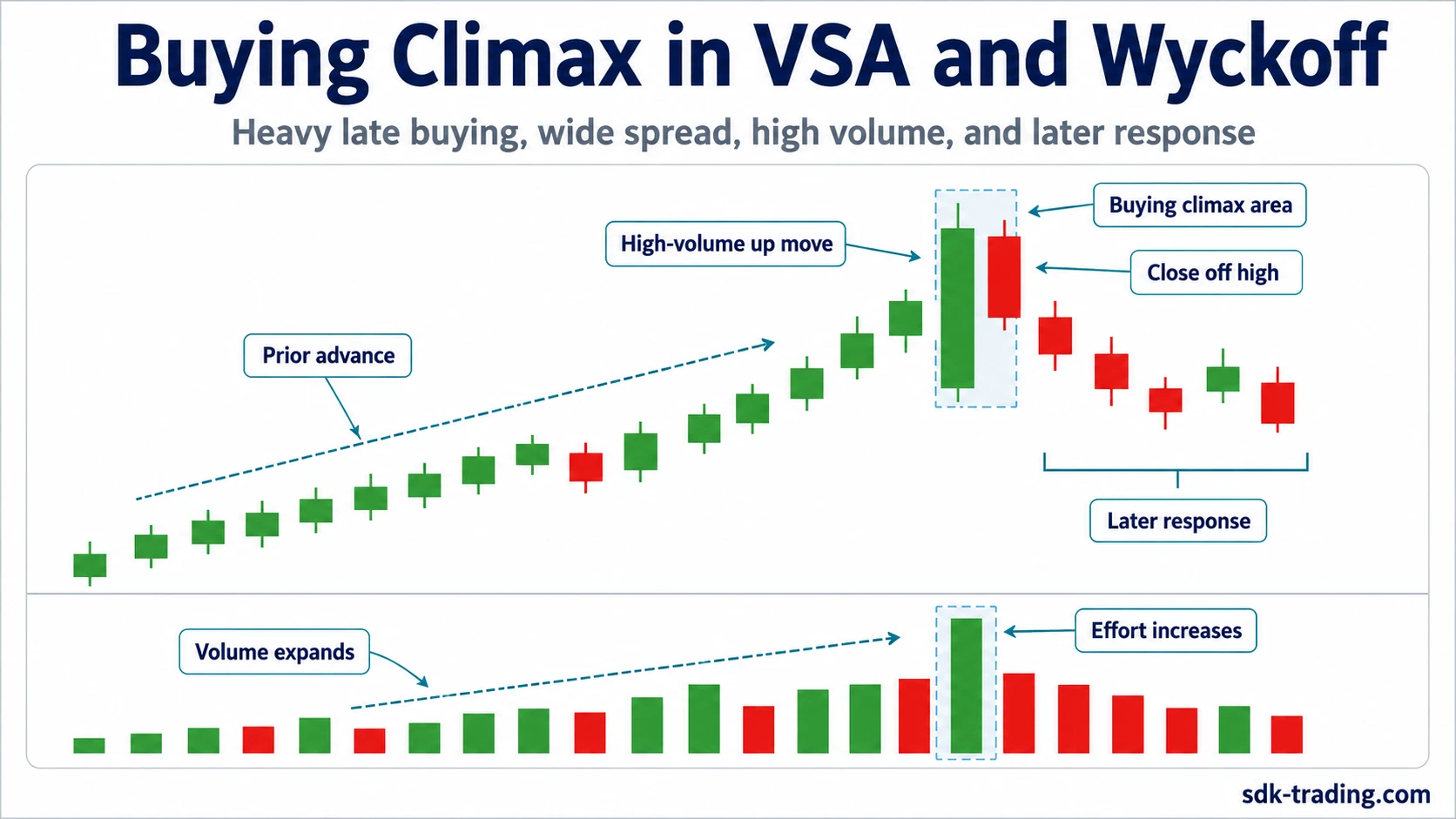
Key Points About a Buying Climax
- A buying climax usually appears after an existing advance, not at a random point in a chart.
- High volume shows increased participation, but it does not automatically prove strength.
- The spread, close location, and next bars help separate continuation from possible exhaustion.
- A failed continuation attempt after the high-volume up move can make the climax reading stronger.
- The reading weakens if price accepts above the climax area and later pullbacks remain controlled.
What Is a Buying Climax?
The word “buying” is the part that often creates confusion. A buying climax records intense demand, but the diagnostic issue is whether that demand still moves price efficiently after an already mature advance.
That is why a buying climax can become a warning rather than a strength label. It does not mean buyers disappear immediately; it means late participation must prove itself through acceptance above the climax area.
For the opposite-side VSA participation extreme, compare the structure with selling climax.
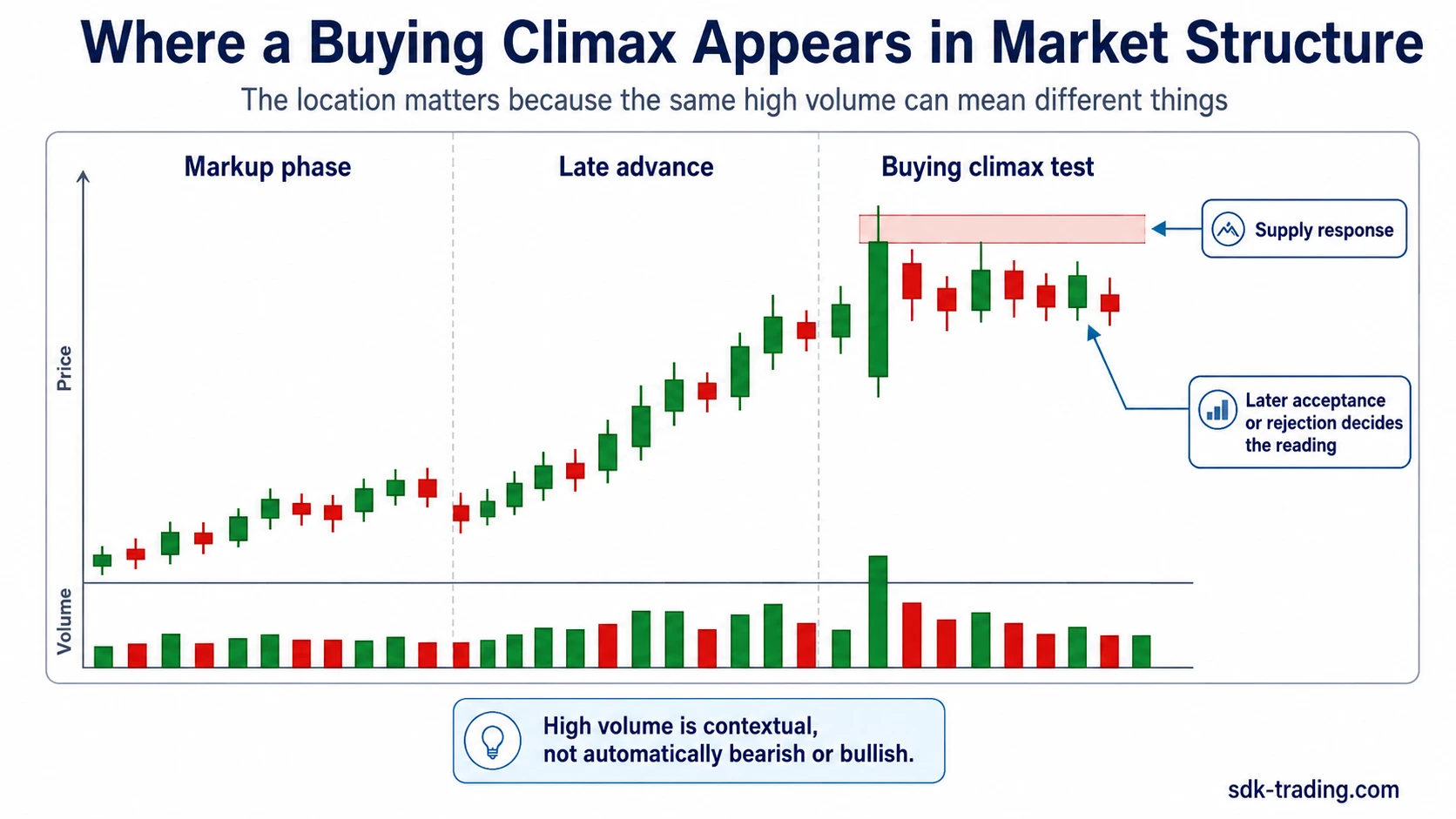
Where a Buying Climax Appears in Market Structure
A buying climax is most relevant after a sustained markup, a fast advance, or a late-stage push where price has already attracted attention. It often belongs to a broader distribution context, but the buying climax itself should not be treated as proof that distribution is complete.
The structural test is effort versus progress. If price needs much more activity to make less useful upside progress, the move may be losing efficiency. If price accepts higher levels after the event, the same heavy activity can reflect effective demand instead of exhaustion.
This is why a buying climax is different from an ordinary strong up bar. A strong up bar can show demand in control when it appears from the right background and continuation follows. A buying climax becomes more suspect when large activity appears late, progress becomes inefficient, and later tests fail to support the bullish reading.
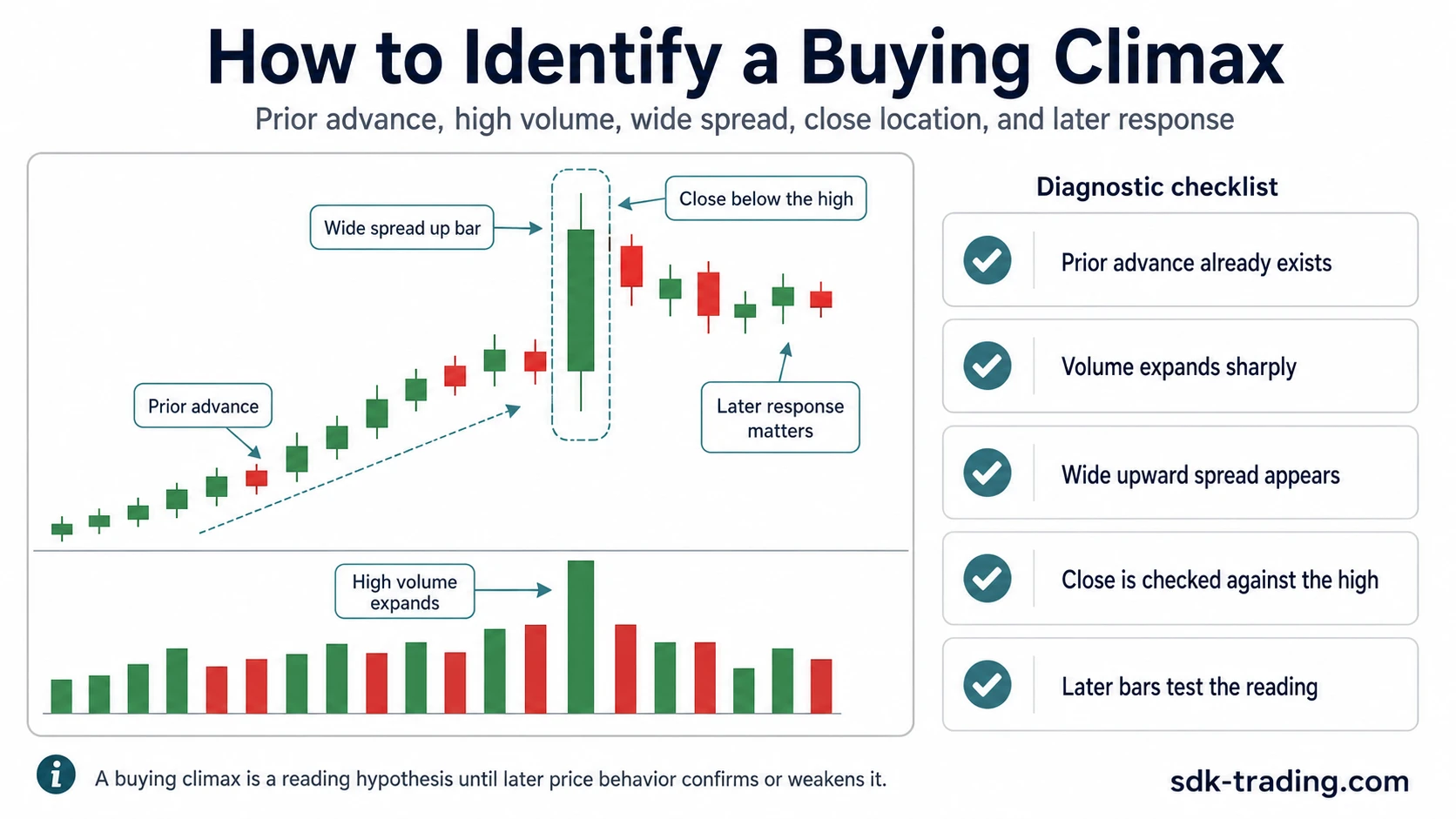
How to Identify a Buying Climax
Identification should work like a checklist, not like a one-candle label. The cleaner cases combine these conditions:
- Price has already advanced before the event appears.
- Volume expands sharply compared with recent activity.
- The bar or candle often has a wide spread, showing strong participation.
- The close may finish below the high, suggesting that supply appeared into the advance.
- Later bars fail to hold or extend the move with the same efficiency.
Together, these signs create a buying climax hypothesis. They do not confirm a reversal by themselves.
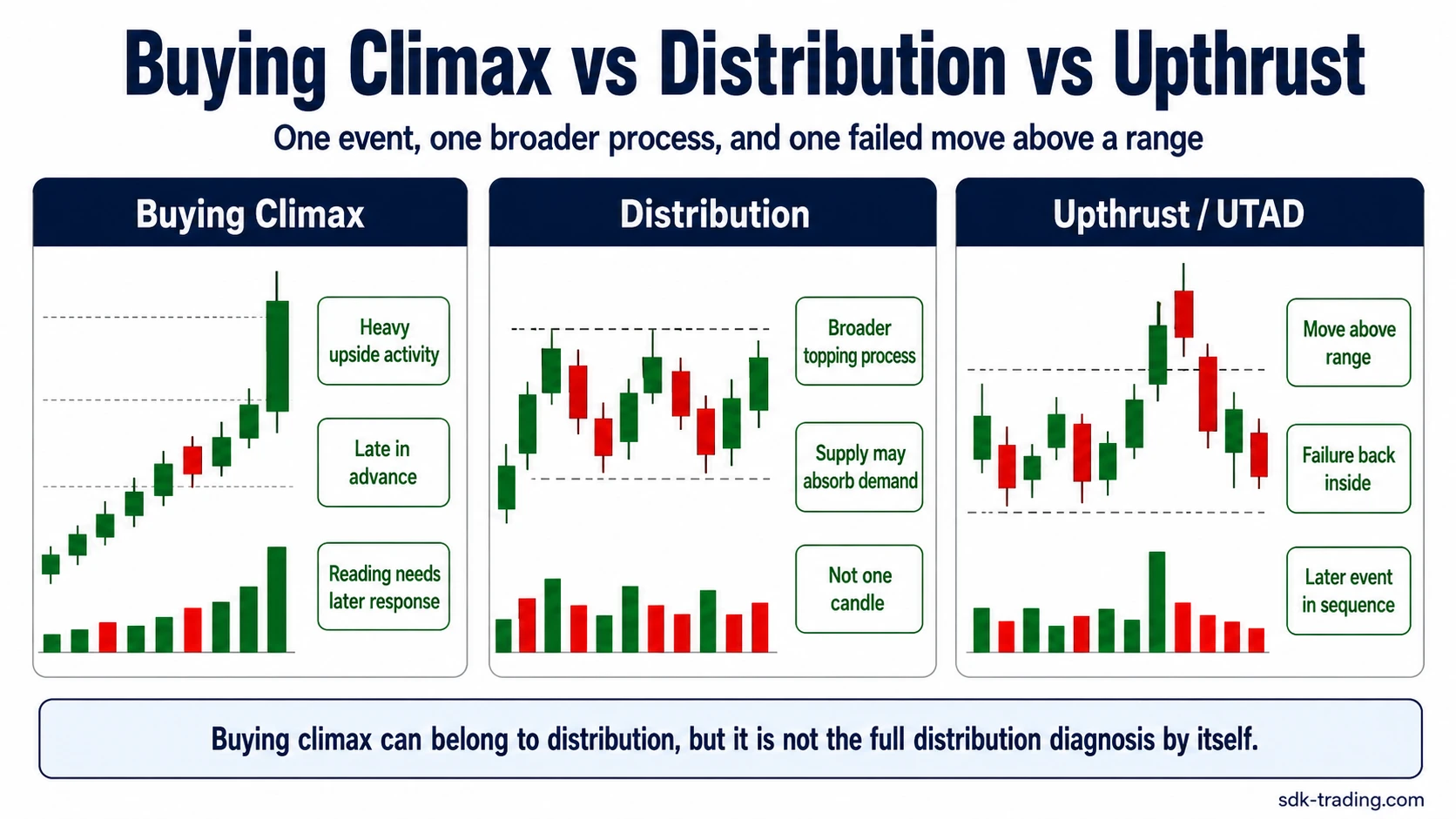
Buying Climax, Distribution, and Upthrust
A buying climax is one event inside a possible late-stage advance. Distribution is a broader market process, while an upthrust or UTAD describes a later failure above a range or resistance area. A buying climax can appear before or inside distribution, but it should not be treated as the full distribution diagnosis.
| Concept | Main role | What it does not prove alone |
|---|---|---|
| Buying climax | Heavy upside activity after an advance | A finished reversal |
| Distribution | Broader process where supply may overcome demand | That every high-volume up move is bearish |
| Upthrust / UTAD | Failure after price moves above a range or resistance area | That the first high-volume bar was enough by itself |
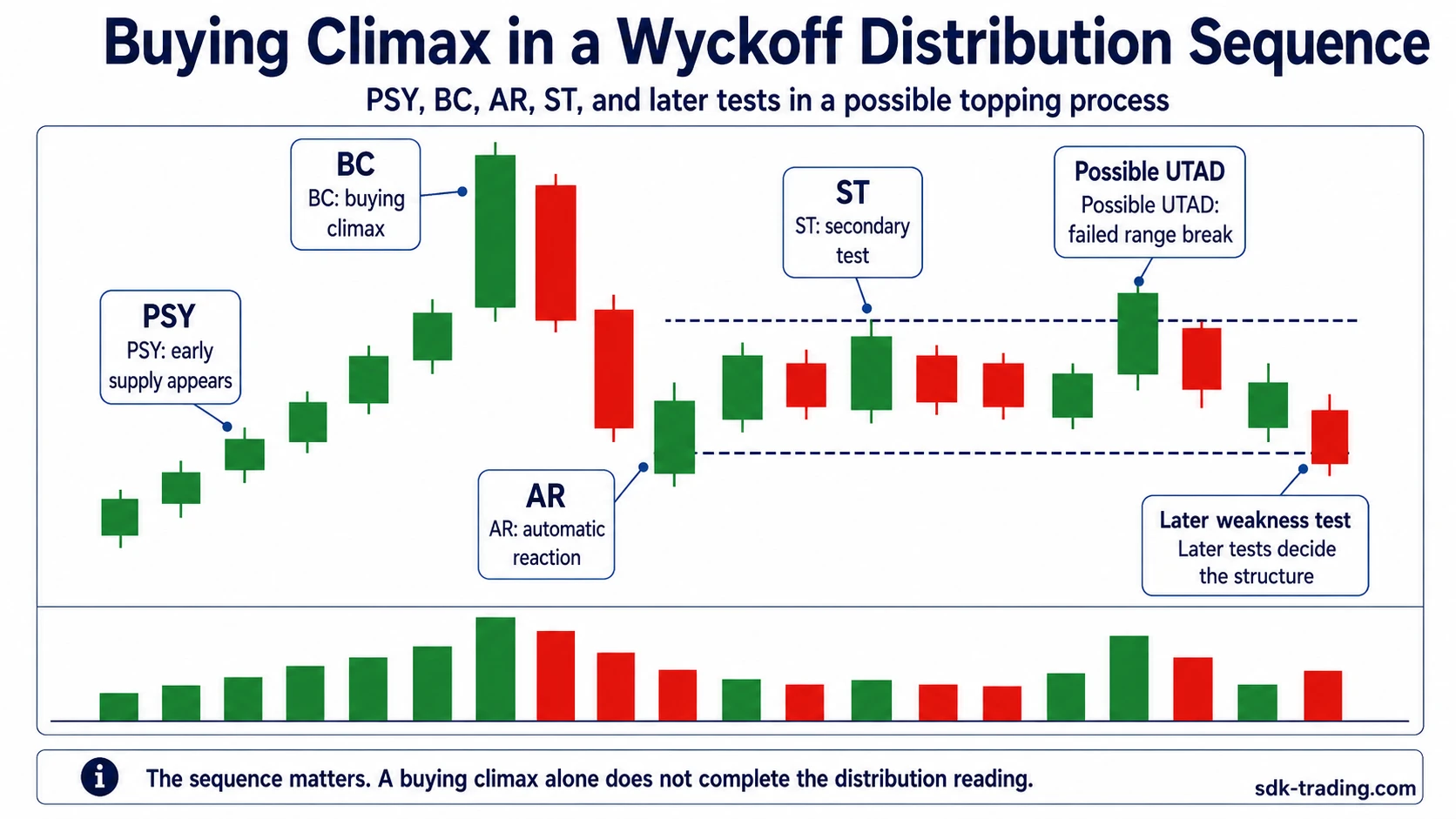
Buying Climax in a Wyckoff Distribution Sequence
In a Wyckoff distribution context, a buying climax often appears in the early part of a topping process after an advance. It may follow preliminary supply and may be followed by an automatic reaction and a later secondary test. This sequence matters because the buying climax alone does not complete the distribution structure.
| Wyckoff event | Typical role | Why it matters |
|---|---|---|
| Preliminary supply (PSY) | Early evidence that supply may be entering the advance | Warns that the prior markup may be maturing |
| Buying climax (BC) | Heavy upside activity after the advance | Tests whether late demand is being absorbed |
| Automatic reaction (AR) | Initial downside response after the climax area | Shows that supply may have become more active |
| Secondary test (ST) | Retest of the climax area or nearby high | Helps test whether demand is weakening |
| Sign of weakness (SOW) | Downside failure after the range develops | Can strengthen the broader distribution read |
The sequence should still be read conditionally. A buying climax can start a distribution hypothesis, but the later automatic reaction, secondary test, and acceptance or failure behavior decide whether that hypothesis gains weight.
Volume, Spread, and Close: What Traders Observe
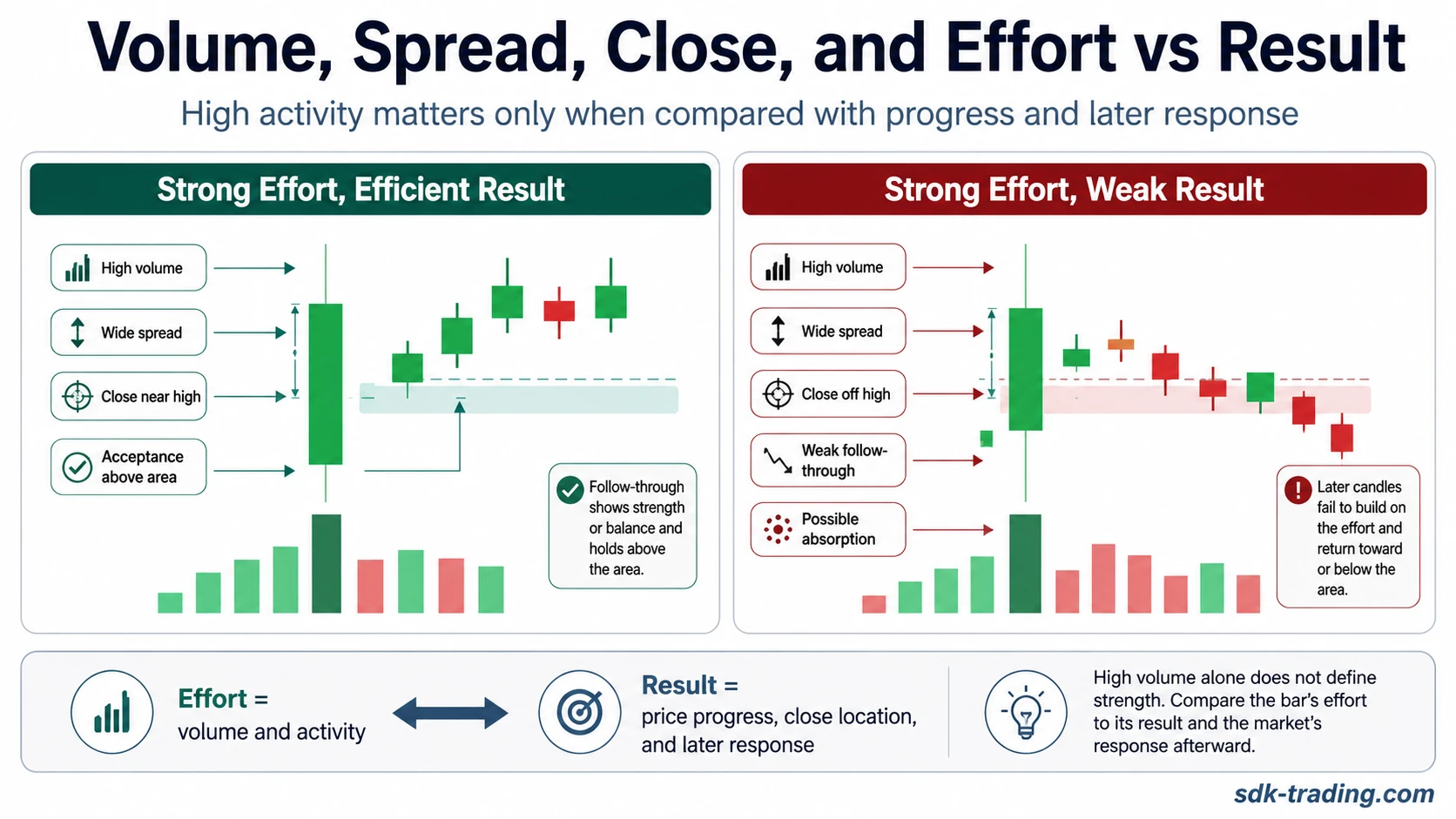
The core reading is built from observable evidence, not from a label attached to one candle. Volume shows activity, spread shows price response, and the close shows where price finished relative to the bar’s range. Later behavior then tests whether the first interpretation had weight.
Volume readings also depend on the data source being used. A buying climax interpretation is weaker if the volume feed does not reflect the market being analyzed or if the trader treats all volume data as equivalent.
| Observation | Possible interpretation | What it does not prove |
|---|---|---|
| Volume expands sharply after an advance | Participation has increased and late buying may be entering the move | It does not show whether that demand remains effective |
| Wide spread up bar | Price moved aggressively, but progress quality still needs context | It does not prove demand remains dominant |
| Close well off the high | Supply may have appeared into the buying surge | It does not complete a distribution read |
| Reduced progress after heavy effort | Effort may be producing weaker result than earlier in the advance | It does not confirm reversal without later behavior |
| Failed continuation after the climax area | The buying climax interpretation becomes more defensible | It still needs structure, context, and follow-through |
Is a Buying Climax a Candlestick Pattern?
A buying climax can appear on a candle or bar chart, but it is not a candlestick pattern in the usual single-candle sense. The candle may show a wide spread, high volume, and a close below the high, yet the label depends on market context and later behavior.
Some traders loosely call it a buying climax pattern. The safer reading is that the pattern is the full sequence: prior advance, high activity, result quality, and later market response. Without that sequence, the candle is only a high-activity up bar.
Effort vs Result in a Buying Climax
Effort versus result is one of the cleanest ways to read a buying climax. The effort is the activity: high volume, expanded participation, and a visible push higher. The result is the actual progress: how far price advances, where it closes, and whether it can hold or extend the move afterward.
A possible buying climax becomes more credible when effort increases sharply but the result begins to weaken. For example, price may push to a new high on exceptional volume, close below the high, and fail to attract clean continuation. That does not guarantee a reversal. It shows that the market may be losing upside efficiency.
The same logic connects with heavy activity that appears near a potential stopping area, where context is still needed before the event can be interpreted safely.
Buying Climax vs Selling Climax
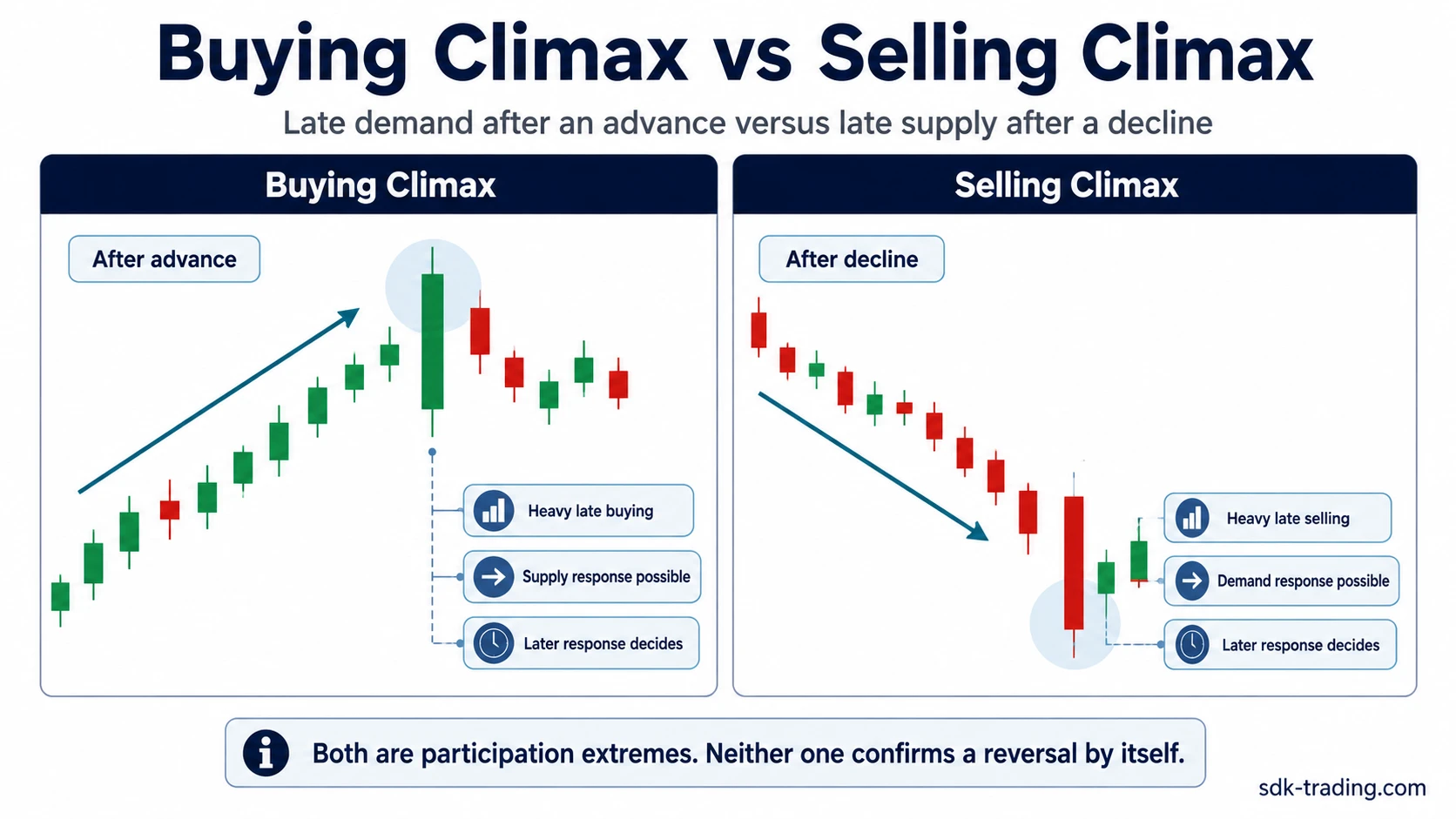
A buying climax and a selling climax both describe extreme participation, but they occur in opposite market conditions. A buying climax appears after an advance and tests whether late demand is being absorbed. A selling climax appears after a decline and tests whether heavy selling is being absorbed or exhausted.
| Event | Typical context | Main question |
|---|---|---|
| Buying climax | After an advance | Is late buying being met by supply? |
| Selling climax | After a decline | Is heavy selling being absorbed? |
This distinction matters because the same visible feature, unusually high volume, can mean different things depending on prior direction and later response.
Common Misreadings
The most common mistake is treating high volume during an up move as automatic strength. High volume only says that activity expanded. It does not explain whether stronger hands were buying aggressively, selling into demand, or absorbing late participation.
A second mistake is reading the candle shape without the background. A large up candle after a base can have a different meaning from a large up candle after a long advance. The buying climax label becomes weaker when the prior trend, nearby resistance, range behavior, and later tests are ignored.
A third mistake is treating the event as a mechanical reversal call. A buying climax can precede a reversal, a range, a distribution process, or a temporary pause before continuation. The market has to show whether demand fails, supply appears, or acceptance above the climax area continues.
Buying Climax Example: When the Reading Strengthens or Weakens
Consider a generic advance where price has already been rising for several sessions or swings. Near the end of that advance, price pushes higher on noticeably expanded volume. The spread is wide, but the close finishes below the high.
The buying-climax interpretation strengthens if the next tests cannot hold above the climax area or if later upside attempts produce weaker progress despite strong activity. In that case, the observation shifts from high participation toward possible absorption.
The interpretation weakens if price accepts above the area, holds higher levels, and later pullbacks show controlled supply. In that case, the high-volume move may have represented effective demand rather than late-stage exhaustion.
Volume climax patterns help separate unusually high participation across different contexts, while a buying climax is specifically tied to late-stage upside activity after an advance.
FAQ
What is a buying climax?
A buying climax is a late-stage upside event where unusually heavy buying activity appears after an advance and later price behavior tests whether that demand was effective or absorbed by supply.
Does high volume on an up move always mean a buying climax?
No. High volume only shows increased activity. A buying climax reading depends on the prior advance, the spread, the close, and the market’s later response.
Is a buying climax the same as a high-volume up bar?
No. A high-volume up bar can be part of a buying climax, but the reading also needs prior advance, effort versus result, close location, and later confirmation or invalidation.
Where does a buying climax appear in Wyckoff distribution?
A buying climax often appears after an advance and may belong to the early part of a Wyckoff distribution structure. It can be followed by an automatic reaction and a later secondary test, but it does not prove that distribution is complete by itself.
Can a buying climax fail?
Yes. The reading weakens if price accepts above the climax area and later behavior shows that demand remains effective.
What is the difference between a buying climax and a selling climax?
A buying climax appears after an advance and questions whether late demand is being absorbed. A selling climax appears after a decline and questions whether heavy selling is being absorbed or exhausted.
How to Read a Buying Climax Safely
A buying climax is most useful when it separates late demand from effective demand. Heavy upside activity after an advance creates the question, but acceptance, failed continuation, secondary tests, and the broader Wyckoff or VSA background decide how much weight the reading deserves.