Stopping volume is not simply any high-volume candle. In VSA, it describes heavy activity after prior movement, usually after a decline, when price fails to make the downside progress that the volume would normally imply. The reading becomes useful only when spread, close location, and later behavior show that the prior pressure may be losing efficiency.
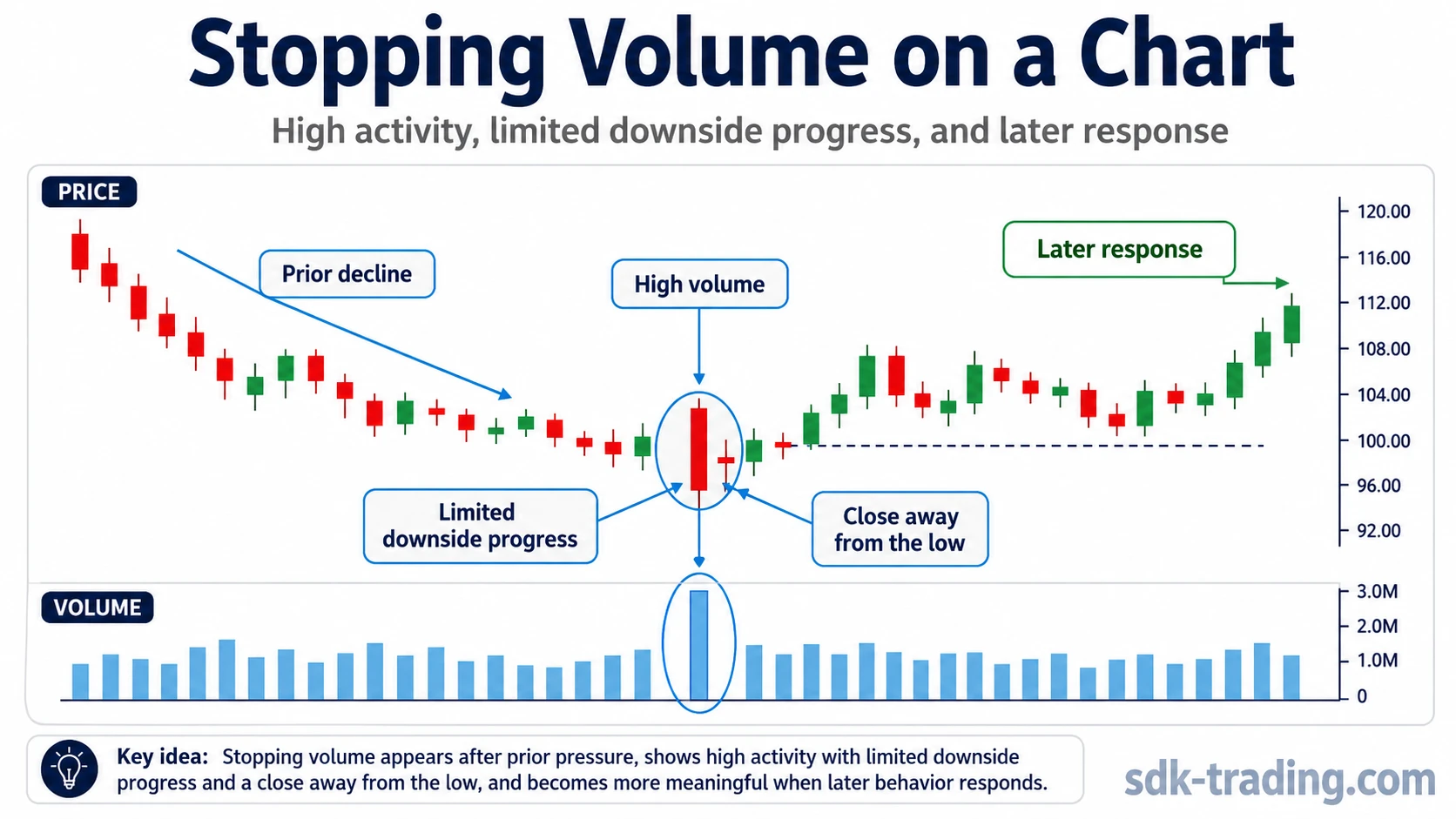
What Is Stopping Volume?
Stopping volume is a Volume Spread Analysis reading where unusually high volume appears after existing pressure, but price progress begins to slow instead of extending cleanly in the same direction.
In the common downside version, the market has already been falling. Volume expands, but the bar does not extend lower as easily as before, or it closes away from the low. That creates the central VSA question: did the heavy effort produce the expected result?
The event may point to absorption, temporary balance, or early evidence that selling pressure is becoming less efficient. It can also fail if later bars regain downside momentum, so the first bar starts the interpretation rather than completing it.
Key Points
- Stopping volume begins with high activity, but high volume alone is not enough.
- The reading needs prior pressure, usually a developed decline or directional move.
- Limited progress, narrower spread, or a close away from the low can suggest absorption.
- Confirmation comes from later bars, not from the first high-volume event alone.
What Stopping Volume Shows
Stopping volume points to a change in the relationship between effort and result. If a market is falling and volume expands sharply, strong downside continuation would normally be expected. When that continuation becomes limited, the bar shows a conflict between selling pressure and opposing demand.
The close location matters. A close near the low keeps the reading weaker because sellers still controlled most of the bar. A close away from the low does not prove a reversal, but it can show that demand appeared before the bar finished. A narrow spread on very high volume can also suggest that activity was absorbed instead of fully converted into directional progress.
The same effort-versus-result logic can appear after other directional moves, but in VSA the term is most often used around heavy activity after a decline. The event matters only when high participation produces limited progress and later behavior confirms that downside pressure has weakened.
How to Read Stopping Volume in Context
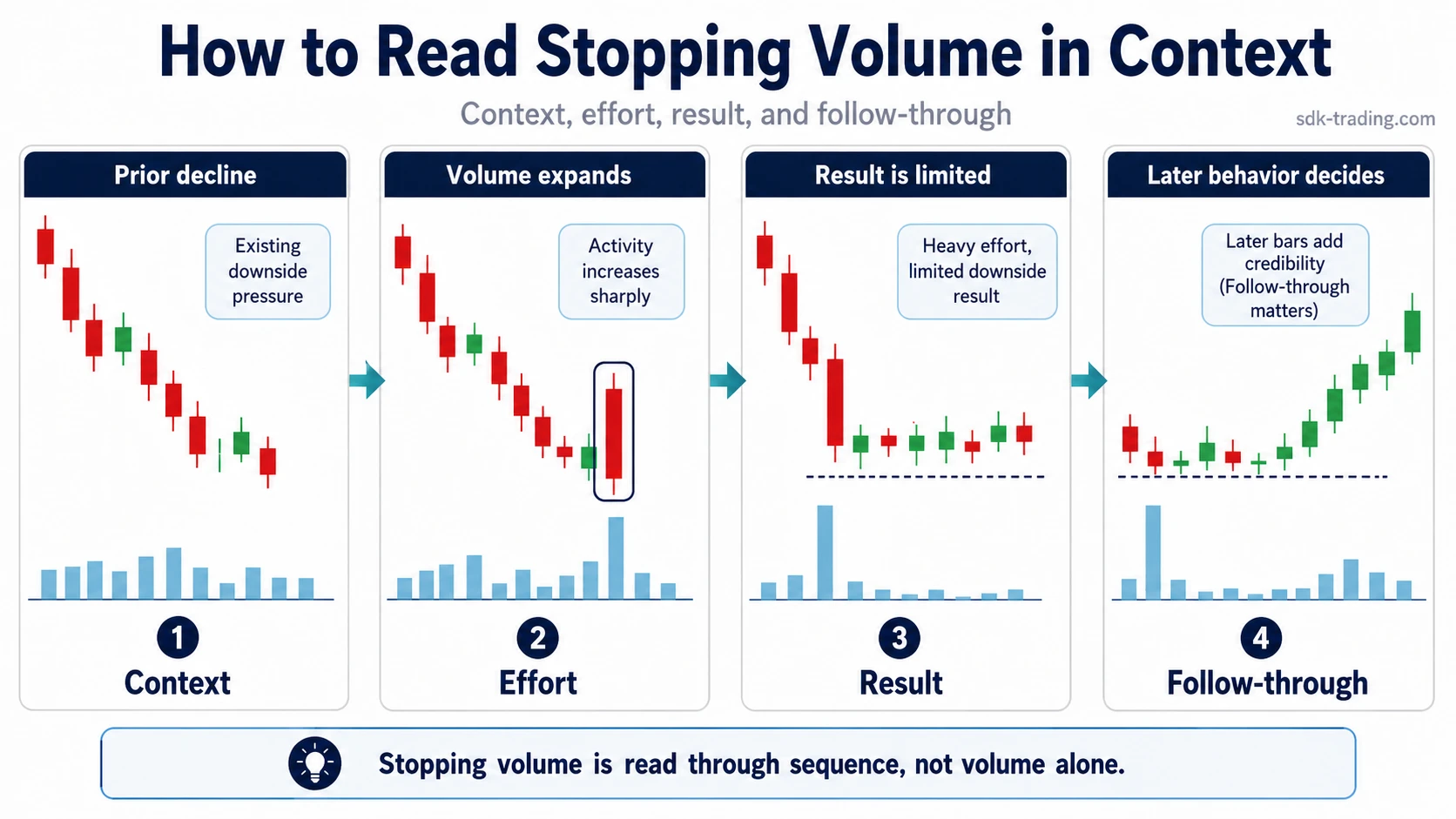
A stopping-volume reading should be built from a sequence of observations. The first bar creates a question. The following behavior decides whether the interpretation was useful.
| Observation | Possible Read | Confirmation Needed |
|---|---|---|
| Prior decline or existing directional pressure | The market already has a pressure background to evaluate | Later behavior must show whether that pressure is weakening |
| Volume expands sharply | Participation and urgency have increased | High volume must be compared with spread, close, and follow-through |
| Downside progress becomes limited | Supply may be meeting demand or absorption | The next bars should not immediately continue lower with strength |
| Close lifts away from the low | Demand may have appeared before the bar completed | A later test, response, or failure of sellers is still required |
| Next bars hold, test, or respond upward | The stopping-volume idea becomes more credible | The reading remains conditional, not a standalone trade instruction |
Common Misunderstanding
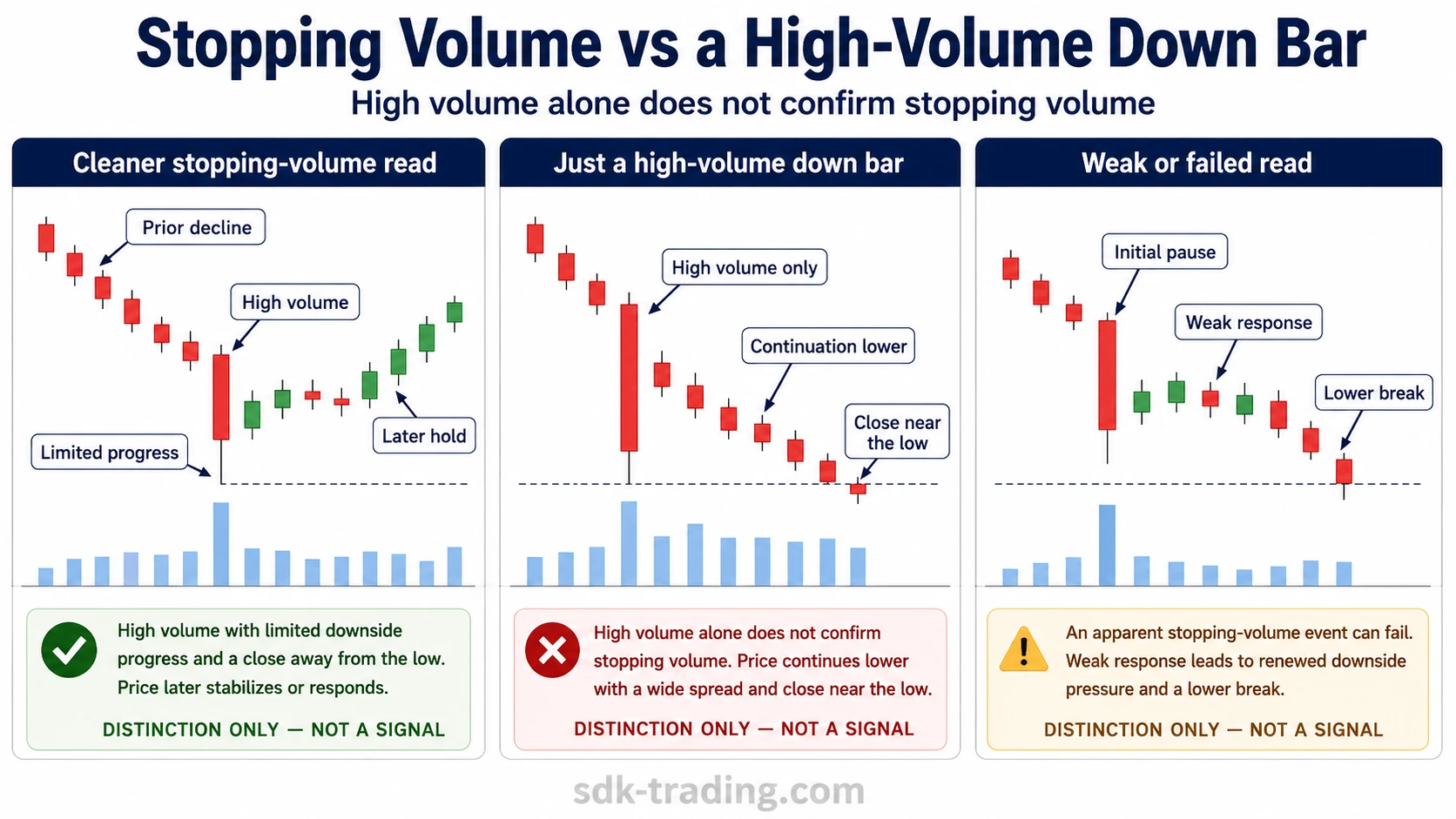
High volume is an observation, not confirmation. A high-volume down bar can show selling pressure, forced liquidation, absorption, or a temporary fight between supply and demand. It becomes stopping volume only when context and later behavior support the idea that the prior move is slowing.
The common mistake is treating the first high-volume event as a reversal signal. That skips the part of the reading that matters most: whether the market can absorb supply, stop making downside progress, and produce a more defensible response afterward. Without that follow-through, the high-volume bar may simply be another part of the decline.
Stopping Volume vs Selling Climax and Buying Climax
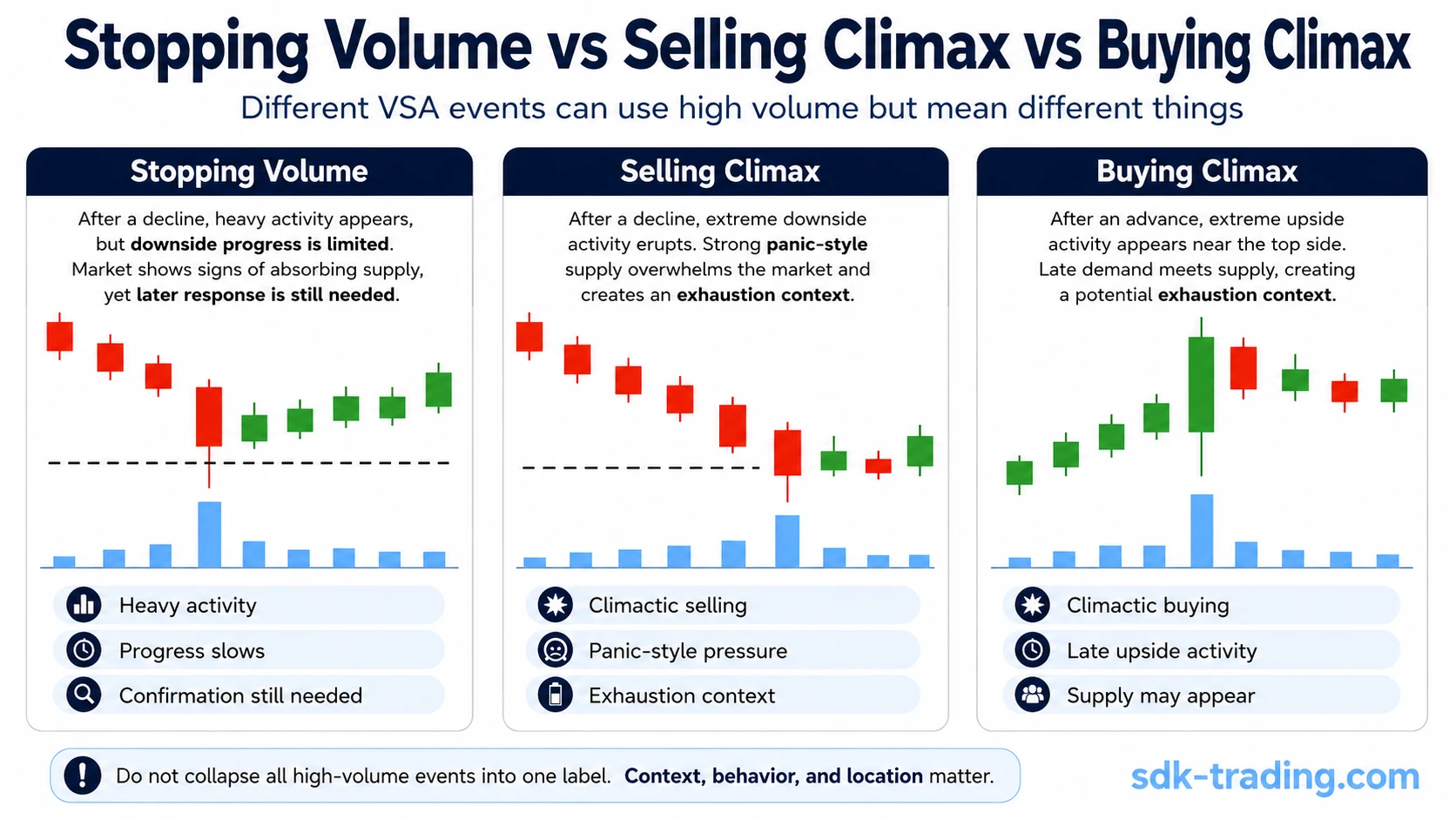
Stopping volume overlaps with other VSA events, but it should not replace them. The clean boundary is that stopping volume focuses on heavy activity slowing or interrupting prior movement. A selling climax is a more specific downside exhaustion event with stronger climactic and panic-style supply logic. A buying climax is the upside counterpart, where late demand and possible supply absorption appear after an advance.
The broader family of extreme-volume behavior belongs under volume climax patterns explained, but stopping volume should stay narrower: it is mainly about effort failing to produce clean continuation after prior pressure.
| Concept | Main Focus | What Not to Assume |
|---|---|---|
| Stopping volume | High activity slows or interrupts prior movement | Do not assume reversal from the first bar |
| Selling climax | Climactic downside pressure and possible exhaustion | Do not treat every high-volume down bar as a climax |
| Buying climax | Climactic upside activity after an advance | Do not assume immediate bearish reversal without confirmation |
| Volume climax | Broader family of extreme-volume events | Do not collapse all high-volume events into one meaning |
Example: What the First Bar Does and Does Not Prove
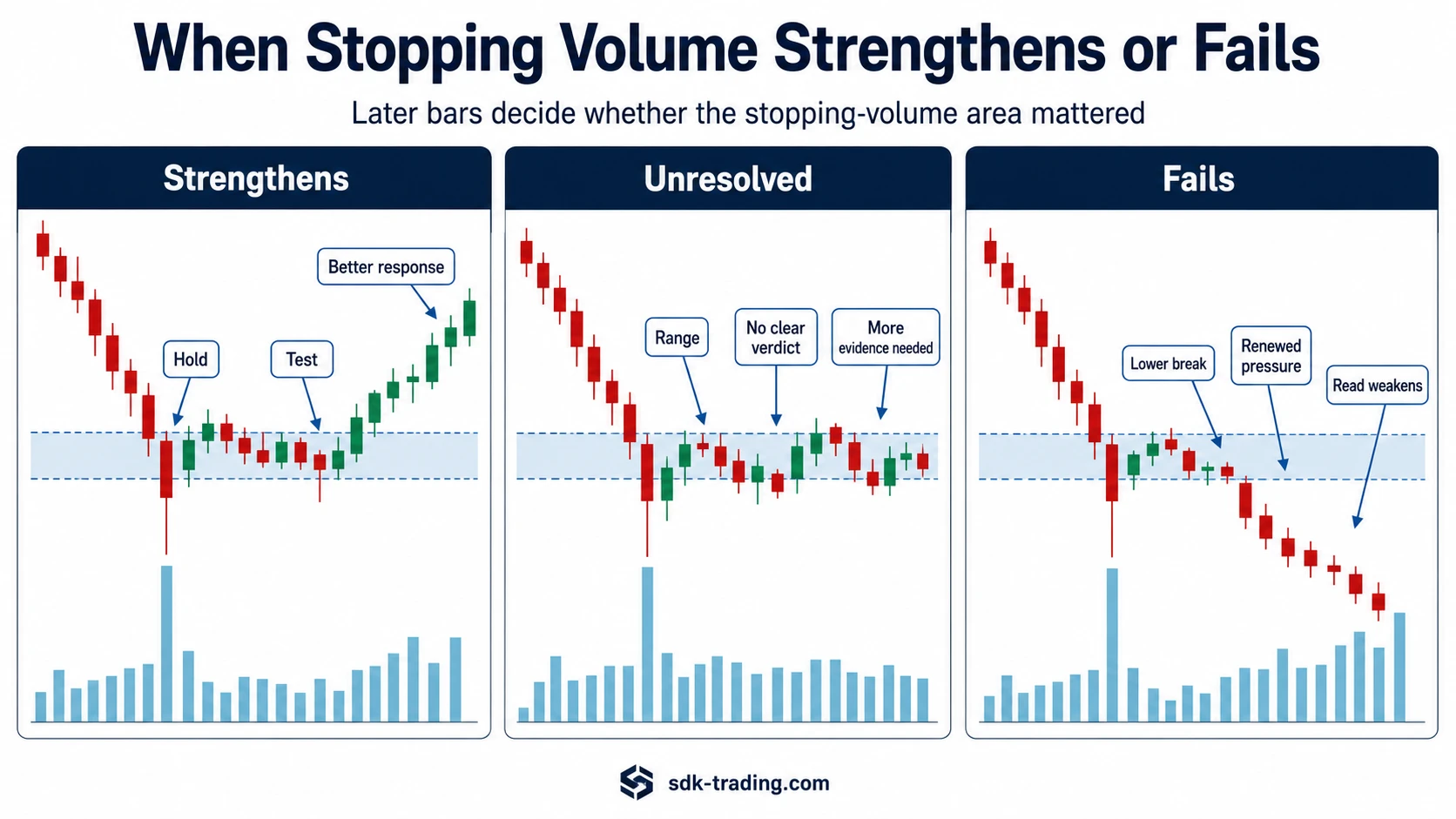
A market declines for several sessions. On one bar, volume expands sharply, but the downside range is smaller than expected and the close lifts away from the low. That does not prove that the decline is over. It only shows that heavy selling did not produce clean downside continuation on that bar.
The reading becomes more credible if the next bars hold above the low, test lower with less supply, or respond with stronger demand. It weakens if price breaks lower again with wide spread and continued pressure.
The useful distinction is simple: the first bar shows a possible change in effort versus result; the following bars decide whether that change mattered.
When the Stopping-Volume Read Strengthens or Fails
The cleaner stopping-volume case appears when heavy activity interrupts pressure rather than extends it. The important clue is not high volume by itself, but the limited result that follows: weaker downside progress, a less effective retest, or a response that shows selling pressure is no longer moving price efficiently.
The reading fails when the market continues lower with wide spread, closes near the lows, or shows lack of demand after a weak rally attempt. In that case, the high-volume area did not absorb enough pressure to change the structure.
This keeps the concept inside its proper role. Stopping volume helps describe a possible interruption in pressure. It does not provide entry, exit, target, or stop-loss instructions.
FAQ
What makes stopping volume different from ordinary high volume?
Stopping volume requires heavy activity with limited directional progress after prior pressure. Ordinary high volume may simply show continuation, news-driven activity, or volatility without evidence that progress is being restrained.
Does high volume always mean stopping volume?
No. High volume is only one observation. Stopping volume also requires context, limited progress, close location, and later behavior that shows whether the prior pressure was actually absorbed.
Where does stopping volume usually appear?
It often appears after an existing decline, when volume expands but downside progress becomes limited. The same effort-versus-result logic can apply in other contexts, but the common VSA use is downside pressure slowing.
When does a stopping-volume reading become stronger?
Confirmation may come from reduced supply, a failed attempt to continue lower, a successful test, or a stronger demand response after the high-volume event.