- Candle names are labels, not signals.
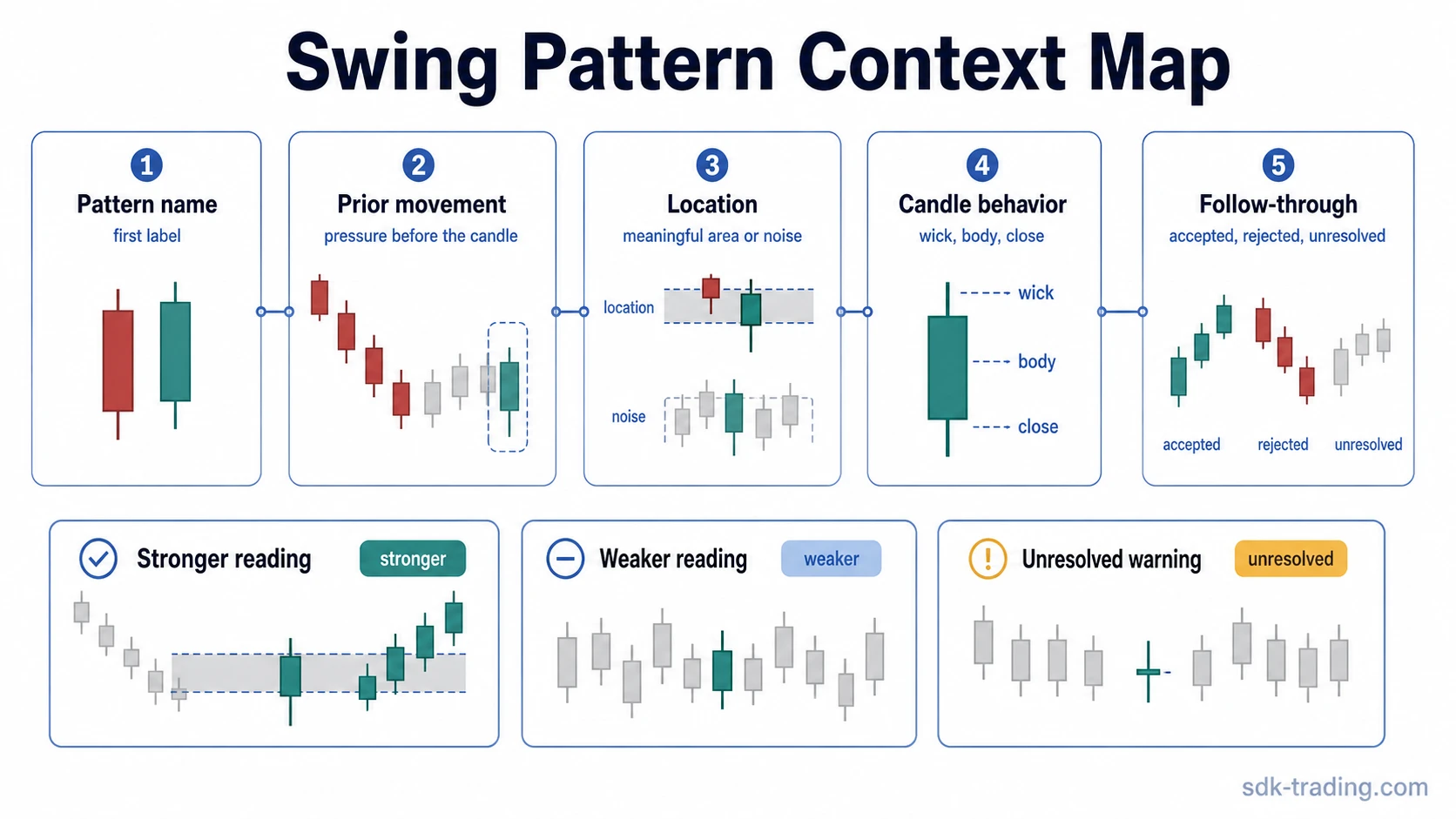
- Swing context comes from prior movement, location, and follow-through.
- Reversal-shaped candles can become continuation pauses.
- Strong candles can fail if price does not accept beyond the relevant area.
- Pattern study works best when it starts with market situation, not memorized names.
What candlestick patterns mean on swing-trading timeframes
Swing trading usually compresses several lower-timeframe attempts into one candle or a short candle sequence. A daily candle may include an early push, a failed continuation, a late recovery, and a close that changes the read. That compression gives the candle more context than a single intraday print, but it does not make the candle automatically stronger.
The useful question is not whether a pattern has a bullish or bearish name. The useful question is where the candle appears in the swing. A candle after several declining sessions near a prior reaction area says something different from the same candle in the middle of overlapping price action. One has clearer prior pressure and location. The other may remain noise until later candles show acceptance or rejection.
Best-use map for swing traders
The most useful candlestick patterns for swing trading are the ones that match the current swing situation. A reversal attempt, a pause, a breakout candle, and an unresolved warning should not be read the same way.
| Swing situation | Useful pattern type | Stronger when | Weaker when | Pattern to study next |
|---|---|---|---|---|
| Extended move into a reaction area | Hammer, pin bar, rejection-style candle | Later candles reject the tested area | Price accepts beyond the wick | Hammer-style rejection patterns |
| Pause inside an existing swing | Doji, small-body pause, marubozu continuation | The range holds and the swing resumes | The pause expands into a reversal attempt | Strong-body continuation candles |
| Strong continuation or acceptance | Marubozu, kicker, gap continuation | The close holds beyond the prior area | The move immediately fails back into the prior range | Sharp response candles |
| Unresolved balance | Doji and other indecision candles | Follow-through clarifies direction | Candles keep overlapping without acceptance | Indecision candle behavior |
Reversal attempts after extended movement
A reversal attempt has more meaning after an extended move than after a short, messy fluctuation. The prior movement matters because it shows whether price has already traveled far enough for exhaustion risk, loss of directional pressure, or failed continuation to become plausible.
A long lower wick after several declining sessions can suggest that lower prices were tested and rejected. That reading remains incomplete if later candles do not respect the rejected area. A long-wick rejection candle becomes more useful when the next response confirms that the wick area was not accepted.
The same shape in the middle of a choppy range is weaker. The candle may look dramatic, but without prior pressure and a meaningful location, the wick can simply mark temporary imbalance. Swing traders can misread that situation by naming the candle before the surrounding structure has changed.
Continuation pauses inside an existing swing
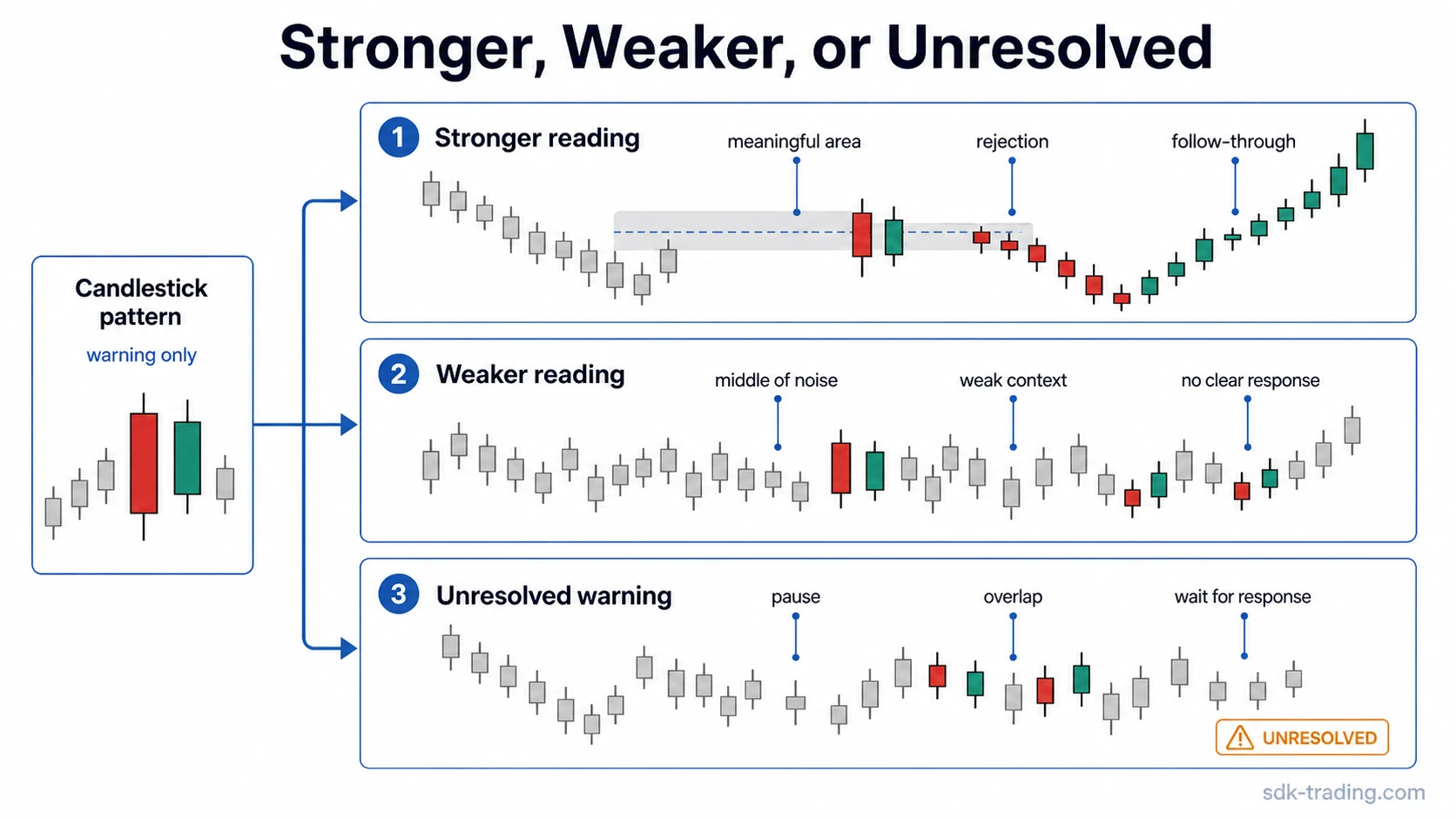
A reversal-shaped candle does not always mean the swing is reversing. During an existing swing, a small-body candle, doji, or brief rejection candle may only show a pause. The larger move can remain intact if price holds its range and resumes in the same direction.
This is why continuation readings need patience. A pause after a strong move may reflect balance between buyers and sellers rather than a completed turn. If later candles hold the prior swing structure and continue away from the pause, the candle acted as temporary hesitation, not a reversal reading.
Strong-body candles can also support continuation when the close holds near the edge of the range being tested. The body matters because it shows where the session or multi-session period finished, but acceptance still needs evidence beyond the first strong close.
Indecision candles and unresolved warnings
Indecision candles are often useful because they keep analysis from becoming too certain. A doji or small overlapping candle can show that neither side has produced clean acceptance. That does not identify the next swing direction by itself.
An unresolved warning is different from a reversal. It says that the current move has lost clarity, not that the opposite move has already taken control. The warning becomes more meaningful only when later candles break the overlap, defend the tested area, or fail to continue beyond it.
Daily candles can make this easier to see because one candle may compress several lower-timeframe attempts into a single close. The close location gives useful information, but a single close should not replace the next response.
Breakout, gap, and acceptance behavior
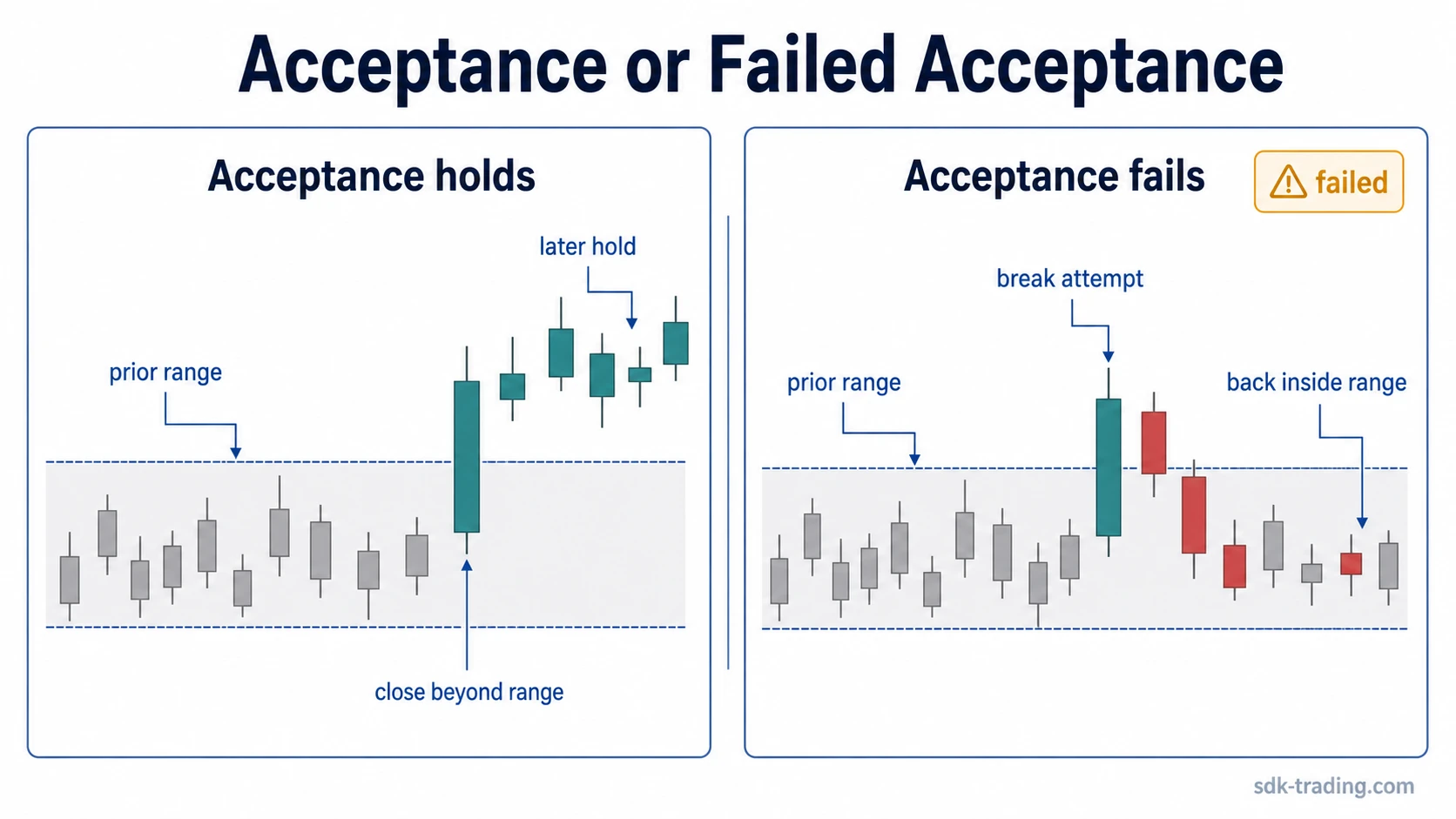
Breakout candles and gap behavior matter in swing trading because they test whether price can accept a new area. A strong candle body, a sudden gap, or a sharp response may look decisive at first, but the read changes if price cannot hold beyond the prior range.
A gap that appears during continuation is stronger when later candles maintain distance from the prior area. The same gap becomes weaker if price immediately trades back into the range and treats the gap as failed expansion rather than acceptance.
Acceptance is the key distinction. A candle can break above or below a level, but the later response decides whether that break was absorbed, rejected, or sustained. Swing traders who focus only on the first candle often miss the difference between a real change in control and a temporary extension.
What weakens a swing-pattern reading
A swing-pattern reading weakens when the candle name is stronger than the context around it. Prior movement, location, close behavior, and follow-through need to support the same interpretation. If they conflict, the pattern should remain a warning rather than a conclusion.
- No clear prior movement: a reversal-shaped candle has less value when price has not moved far enough to create meaningful exhaustion or failed continuation.
- Poor location: a dramatic candle in the middle of overlapping price action often carries less information than a smaller candle near a tested area.
- Weak close behavior: a wick may look like rejection, but the close and later candles must show whether the tested area was actually refused.
- No follow-through: a candle that receives no later response may remain unresolved.
- Immediate failure: a strong candle loses weight if price quickly accepts back inside the prior area.
The practical mistake is treating a named pattern as the decision. Candlestick analysis is better used as a secondary confirmation layer. The pattern may frame the question, but swing structure, acceptance, rejection, and later response decide whether the reading gains or loses weight.
How to choose the next pattern to study
Pattern study is more useful when it starts with the market question. A reaction after an extended move points toward rejection-style candles. A pause inside an existing swing points toward doji, small-body, or strong-body continuation behavior. A move beyond a prior range points toward acceptance, failed acceptance, gap behavior, or sharp response candles.
Candlestick names are useful shortcuts, but swing-trading value comes from matching the candle to the stage of the move.
FAQ
Are candlestick patterns more useful on daily charts than intraday charts?
Daily candles can be useful because they compress a full session of attempts, failures, and closing behavior. That does not make them automatically stronger. Their value still depends on location, prior movement, and follow-through.
Which candlestick patterns matter most for swing trading?
No single pattern group matters in every swing. Rejection candles are more useful after extended movement into a tested area, strong-body candles and gaps are more useful when acceptance is being tested, and indecision candles are more useful when the swing has lost clarity.
Can a reversal candle become continuation?
Yes. A reversal-shaped candle can become only a pause if the larger swing remains intact and later candles continue in the same direction. The candle shape starts the interpretation, but later acceptance or rejection determines whether the reversal reading gained support.
What role should candlestick patterns play in swing trading?
On swing charts, candlestick patterns work best as context for reading pressure, rejection, acceptance, and uncertainty inside the broader swing structure.
Why do candlestick readings fail on swing charts?
They often fail when the candle is read without enough context. A pattern can lose meaning if it appears in the middle of noise, lacks follow-through, fails to hold the tested area, or conflicts with the broader swing.