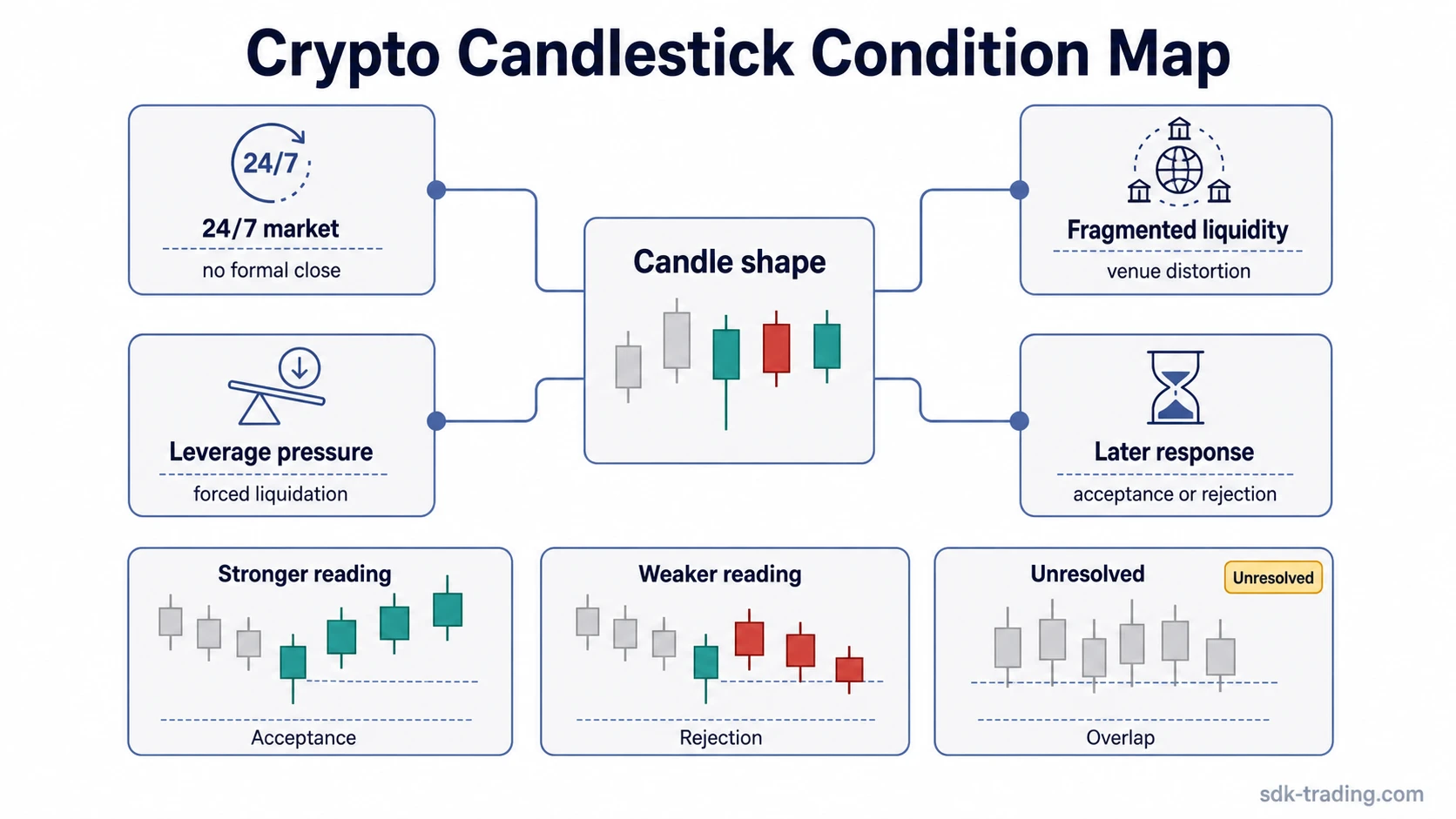
Crypto candlestick patterns use the same open, high, low and close structure as candles in stocks, futures or forex, but their meaning is filtered through crypto’s 24/7 trading, fragmented liquidity, leverage pressure and later follow-through. The candle shape is the same; the evidence behind the candle can be different.
A long lower wick, a wide directional body, or a small indecision candle needs an extra crypto filter: was the move broad participation, thin-liquidity distortion, or a leverage-driven flush that reversed quickly? The candle carries more weight when later price behavior holds across the market instead of appearing as a brief isolated spike.
Crypto Reading Filters
- Use the candle shape as the first observation, not as a complete signal.
- Check whether the move happened during thin liquidity, a liquidation flush or broad participation.
- Compare the candle with follow-through, not only with the prior candle.
- Separate exchange-specific wick distortion from a reaction that holds across the market.
- Give more weight to patterns that appear at meaningful structure and then hold their interpretation.
What Makes Crypto Candlestick Patterns Different
Crypto markets do not have the same clean session structure as many equity markets. A candle can form during deep liquidity, thin weekend depth, a sudden funding-driven squeeze or a localized exchange imbalance. The same visual pattern can therefore carry different weight depending on what produced it.
The practical distinction is not that crypto candles are a separate language. The distinction is that crypto conditions can distort the evidence behind the candle. A wide body may reflect real directional participation, but it may also reflect forced liquidation through a thin book. A wick may show rejection, but it may also be a short-lived liquidity event that later gets accepted.
This is why crypto candlestick reading needs a condition-first filter. The question is not only “what candle formed?” The stronger question is “what condition produced the candle, and did later price behavior confirm or weaken that interpretation?”
Crypto Conditions That Change Candle Meaning
| Crypto condition | Effect on candle reading | Pattern types most affected | What to compare next |
|---|---|---|---|
| 24/7 trading | Session gaps are less formal, so continuation must be judged more by acceptance and follow-through than by classic gap structure. | Continuation candles, impulse candles, gap-like moves | Compare with continuation gap logic when price holds beyond the prior area. |
| Fragmented exchange liquidity | One venue may print a sharper candle than the broader market, especially during fast movement. | Wick candles, rejection candles, pin-style candles | Check whether the rejection also appears beyond one exchange or one isolated spike. |
| Thin order-book depth | A sharp wick can appear because small order flow travels through weak depth, not because durable demand or supply stepped in. | Long lower wicks, long upper wicks, reaction candles | Compare the wick with later failed acceptance or renewed overlap. |
| Leverage and liquidations | Forced liquidations can create a large one-sided candle that looks decisive before the market has shown whether the move can hold. | Large one-sided candles, abrupt impulse candles | Look for continuation, rejection or quick return into the prior range. |
| Lower-timeframe noise | Small candles can multiply during choppy crypto movement and make indecision look more meaningful than it is. | Small indecision candles, spinning-type candles | Compare the candle with location and whether the next response resolves the overlap. |
| Localized wick distortion | A wick can show a probe, stop-run or liquidity event, but the reading stays incomplete until price accepts or rejects the wick area. | Failed acceptance wicks, long-wick reactions | Check whether later candles hold away from the wick or rotate back through it. |
| Abrupt sentiment repricing | News, funding pressure or fast cross-market repricing can create a sudden directional candle, but the first candle may overstate the quality of the shift. | Abrupt repricing candles, wide-body reversals | Compare the first shock with the next acceptance zone. |
| Reaction near prior structure | A lower-wick reaction is more useful when it appears near a meaningful prior area and later candles hold above the reaction zone. | Lower-wick reaction candles, rejection candles | Check whether the reaction becomes supported behavior or only a temporary bounce. |
Why Candle Shape Alone Is Weaker in Crypto
Candle shape alone is often weaker in crypto because the visible candle can be shaped by short bursts of liquidity rather than sustained control. A long wick may look like rejection. A wide body may look like conviction. A small candle may look like balanced indecision. Each reading can be useful, but none is complete without the surrounding conditions.
Shape-alone limitation: A crypto candle becomes more informative when the pattern appears at a meaningful location, forms under conditions that support the reading, and receives later confirmation from acceptance, rejection or follow-through. Without that sequence, the candle remains an early clue.
A realistic scenario is a sharp lower wick after a fast selloff in a thin crypto pair. The wick may tempt a demand-side reading because price quickly traded back above the low. That interpretation is incomplete if the move came from a brief liquidation flush and the next candles cannot hold above the wick area. The reading becomes more defensible only if later candles reject the lower area again and stop accepting trade below the reaction zone.
Which Pattern Types Are Most Affected
The most affected crypto candlestick patterns are the ones whose meaning depends on rejection, impulse or sudden repricing. In crypto, the diagnostic question is whether the candle reflects broader participation or only a temporary liquidity event.
- Indecision candles need location and resolution. A small-body candle in the middle of noisy overlap carries less weight than one that appears after a strong move near a meaningful area.
- Lower-wick reactions need later support. A wick that forms during a flush can warn of rejection, but durable meaning depends on what happens after the flush.
- Wide-body impulse candles need acceptance. A large candle can reflect real participation, forced liquidation or both.
- Abrupt repricing candles need a second read. The first shock may show possibility; the next response shows whether the repricing is being accepted.
- Wick-based rejection patterns need failed acceptance. The wick matters more when price refuses to return through the same area.
How Follow-Through Changes the Reading
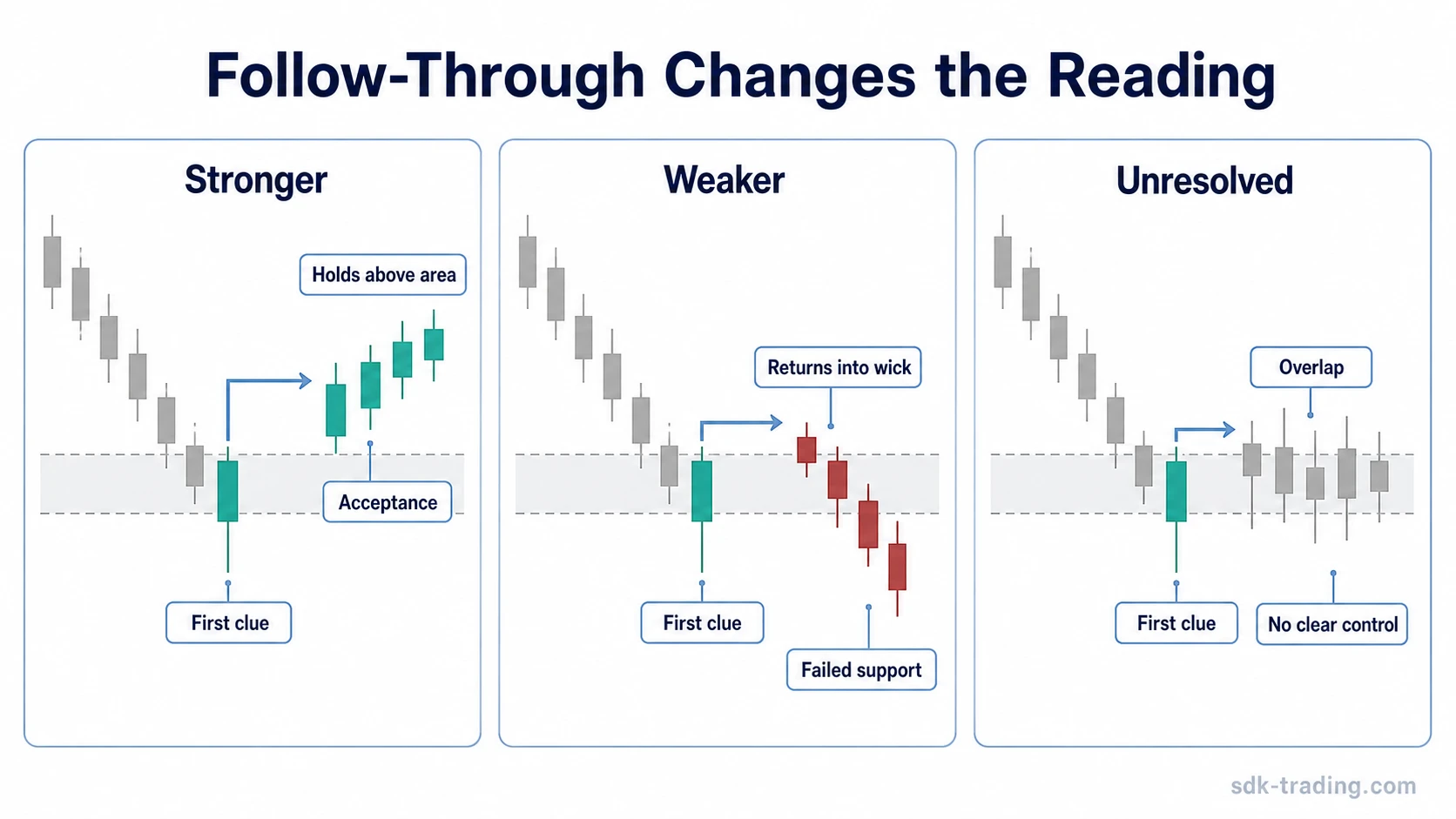
Follow-through is the difference between a visual clue and a stronger interpretation. A candle can warn that pressure changed, but later behavior decides whether the market accepts the new area, rejects it or stays unresolved.
After a bullish-looking lower wick, stronger follow-through means price holds above the wick area and stops accepting lower trade. Weaker follow-through means price drifts back into the wick and treats the reaction as temporary. An unresolved reading appears when price overlaps sideways and neither side gains control.
The same logic applies to upper wicks and wide directional candles. A bearish-looking upper wick becomes more useful when price rejects higher trade and continues lower. A wide bullish candle becomes more useful when price holds above its breakout area. If price immediately returns into the prior range, the first candle may have been a liquidity event rather than a durable shift.
Common Crypto Candlestick Reading Mistakes
- Treating a candle name as a complete trade reason instead of a first visual label.
- Ignoring whether the candle formed during thin liquidity or broad participation.
- Calling every long wick a rejection before checking later acceptance.
- Reading liquidation candles as clean directional conviction without follow-through.
- Using lower-timeframe candles without checking whether the higher-timeframe structure supports the same interpretation.
Candlesticks are a secondary confirmation layer, not the full trading system. In crypto, that distinction matters because candles can warn early, but structure and later response decide whether the warning gains weight.
FAQ
Are crypto candlestick patterns different from stock candlestick patterns?
The candle shapes are the same, but the interpretation can differ because crypto trades continuously and can be affected by fragmented liquidity, leverage, liquidation pressure and uneven market depth.
Why can a crypto wick be misleading?
A crypto wick can come from a brief liquidity sweep, thin order book or forced liquidation. The wick becomes more meaningful only if later candles reject the same area instead of accepting trade through it.
When does a crypto candlestick reading become more reliable?
A crypto candlestick reading becomes more reliable when the next response supports the first clue. Acceptance, rejection and follow-through help separate a durable reaction from noise, liquidation pressure or temporary overlap.