A breakout trading strategy is a sequence for judging what happens before, during, and after price moves beyond a defined market boundary. The framework starts with the quality of the boundary, then evaluates the break, outside acceptance, follow-through or retest behavior, and the condition that would invalidate the breakout reading.
Core distinction: the breakout is the event. The strategy is the framework used to decide whether that event develops into accepted continuation, remains unresolved, or fails back into the prior structure.
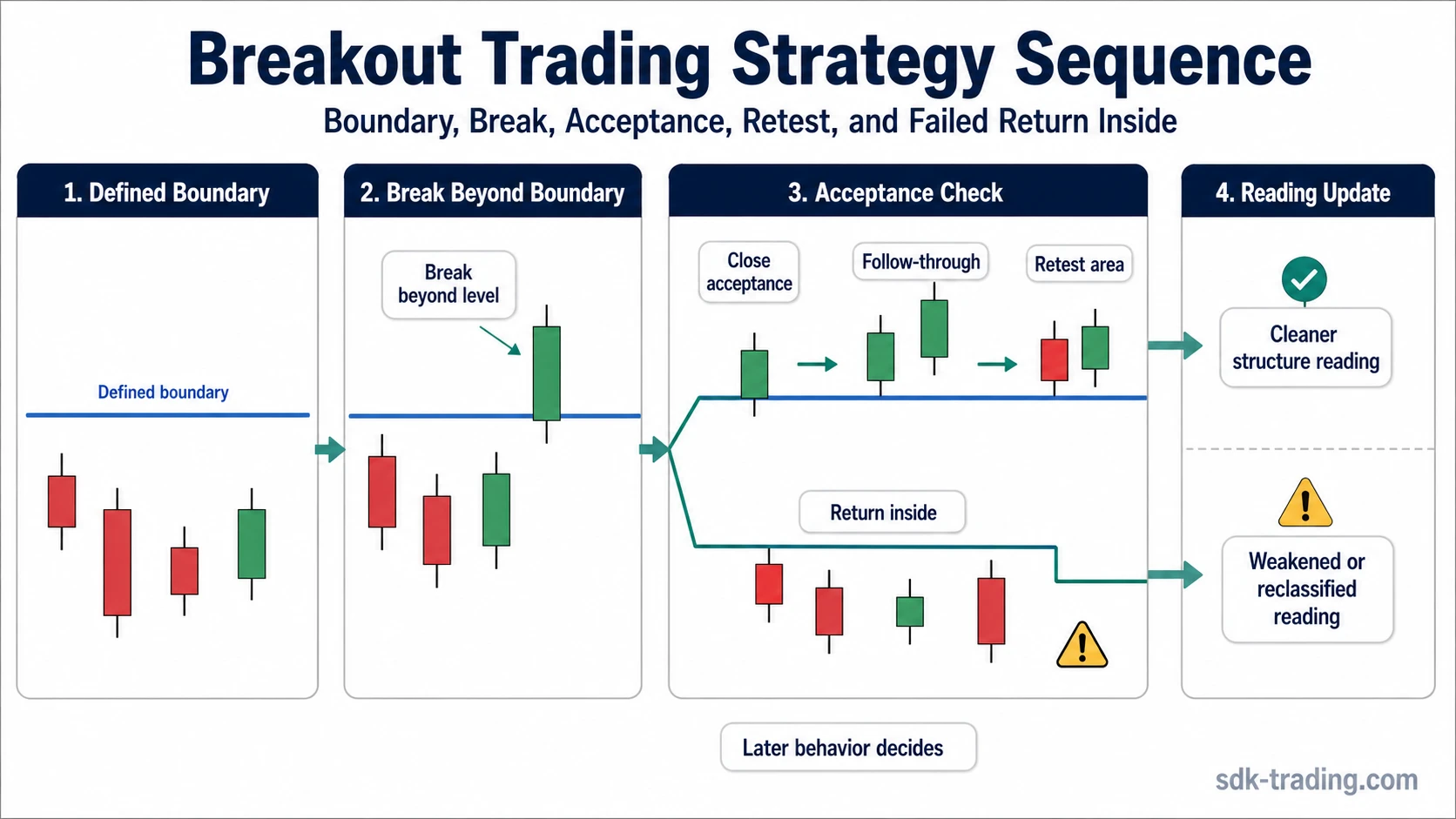
The Breakout Strategy Sequence
A breakout framework starts before price crosses the level. The boundary must already be visible enough to matter. Support, resistance, a range edge, a prior swing, or the outer edge of a consolidation can provide that reference.
| Stage | Main question | Failure clue |
|---|---|---|
| 1. Boundary | Was the level visible and structurally relevant before the break? | The level is vague, over-fitted, or only obvious after price moves. |
| 2. Break | Did price only probe through the boundary, or establish a more developed move beyond it? | The move is only a brief wick or immediate rejection. |
| 3. Acceptance | Can price remain outside the prior structure? | Price quickly returns through the boundary. |
| 4. Follow-through or retest | Does later behavior preserve the new side of the level? | Price stalls, overlaps heavily, or loses the new area. |
| 5. Invalidation | What would show that the breakout interpretation no longer fits? | Price re-enters the prior structure and cannot re-establish the breakout side. |
This sequence prevents the first move through a level from carrying more meaning than the later structure supports.
Why the Boundary Comes First
A large candle is not automatically a meaningful breakout. The move matters because it crosses a reference that existed beforehand.
A boundary formed by a visible range, repeated reaction, prior swing, or consolidation edge creates a clearer structural test than a level drawn only after the move has occurred.
This also makes invalidation easier to define. If the market cannot preserve the new side of a boundary that previously mattered, the breakout thesis has information that can be tested rather than defended indefinitely.
Acceptance Matters More Than the First Cross
Price can trade through a boundary without establishing a durable change in structure. A wick beyond the level shows that the outside area was tested. A close beyond it represents a more developed attempt, but the next price behavior still matters.
Acceptance becomes clearer when price can remain outside the previous structure and create separation from the broken area. Repeated closes, controlled continuation, or later support from the new side can strengthen that interpretation.
Volume, volatility expansion, or momentum can provide supporting context, but they do not replace the price result. Strong activity attached to a move that immediately fails back through the level does not rescue the breakout framework.
A Retest Can Clarify the Breakout, but It Is Not Required
Some accepted breakouts continue without returning cleanly to the old boundary. Others pull back toward it before the next directional move.
When a return does occur, the break-and-retest structure can help show whether the old boundary is beginning to function from the new side.
The important point is not that every breakout must produce a textbook retest. The retest is one possible acceptance test inside the larger sequence.
When the Breakout Reading Fails
A breakout framework needs a condition that can change the original interpretation. Without one, almost any later price path can be explained after the fact.
The clearest failure occurs when price moves beyond the boundary but cannot maintain the outside area and returns into the previous structure. That behavior can develop into a false breakout reading when the attempted structural change fails to establish acceptance.
Invalidation example: price closes above a well-defined resistance area after several sessions of compression. The next candles fail to separate from the level, price falls back below resistance, and later attempts to reclaim the breakout side fail. The original breakout interpretation should then be reclassified rather than treated as an active continuation structure.
This does not automatically imply a large reversal. It only shows that the breakout framework has lost the condition that supported continuation beyond the original boundary.
How Later Structure Changes the Classification
The first boundary break can develop into several more specific structures. Those labels belong to the later price behavior, not to the initial cross itself.
If the broken area begins functioning from the opposite side, it can develop into a flip zone. The important change is the role of the area after the break.
A fakey pattern is narrower because it depends on failed-break behavior around an inside-bar or mother-bar structure.
A hikkake is also a more specific sequence. It should be used only when its required inside-structure and failed-break conditions are present.
Classification rule: begin with the boundary and breakout event. Use the later structure to decide whether the move remains an accepted breakout or becomes a more specific retest, role-change, or failed-break structure.
Practical Breakout Framework Example
Suppose price spends several sessions below a visible resistance area. After compression, price closes above the boundary.
At that point, the framework has only reached the breakout stage. If later candles remain above resistance and create separation, outside acceptance becomes clearer. If price returns toward the level and the area holds from above, the retest provides another piece of structural evidence.
If instead price falls back below resistance and remains inside the old range, the same initial breakout event has produced a different outcome. The sequence makes that change explicit rather than forcing both price paths into the same bullish interpretation.
What the Framework Does Not Define
A breakout framework classifies price behavior around a boundary. It does not by itself define an entry price, stop distance, position size, profit target, or expected return.
Those execution and risk decisions require separate rules. The value of the breakout framework is narrower: it organizes the evidence around the structural change and specifies when that interpretation should be reconsidered.
Core limit: a break beyond a boundary creates a new structural question. It does not guarantee that price will continue in the breakout direction.