Inside bar trading is a price-action framework for reading a candle that forms fully inside the previous candle’s high-low range. The inside bar shows temporary compression, but its meaning depends on context, boundary behavior, and what price does after the range is tested.
Definition: An inside bar is a candle whose high is below the previous candle’s high and whose low is above the previous candle’s low. The previous candle is usually called the mother bar because it contains the inside bar’s full range.
The pattern does not carry the same message in every market condition. A contained candle after a strong move may show pause, hesitation, or short-term balance. A contained candle near a well-defined level may show that the market is compressing before later acceptance or failure decides the reading.
The useful question is not only whether an inside bar exists. The better question is whether the market respects, breaks, rejects, or re-enters the range defined by the mother bar.
Key Points
- Inside bar trading starts with containment: the inside candle must remain inside the mother bar’s high-low range.
- The pattern is best read as compression first, not as a standalone directional message.
- Context matters because the same inside bar can appear in a trend, a range, a pullback, or near a failed breakout area.
- Later boundary behavior separates a sustained breakout reading from a failed breakout or reclassification.
- Lower timeframes create more inside bars, so noise risk rises when the structure is too small or too isolated.
What Is Inside Bar Trading?
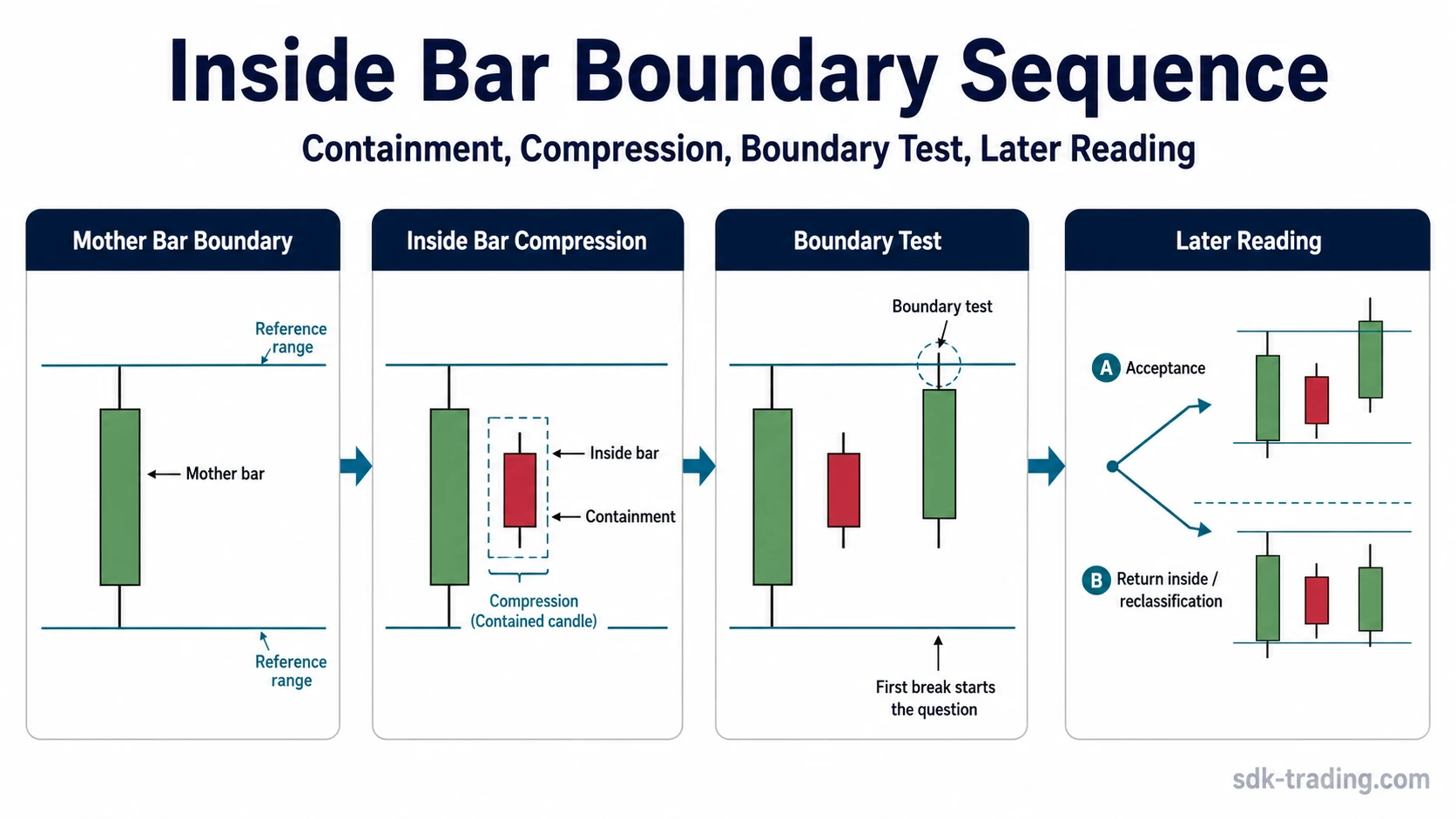
Inside bar trading starts with the contained candle, but the useful reading comes from the sequence around it: mother-bar range, compression, market location, boundary test, and later acceptance or rejection.
This makes inside bar trading different from treating the candle as a simple signal. The structure begins with containment, but interpretation depends on location, market phase, trend quality, and whether the next movement gains acceptance outside the mother bar range.
Core idea: The inside bar is the compression point. The mother bar defines the boundary. Later behavior around that boundary gives the pattern its practical meaning.
Mother Bar and Inside Bar Anatomy
The mother bar is the wider candle that contains the next candle. The inside bar is the narrower candle that forms inside that prior range. For a strict inside bar, the inside candle’s high stays below the mother bar high, and its low stays above the mother bar low.
| Component | What it shows | How to read it safely |
|---|---|---|
| Mother bar | The wider reference candle that creates the active high-low boundary. | Use its range as the structure being tested, not as a prediction. |
| Inside bar | A narrower candle that remains contained inside the mother bar. | Read it as compression or pause until later behavior adds context. |
| Upper boundary | The mother bar high or nearby resistance area. | Watch whether price accepts above it, rejects it, or quickly returns inside. |
| Lower boundary | The mother bar low or nearby support area. | Watch whether price accepts below it, rejects it, or returns into the range. |
| Later behavior | The candles after the inside bar that test the boundary. | Use follow-through, rejection, and range re-entry to classify the reading. |
Small differences in candle shape can change whether the setup is clean. A candle that slightly exceeds the mother bar high or low may no longer be a strict inside bar, even if it still shows compression. For a clean reading, the containment rule should be checked before any interpretation is added.
How Inside Bar Trading Reads Compression
Compression means price has narrowed its movement relative to the previous candle. In an inside bar, that compression is visible because both the high and low are contained. The market is still active, but neither side has expanded beyond the prior range.
Compression can appear before continuation, reversal, failed breakout behavior, or simple noise. The inside bar does not decide which one is happening by itself. It only marks a constrained range where later expansion can be evaluated.
| Stage | Question to ask | Safer interpretation |
|---|---|---|
| Mother bar forms | What range is now containing price? | The mother bar creates the boundary for later reading. |
| Inside bar forms | Is the next candle fully contained? | Containment shows compression, not a completed directional message. |
| Context is checked | Is the structure in a trend, range, pullback, or boundary area? | Location changes the meaning of the same candle pattern. |
| Boundary is tested | Does price accept outside the range or fail quickly? | The first break begins the classification, but does not finish it. |
| Later behavior develops | Does the market follow through, reject, or return inside? | Follow-through supports a breakout reading; rejection or re-entry can shift the reading. |
Breakout, Failed Breakout, and Context
An inside bar often draws attention because price is compressed inside a clear range. When price later moves beyond the mother bar high or low, that first movement may look like a breakout attempt. The reading becomes more defensible only if the move shows acceptance rather than immediate rejection.
Break-and-retest describes the post-break sequence where price moves outside the range, revisits the broken boundary, and tests whether that boundary is respected from the other side.
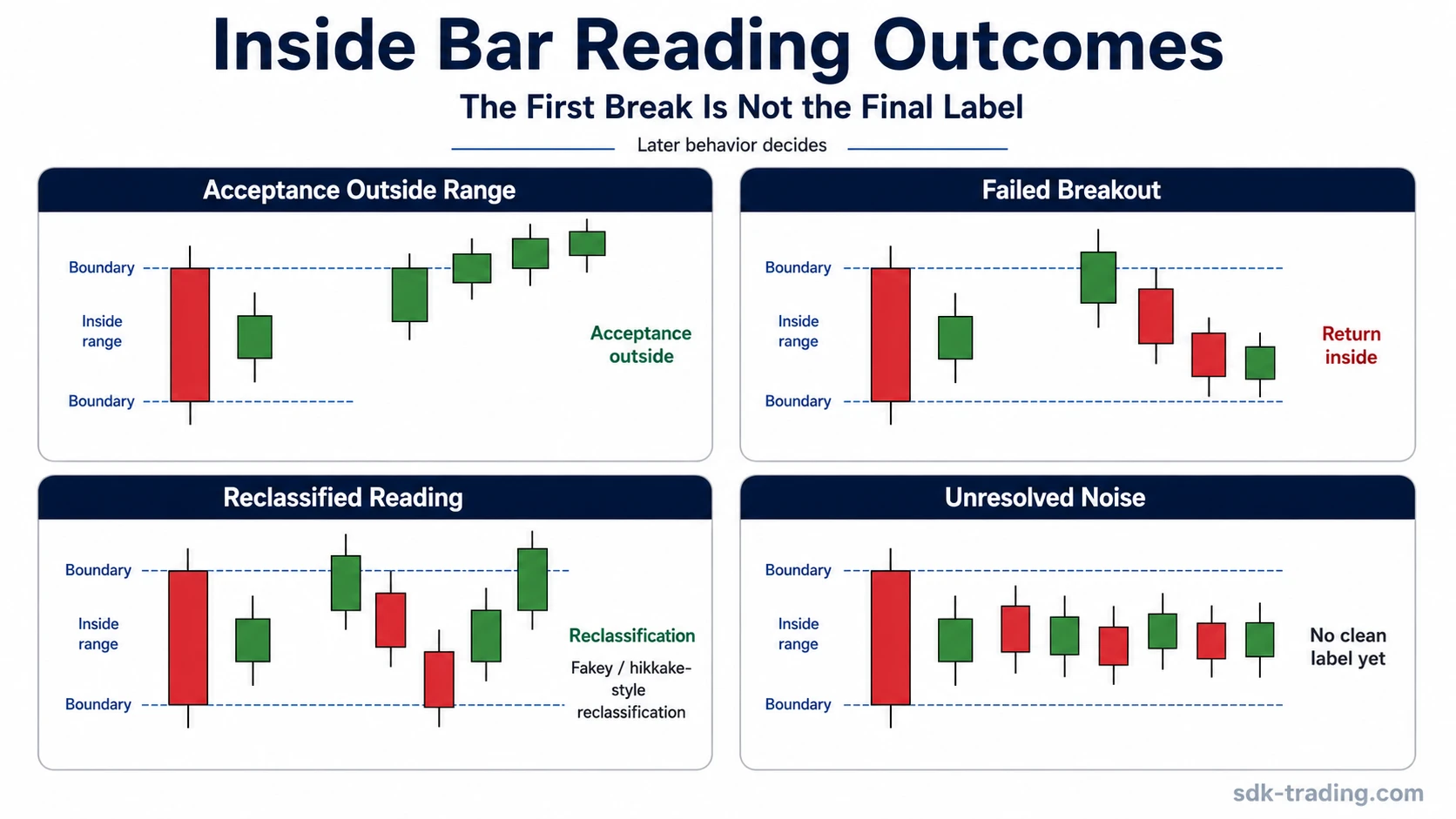
A failed acceptance beyond the mother bar can shift the structure toward a false breakout reading, especially when the market quickly returns back inside the prior range.
The same boundary can later behave like a flip-zone if the area that previously contained price changes role after a clear break and retest sequence.
Boundary limitation: A wick beyond the mother bar is not enough to classify the move. The close, follow-through, retest behavior, and return inside the range all affect whether the reading is sustained, failed, or still unresolved.
Inside Bar Trading Framework Flow
A clean inside bar reading follows a sequence. Skipping the early steps can make the pattern look more certain than it is.
| Step | Framework question | Reading outcome |
|---|---|---|
| 1. Containment | Is the inside candle fully contained by the mother bar? | Confirms whether the structure qualifies as an inside bar. |
| 2. Location | Is the pattern forming in trend, range, pullback, support, resistance, or after expansion? | Shows whether compression has structural relevance or is likely noise. |
| 3. Boundary test | Which side of the mother bar does price test first? | Identifies the first area where acceptance or rejection must be judged. |
| 4. Acceptance or rejection | Does price hold outside the range or return inside? | Separates sustained boundary behavior from failed movement. |
| 5. Reclassification | Does later behavior change the label? | Shows when the structure shifts toward fakey, hikkake, false breakout, or unresolved noise. |
Fakey-pattern describes the inside-bar failure sequence where the breakout attempt fails and price moves back through the prior range instead of accepting beyond it.
A hikkake reading is more specific because it depends on an inside-range break attempt followed by later behavior that changes the structure label.
What Makes an Inside Bar Reading Stronger or Weaker?
Inside bar quality depends on how cleanly the structure forms and where it appears. A strict inside bar in a clear market context is easier to evaluate than a tiny inside candle in a noisy range.
| Reading factor | Stronger reading | Weaker reading |
|---|---|---|
| Containment | The inside candle is clearly contained within the mother bar. | The candle barely fits, overlaps, or breaks the range. |
| Location | The pattern forms near a meaningful structure, trend pause, or defined boundary. | The pattern forms in the middle of random chop with no clear reference area. |
| Range quality | The mother bar creates a visible and usable high-low boundary. | The range is too small, distorted, or buried inside overlapping candles. |
| Break behavior | Price shows acceptance, retest behavior, or clean rejection that can be classified. | The first break is only a wick or quickly becomes unresolved overlap. |
| Timeframe | The structure is visible enough to matter within the selected trading context. | The structure is so small that noise dominates the reading. |
Inside Bar Trading Strategy Without Signal Thinking
The phrase inside bar trading strategy can be misleading if it turns the candle into a mechanical action rule. A safer framework treats the inside bar as one part of a larger reading sequence.
The strategy element is the process: define the mother bar, confirm containment, judge location, observe the boundary test, and then classify the later behavior. That process can help separate compression from continuation, failed breakout behavior, or unresolved noise.
Strategy framing: The inside bar does not become useful because it predicts the next candle. It becomes useful when it gives the reader a defined range for observing acceptance, rejection, and reclassification.
Common Inside Bar Trading Mistakes
| Mistake | Why it creates risk | Cleaner interpretation |
|---|---|---|
| Treating every inside bar as a signal | It ignores context and turns compression into a directional claim. | Start with containment, then wait for boundary behavior to classify the structure. |
| Ignoring the mother bar range | The pattern loses its reference point if the active boundary is unclear. | Use the mother bar high and low as the structure being tested. |
| Reading a wick as acceptance | A brief move outside the range can fail quickly. | Check close, follow-through, retest behavior, and whether price returns inside. |
| Forcing the pattern in noisy markets | Lower timeframes and choppy ranges can produce many weak inside bars. | Filter for clean structure and meaningful location. |
| Ignoring reclassification | The first label may become wrong when later behavior changes. | Allow the reading to shift toward failed breakout, fakey, hikkake, or unresolved noise when evidence changes. |
Example Scenario
A market forms a wide candle near a prior resistance area. The next candle stays fully inside that range, creating an inside bar. At that point, the structure shows compression near a boundary, not a completed reversal or continuation. If price briefly moves above the mother bar and then returns inside the range, the reading weakens as a sustained breakout and may shift toward failed-break behavior. If price accepts beyond the range and later respects the boundary, the structure can be read differently.
The scenario shows why the inside bar should be read as a sequence. Containment comes first, then context, then boundary behavior, then classification. Changing the order can turn a conditional structure into a premature conclusion.
Risk, Failure, and Invalidation Boundaries
An inside bar reading weakens when later price behavior contradicts the expected boundary response. That contradiction may appear as immediate return inside the mother bar, repeated overlap around the boundary, lack of follow-through, or a clean break in the opposite direction.
Invalidation in this context means the structure no longer supports the same interpretation. It does not require a trading instruction. It means the original reading should be reclassified or set aside because later behavior changed the evidence.
Failure boundary: If the market cannot hold beyond the mother bar range after a break attempt, the breakout reading becomes less defensible. If the market repeatedly overlaps the range without clear acceptance or rejection, the structure may be better treated as unresolved noise.
FAQ
What is inside bar trading?
Inside bar trading is a price-action framework that reads a candle contained within the previous candle’s high-low range, then evaluates context and later boundary behavior before assigning meaning.
What is the mother bar in an inside bar pattern?
The mother bar is the previous candle that contains the inside bar. Its high and low define the range that later price behavior tests.
Does an inside bar always mean a breakout is coming?
No. An inside bar shows compression, but it does not guarantee expansion, continuation, reversal, or a clean breakout. The later boundary behavior decides the reading.
Why do inside bars fail?
Inside bars can fail when the first move beyond the mother bar range does not gain acceptance, quickly returns inside the range, or becomes lost in choppy overlapping price action.
Is an inside bar the same as a fakey or hikkake?
No. An inside bar is the containment structure. Fakey and hikkake readings depend on later failure or reclassification behavior after the initial inside-range setup.