Price action setups are repeated structural situations in price movement that traders study to understand context, boundaries, reactions, failures, continuations, and rejections. They are not automatic trade signals. A setup name only identifies the structure being examined; the quality of the reading depends on what price did before the setup, how the boundary behaved, and what developed after the first reaction.
Definition: A price action setup is a recognizable price-structure situation used to organize market behavior. It may involve a boundary, a range, a failed break, a return to a prior area, or a shift in how a zone behaves, but the name alone does not decide direction or outcome.
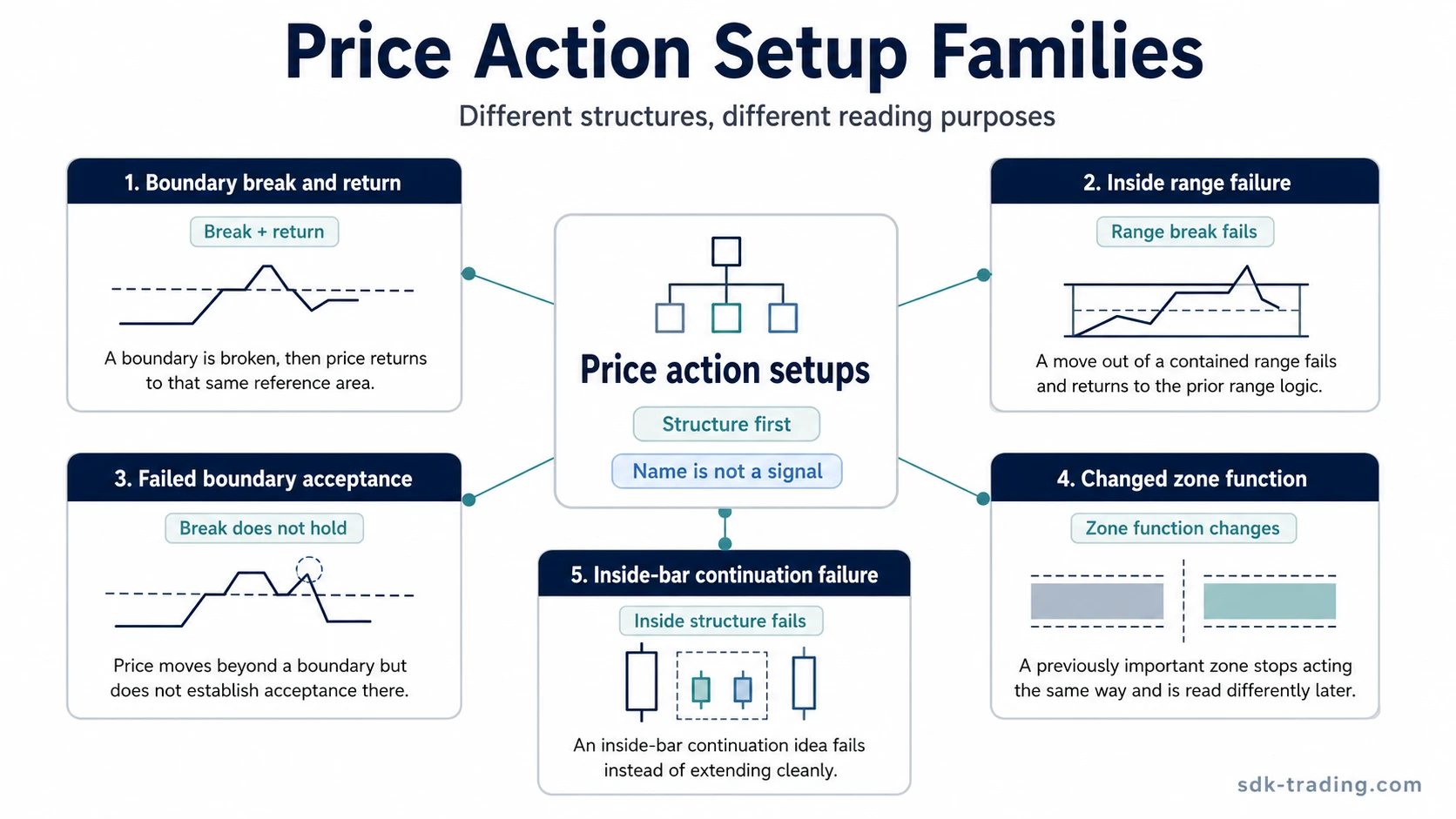
Some setups focus on a broken boundary and later return. Some focus on failed acceptance beyond a range. Some focus on a zone that changes function. Others focus on failed continuation from an inside-bar structure. Grouping them by reading purpose makes it easier to separate boundary behavior, failed acceptance, changed zone function, and inside-range failure without forcing every setup into one trading formula.
Key Points
- Price action setups describe structural situations, not guaranteed directional signals.
- Setup families are easier to understand when grouped by what they try to read: boundary behavior, failure, return, continuation, or changed zone function.
- Reading quality depends on context, boundary clarity, acceptance or rejection, and follow-through behavior.
- A weak, unresolved, or invalid setup can carry the same name as a cleaner one, so the name is only the beginning of the analysis.
- Each setup type needs its own detailed explanation. At the overview level, the useful task is to separate the families and choose the structure being examined.
What Price Action Setups Are
A price action setup starts with visible structure. That structure might be a prior boundary, a range, a swing sequence, a level that price has reacted from, or a compact inside-bar formation. The setup becomes meaningful only when price interacts with that structure in a way that can be compared with a known behavior pattern.
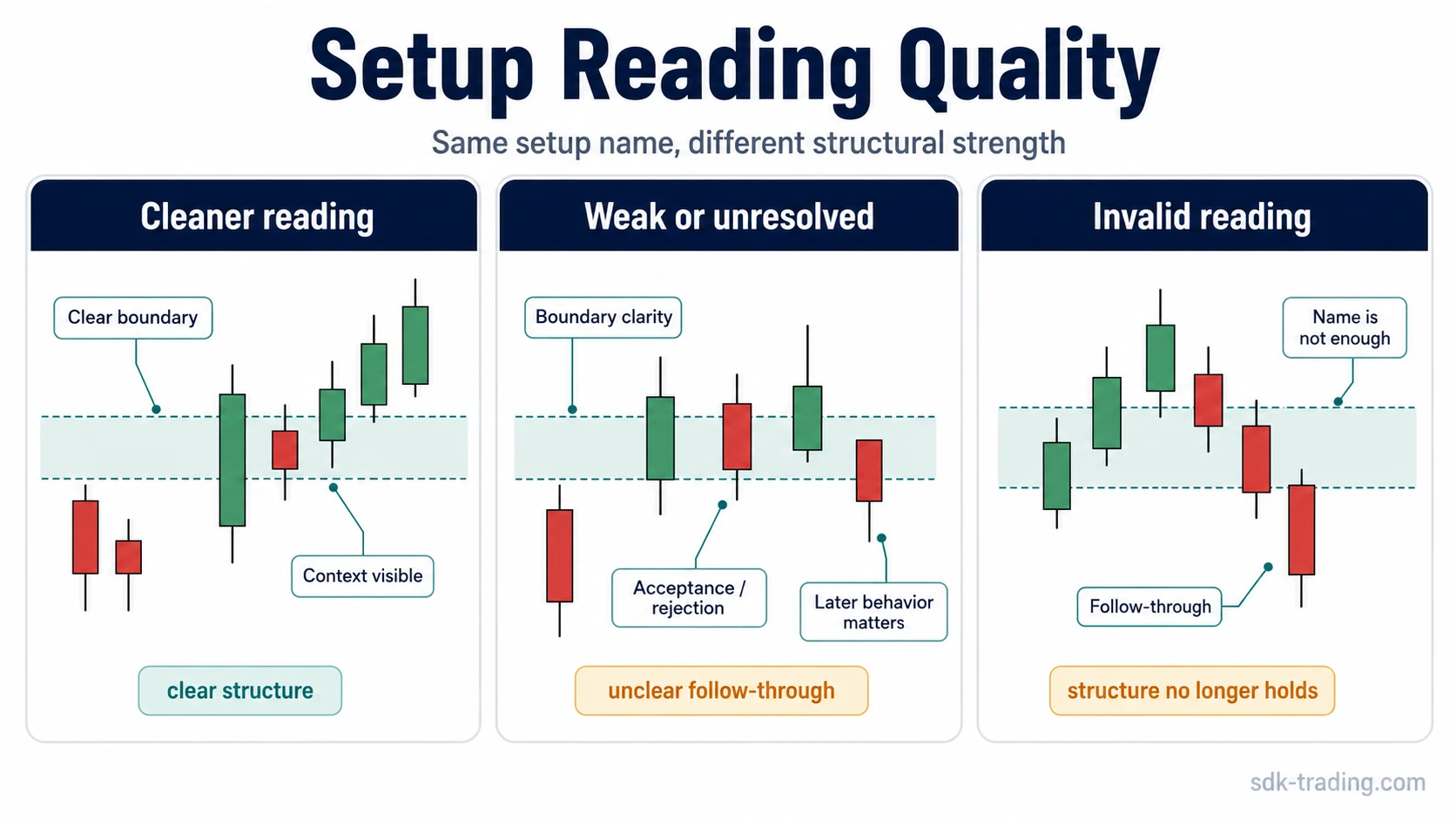
The same setup name can describe very different quality levels. A clean reading usually has visible prior structure, a clear boundary, a meaningful break or reaction, and follow-through that supports the interpretation. A weaker reading may have a vague boundary, a shallow break, poor continuation, or behavior that leaves the structure unresolved.
Structural reading: The setup name identifies the situation being studied. It does not remove the need to judge context, boundary quality, follow-through, and invalidation.
Main Price Action Setup Families
Setup families can be grouped by the market behavior they try to clarify. This keeps similar terms from being treated as identical and helps separate structural reading from trade instruction.
| Setup family | What it tries to read | What makes the reading cleaner | What can weaken it | Detailed concept |
|---|---|---|---|---|
| Boundary break and return | Whether price can move beyond a known boundary and later interact with the breached area. | A visible boundary, a decisive break, and a controlled return toward the same area. | A vague boundary, a shallow breach, or a return that does not interact with the prior area clearly. | Break and retest |
| Inside range failure | Whether a break outside an inside range fails and returns toward the prior structure. | A clear mother-bar or inside-bar range, a visible break, failed acceptance outside the range, and a return into or toward the range. | An unclear range, a minor probe, or behavior that does not show failed acceptance. | Fakey pattern |
| Failed boundary acceptance | Whether price temporarily moves beyond a boundary but cannot remain accepted there. | A meaningful prior level, a break beyond it, and rejection or return that shows the break did not hold. | Treating every wick as failure, ignoring the close, or judging the structure before enough follow-through develops. | False breakout |
| Changed zone function | Whether a prior area that mattered in one role later becomes a reference area in a different role. | A prior zone with visible reactions, a meaningful break, failed prior function, and new interaction around the same area. | A zone with no prior importance, a messy break, or no later interaction with the area. | Flip zone |
| Failed inside-bar continuation | Whether an inside-bar continuation attempt fails and changes the interpretation of the range. | A clear inside-bar structure, a break attempt, failed continuation, and follow-through that supports the failure reading. | An unclear inside structure, no meaningful break attempt, or immediate noise without readable confirmation. | Hikkake |
Where Each Setup Type Fits
The setup name should match the structure being examined. When the issue is a breached boundary and return, break-and-retest logic fits better than a failed-inside-range label. When the issue is failed acceptance beyond a boundary, false-breakout logic is more precise than a generic breakout label. When the issue is a prior zone changing function, flip-zone logic becomes more relevant.
| Structure being examined | Better setup family | Why the distinction matters |
|---|---|---|
| Price breaks a boundary and later returns to the same area. | Boundary break and return | The main issue is the relationship between the breached area and the retest behavior. |
| A break outside an inside range fails. | Inside range failure | The range boundary and the return into or toward that range carry the main meaning. |
| Price moves beyond a level but fails to remain accepted there. | Failed boundary acceptance | The key issue is acceptance versus rejection beyond the boundary, not the break alone. |
| A prior zone stops behaving the way it behaved before. | Changed zone function | The focus shifts from the first reaction to the new role of the same area. |
| An inside-bar continuation attempt fails. | Failed inside-bar continuation | The failed continuation attempt is the defining feature, not just the presence of an inside bar. |
Example scenario: Price compresses inside a visible range, briefly breaks outside it, fails to hold beyond the boundary, and then returns toward the prior range. That sequence is closer to an inside-range failure reading than a generic continuation reading. If the same market instead breaks a well-tested horizontal boundary and later returns to that breached area, the cleaner family is boundary break and return.
How to Judge Setup Reading Quality
Setup quality is not a mechanical score. It is a structural judgment about how clearly the market presented the setup and whether follow-through supports or weakens the interpretation.
| Quality factor | Cleaner reading | Weaker or unresolved reading |
|---|---|---|
| Prior structure clarity | The range, boundary, zone, or swing context was visible before the setup formed. | The structure is only obvious after the fact or depends on a forced line. |
| Boundary clarity | The market has a recognizable area that price reacts around more than once. | The boundary is vague, too wide, or selected only because the later move needs it. |
| Break quality | The break is meaningful enough to test whether the prior structure still matters. | The break is only a minor probe or a noisy candle with little structural value. |
| Acceptance versus rejection | Follow-through helps show whether price accepted or rejected the area beyond the boundary. | The market has not yet shown whether the move beyond the boundary matters. |
| Follow-through behavior | Price action after the first reaction supports the setup reading. | The next sequence conflicts with the name or leaves the structure unresolved. |
| Invalid reading | The original setup idea remains structurally consistent with what followed. | New behavior breaks the condition that made the setup readable in the first place. |
Setup Names Versus Trading Strategies
A setup name and a trading strategy are not the same thing. A setup name classifies price behavior. A full trading strategy would require separate rules for market selection, timeframe, risk definition, position management, review process, and failure handling. Mixing those two layers can make a structural observation sound more certain than it is.
Useful distinction: A setup can describe what the market is doing around a structure. It does not automatically define what action to take, how much risk is acceptable, or whether the structure is strong enough to act on.
This distinction matters because many setup terms are visually simple but context-dependent. A break, a return, a wick, or a range boundary can look important in isolation. The reading becomes more useful only when the surrounding structure and follow-through support it.
Common Mistakes When Reading Price Action Setups
Most weak setup readings come from treating the name as the conclusion. The safer approach is to treat the name as the starting point and then test whether the structure supports it.
| Mistake | Safer interpretation |
|---|---|
| Treating every pattern name as a signal | The name identifies a structure. Context and follow-through decide whether the reading is cleaner, weaker, unresolved, or invalid. |
| Ignoring prior context | A setup that appears around a clear boundary or range carries a different meaning from the same shape in random noise. |
| Judging from one candle | One candle can start the question, but the close, acceptance behavior, and next reaction decide the reading. |
| Assuming a break is accepted immediately | A break beyond a boundary is only the first event. Acceptance or rejection requires follow-through. |
| Copying “best setup” claims | Setup quality changes with structure, context, and follow-through. A name that sounds strong can still describe a weak or invalid reading. |
Limitation: A price action setup does not predict future movement by itself. The same setup family can produce a cleaner reading, a weak reading, an unresolved structure, or an invalid structure depending on boundary quality, acceptance behavior, and follow-through.
How to Use Setup Grouping
Setup grouping works best when the first question is structural: what is the market interacting with? The answer may be a boundary, a prior range, a failed break, a changed zone, or an inside-bar structure. Once the structure is identified, the next question is whether follow-through supports the reading or weakens it.
- Identify the prior structure: Look for the range, boundary, zone, or sequence that mattered before the setup name is applied.
- Name the structure being tested: Decide whether the issue is break-and-return, failed acceptance, changed zone function, or failed continuation.
- Check the follow-through: Separate the first reaction from the behavior that confirms, weakens, or invalidates the reading.
- Choose the precise setup family: Match the structure to the most relevant setup type instead of forcing every situation into one label.
A clean grouping process reduces two common problems: overusing broad labels and over-explaining a setup before the market has shown enough structure to read it responsibly.
FAQ
Are price action setups the same as trading signals?
No. Price action setups are structural reading categories. A setup can help organize what price is doing around a boundary, range, failure, return, or zone, but it does not automatically create a directional conclusion.
Which price action setup is easiest to classify first?
The easiest setup type to classify is usually the one with the clearest visible structure. Boundary-based setups are often easier to separate because the prior level or range gives the reading a clearer reference point. The important skill is separating the setup name from the quality of the follow-through.
Why are some setup types explained separately?
Some setup names describe different structural questions. A break and retest, a false breakout, a fakey pattern, a flip zone, and a hikkake can all involve boundaries or ranges, but each reads a different relationship between prior structure and what follows.
Final Setup Reading Check
Price action setups are most useful when they classify what the market is doing, not when they are treated as shortcuts. The cleanest reading usually starts with a visible prior structure, continues through a meaningful interaction with that structure, and remains open to stronger, weaker, unresolved, or invalid outcomes as follow-through develops.