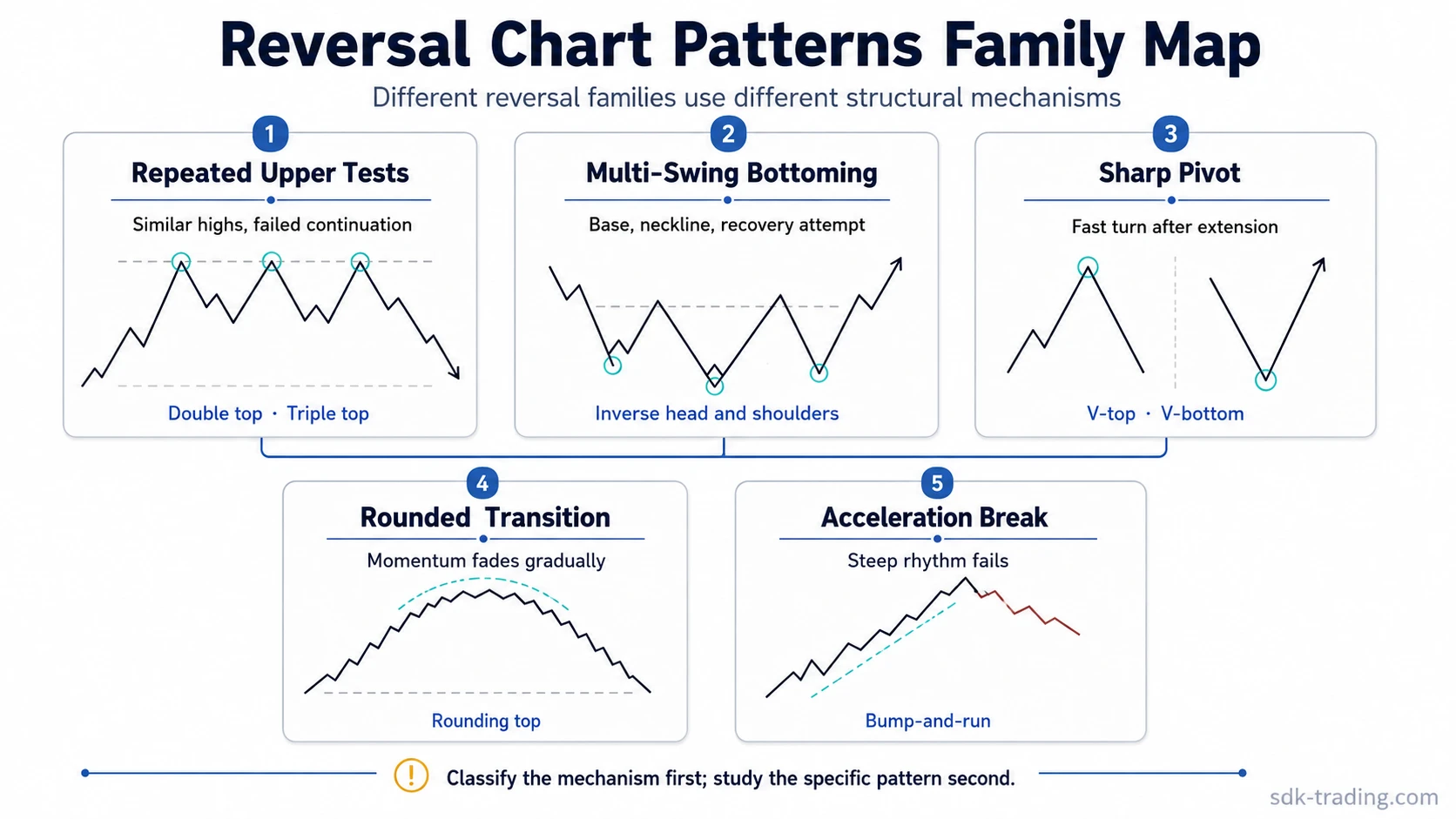
Reversal chart patterns are multi-swing price structures that develop after an established advance or decline begins to lose its previous continuity. Different patterns describe different ways that transition can happen: repeated tests near the same boundary, a shoulder sequence, a gradual rounded shift, a sharp V-shaped pivot, or a break after late-stage acceleration.
Definition: A reversal chart pattern is a price structure that forms during a possible transition away from a prior directional move. The pattern develops as the previous swing sequence stops extending in the same way and a different relationship between highs, lows, pullbacks, and recoveries begins to appear.
Key Points
- A reversal chart pattern needs a prior advance or decline because the structure describes a change from an existing directional condition.
- The first change is often a loss of trend continuity rather than an immediate move in the opposite direction.
- Repeated-test, shoulder, rounded, V-shaped, and acceleration-break patterns represent different transition mechanisms.
- Top reversal patterns develop after advances, while bottom reversal patterns develop after declines.
- The same early price behavior can remain a pause or consolidation if the previous directional sequence resumes.
How a Trend Becomes a Reversal Candidate
During an established advance, price generally keeps extending through higher highs and higher lows. The sequence does not need to be perfectly clean, but new upside progress keeps appearing. A reversal question begins when that progress becomes harder to maintain. Highs may start repeating near the same area, a new high may produce little additional distance, pullbacks may deepen, or later recovery swings may fail to reach the previous extreme.
The opposite process can develop after a decline. Lower lows may stop extending, repeated tests can appear near the same lower area, rebounds can travel farther, or price can recover sharply enough to disrupt the rhythm of the decline.
These changes describe a transition rather than one universal reversal formula. A double top develops through repeated upper tests. Head and shoulders uses a different multi-swing sequence. A rounding structure changes gradually, while a V-shaped structure compresses the transition into a much shorter period.
Main Types of Reversal Chart Patterns
The most useful classification starts with the way the prior move loses continuity. Patterns that form near the same horizontal area behave differently from shoulder structures, gradual rotations, sharp pivots, and late acceleration breaks.
| Pattern family | Typical transition | Pattern examples | Main structural question |
|---|---|---|---|
| Repeated upper-boundary tests | An advance reaches a similar upper area several times without maintaining clean upside progress. | Double top structures; triple top formations | Does repeated testing continue to produce new upside progress, or does the upper area begin containing the advance? |
| Multi-swing bottoming transitions | A decline develops several lower-area swings before recovery begins changing the previous sequence. | Inverse head and shoulders patterns | Does the central low remain the dominant extreme while later swings build a different bottoming structure? |
| Sharp pivot structures | Price changes direction quickly after an extended move, with little time spent building a broad base or top. | V-top reversals; V-bottom reversals | Does the opposite-direction move continue beyond the initial snapback, or does price return into the previous trend? |
| Rounded transitions | Directional progress slows over a longer series of swings instead of ending through one abrupt pivot. | Rounding top structures | Is the prior directional sequence gradually losing distance and slope as the transition develops? |
| Acceleration-break structures | A late trend phase becomes unusually steep before price can no longer maintain the same rate of advance. | Bump-and-run patterns | Does price restore the accelerated slope, or has the late-stage rhythm already changed? |
Top and Bottom Reversal Patterns
Top reversal patterns form after an advance. The common feature is a deterioration in upside continuity, although the geometry can vary considerably. A double top develops around two main upper tests. A triple top adds another attempt near the same area. Head and shoulders produces a higher central peak between two lower shoulder regions. Rounding tops lose upside progress gradually, while V-tops change direction much faster.
Bottom reversal patterns develop after declines. Double bottoms and triple bottoms are built around repeated lower tests. Inverse head and shoulders creates a deeper central low between two shoulder regions. Rounding bottoms transition gradually, whereas a V-bottom can recover before a broad base has time to develop.
This is why the terms top reversal and bottom reversal are categories rather than specific patterns. The direction of the prior move identifies the broad category; the internal swing sequence determines the pattern family.
How Reversal Pattern Families Differ
Repeated-test patterns concentrate information around a relatively stable price area. The market keeps returning to roughly the same boundary, so the important development is whether each attempt continues the trend or produces less progress.
Shoulder structures distribute the transition across several swings. The central extreme and the surrounding shoulders create a sequence that is different from two or three similar horizontal tests.
Rounded structures stretch the transition over more time. Price stops progressing at the previous rate, the slope changes, and successive swings gradually reshape the directional structure.
V-shaped reversals compress much of that change into a fast pivot. They can look visually decisive because price travels quickly in the opposite direction, although the initial move can still retrace if the broader transition does not continue.
Acceleration-break structures start from the opposite condition: the prior trend becomes unusually steep before it fails to maintain that pace. Their defining feature is the change in slope and rhythm rather than repeated tests around one horizontal level.
Reversal Patterns and Trend Structure
A pattern becomes easier to understand when it is read as a change in swing behavior. Consider an advance that has been producing higher highs and higher lows. If the next rally stops near the previous high, the chart has lost one element of its earlier progression. If the following pullback then travels deeper than previous pullbacks, another part of the sequence has changed.
The exact pattern name depends on what happens between those changes. Two similar highs can develop into a double top. Three upper tests can form a triple top. A higher central peak surrounded by lower peaks can create head-and-shoulders geometry. A much slower loss of slope can develop into a rounding top without any single swing defining the entire transition.
The same principle applies after a decline. The important information comes from how the sequence of lows, rebounds, and later tests changes relative to the structure that existed before it.
Reversal vs Continuation
A pause inside a trend can initially resemble the early stages of a reversal pattern. The distinction becomes clearer as the swing sequence develops.
| Price behavior | Reversal interpretation | Continuation interpretation |
|---|---|---|
| Previous trend pauses | The pause begins changing the earlier swing sequence. | The market consolidates while the main directional structure remains intact. |
| Previous extreme is tested again | The test produces less progress and becomes part of a topping or bottoming structure. | Price absorbs the pause and later extends through the previous extreme. |
| Pullback becomes deeper | The deeper swing contributes to a developing structural transition. | The pullback remains contained within the broader directional sequence. |
| Price moves away from the pattern | The movement begins establishing a different sequence of highs and lows. | The original directional sequence reasserts itself. |
When a Reversal Pattern Is Still Developing
Reversal patterns are often easiest to label after the chart is complete. Real-time classification is less clean because several different structures can share the same early swings.
Two upper tests may eventually become a double top, develop another peak and resemble a triple top, or expand into a more complex shoulder structure. A lower-area recovery can develop into a double bottom, continue into an inverse head and shoulders, or disappear when the decline resumes.
During that stage, the useful information is the structure already visible: the prior direction, the position of the important swings, whether new extremes are still extending, and whether the distance between reactions is changing. The final pattern name can remain open while those relationships are still developing.
Example of a Reversal Structure Developing
Suppose price advances through a sequence of higher highs and higher lows, then reaches an upper area and pulls back. The next rally returns to roughly the same level but adds very little upside distance. At that point, the previous trend has stopped extending as cleanly as before, although the chart still does not establish which reversal family will develop.
A second failure near the upper area can produce double-top geometry. Another comparable test can shift the classification toward a triple top. If the middle rally extends above the surrounding peaks and later swings form on both sides, the structure may develop into head and shoulders instead.
The important change occurs before the final label becomes obvious: the advance has stopped producing the same progression it produced earlier. The pattern name describes how that loss of continuity develops from there.
Common Reversal Pattern Misreads
| Misread | Structural problem | Better classification |
|---|---|---|
| Labeling a reversal inside a sideways range | There is no established directional sequence for the pattern to reverse. | Classify the structure as a range until a clear prior directional condition exists. |
| Choosing the final pattern name from the first two swings | Several reversal families share similar early geometry. | Keep the family open until the swing sequence separates the alternatives. |
| Using one dramatic candle as the complete chart pattern | A chart pattern normally depends on a broader sequence of swings. | Separate candlestick behavior from the larger reversal structure. |
| Forcing every transition into a horizontal top or bottom | Rounded, shoulder, V-shaped, and acceleration structures use different geometry. | Match the label to the actual transition mechanism. |
| Assuming the first loss of momentum establishes a new opposite trend | A weakening prior trend can still move sideways or resume. | Separate loss of continuity from an already established opposite-direction sequence. |
When a Reversal Reading Fails
A developing top can disappear when price moves through the tested upper area and resumes the previous sequence of higher highs and higher lows. A developing bottom can fail in the same way when sellers regain control and price extends to new lows.
Sharp V-shaped moves can retrace back into the original trend. Rounded transitions can flatten without developing a sustained move in the opposite direction. Repeated tests can eventually break through the boundary instead of producing a reversal.
These outcomes are part of the classification problem. A reversal pattern describes a developing structural transition, while the market can still resolve by restoring the previous trend or by remaining range-bound.
FAQ
What are reversal chart patterns?
Reversal chart patterns are multi-swing price structures that develop after an established advance or decline begins losing its previous directional continuity. They classify different ways a market can transition away from the earlier trend structure.
What are the main types of reversal chart patterns?
Common families include repeated tops and bottoms, head-and-shoulders structures, rounded tops and bottoms, V-shaped reversals, and acceleration-break formations such as bump-and-run patterns.
Does a reversal pattern require a prior trend?
A meaningful reversal classification requires a prior directional move. Without an advance or decline beforehand, similar geometry may simply be part of a range or another non-reversal structure.
What is the difference between a reversal and a continuation pattern?
A reversal structure develops as the previous directional sequence begins changing. A continuation structure preserves the larger directional condition through a pause, consolidation, or controlled pullback before the earlier move resumes.
Can a reversal pattern fail?
Yes. A developing reversal can fail when price restores the previous trend sequence, breaks through the area that was containing the move, or remains range-bound instead of establishing a sustained transition.